
Secondary Research Review by gamesmom.com, 2026 Edition
The Future of Childhood in the Age of AI
Artificial Intelligence in Learning, Play, Creativity, Safety and Child Development
Executive Summary
Artificial intelligence is changing how children learn, talk, play and understand what is real. This review gathers the global evidence across twenty six topics into one clear, practical guide for parents, teachers and policy makers.
Why AI Matters for Children
Childhood is going through its biggest change since the arrival of the internet. A child born today is growing up alongside chatbots that talk back, tools that make pictures on demand, tutoring apps that adapt to them, and toys and speakers with AI built in. Unlike the television or the tablet before it, AI does not just play at a child. It answers, holds a conversation, and increasingly behaves as though it were a person.
This matters because childhood has short windows when language, self control, feelings and friendships take shape, and those windows are easily shaped by what surrounds them. Bringing AI into homes and classrooms during these years opens real opportunities and real risks at the same time.
Major Findings
Drawing together published research and official guidance from bodies including UNESCO, UNICEF, the OECD, the World Bank, the Pew Research Center and Common Sense Media, five shifts stand out as the ones that matter most for children:
- Personalization vs Cognitive Dependency: AI adaptive tutors can accelerate academic mastery in foundational mathematics and reading by tailoring difficulty in real time. But leaning on generative AI to do the thinking risks weakening the independent reasoning and persistence that only effortful practice builds.
- Co Creation vs Creative Replacement: Generative AI tools can work well as creative partners for storytelling, drawing and first steps in coding, but they can crowd out the open, unaided imaginative play that children most need if they are introduced without an adult alongside.
- Language and Access Gains: Natural language tools can support speech practice, translation and vocabulary building, which is especially valuable for children learning a second language and for some neurodivergent learners.
- Privacy and Surveillance Vulnerabilities: Children's voice recordings, images and learning data are collected by consumer education tools at scale, creating real compliance and safety challenges under child privacy rules such as COPPA in the United States and the GDPR and the Age Appropriate Design Code in Europe and the UK.
- The Digital Equity Gap: Access to high-quality, privacy-safe AI learning tools is concentrated in wealthier regions, which risks widening the gaps between children rather than closing them.
Key Empirical Statistics
Core Stakeholder Recommendations
The review sets out clear steps for each group:
- Parents: sit with a young child while they use AI rather than leaving them to it, protect daily screen-free time for real play, and turn off voice and camera recording on smart toys.
- Teachers and schools: move some marking toward the things AI cannot fake, like explaining an answer out loud and working in a group, and let AI take on the routine job of tailoring materials to different levels.
- App and tool makers: build for privacy from the start, with no tracking, put real safety limits in place for a child's age, and favor open, free to reach educational games.
- Governments: hold AI used by children to firm safety standards such as those in the EU AI Act, require that child facing systems be audited openly, and pay to get good connectivity into communities that lack it.
How We Made This Review
Purpose and scope
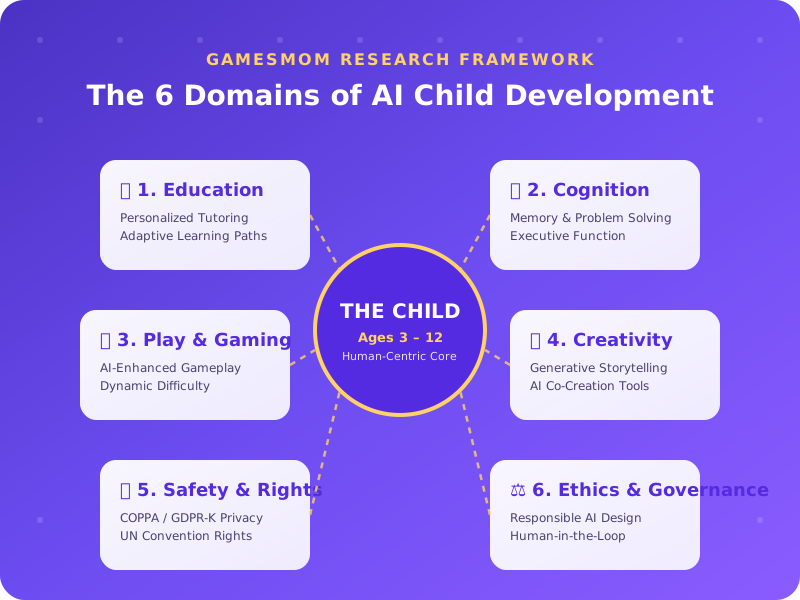
GamesMom Research published this review to pull together, in one place, what the growing body of scientific, government and international work says about how artificial intelligence is affecting children aged three to twelve. As a platform built around healthy learning through play, we publish secondary research reviews to help parents, teachers and policy makers make sense of a field that is moving very fast.
How this review was put together
This is a secondary review, which means it runs no study of its own. Instead it gathers and compares findings that others have already published and checked. Those sources fall into four main groups:
International Bodies
UNESCO, UNICEF Innocenti, World Health Organization (WHO), OECD Education 2030, World Economic Forum (WEF).
Academic Institutions
Harvard Graduate School of Education, MIT Media Lab, Stanford Human Centered AI (HAI), Oxford Internet Institute, University of Cambridge (PEDAL Centre).
Peer Reviewed Journals
Nature Human Behaviour, Science Robotics, Computers and Education, Frontiers in Psychology, Elsevier Educational Research Review.
Nonprofit and Advocacy
Common Sense Media, Joan Ganz Cooney Center at Sesame Workshop, IEEE Ethics in Action, Fairplay for Kids.
What we included and left out
Included: peer-reviewed studies, systematic reviews and official policy documents published between 2020 and 2026 that deal with child development (ages three to twelve), educational technology, how children think and learn, and the ethics of AI.
Left out: opinion blogs, company marketing material, and unreviewed speculation, along with research that is only about AI replacing adult jobs.
What this review cannot tell you
Because AI tools change so quickly, the long-term studies that would follow the same children over ten or fifteen years are still under way. Where that kind of long-range evidence does not yet exist, this review says so plainly and bases any look ahead on what is already well established about how children grow and learn.
1. What Is Artificial Intelligence?
Current Evidence
Artificial intelligence, or AI, is the name for computer systems built to do things we usually think of as needing human intelligence: learning, reasoning, spotting patterns and solving problems (UNESCO, 2024). One thing is worth being clear about from the start. Modern AI is not aware and does not understand the world the way a person does. It works by finding patterns in enormous amounts of data and using them to predict what text, image or answer is likely to come next.
Key Subfields Explained Simply
- Machine Learning (ML): Algorithms that analyze data to identify patterns and make predictions without being explicitly programmed for every scenario.
- Generative AI (GenAI): Advanced neural networks capable of generating new original content, including text, artwork, music, and computer code, based on prompt instructions.
- Large Language Models (LLMs): Deep learning models (such as GPT-4, Gemini, and Claude) trained on vast text corpora to understand, translate, and generate human language.
- Computer Vision and Robotics: Technologies enabling machines to perceive visual input from digital cameras, inspect real-world physical objects, and interact with physical or virtual space.
Benefits for Young Learners
When children understand a little about how AI works, they stop being only users of technology and start to become makers who can question it. Meeting these ideas early also builds the patient, step-by-step thinking that helps with problem solving of every kind.
The Risk of Treating AI Like a Friend
Children under about eight naturally treat things as if they were alive, and they will happily credit a talking AI with feelings, intentions and friendship. Without a grown up to explain otherwise, a child can come to treat a piece of software as a real confidant.
Practical Recommendations
Explain AI to children using clear, accurate metaphors: AI is like a super fast library reader that looks for pattern clues, but it does not have feelings or understand the world like a real human friend.
2. Why Childhood Is Entering an AI Era
Current Evidence
AI has moved quickly out of distant data centers and into living rooms, classrooms and the everyday entertainment children use (UNICEF, 2025). Voice assistants in the kitchen, reading apps on a school tablet, and the recommendation feeds behind video apps mean that a child brushes up against an algorithm many times a day, often without noticing.
Real World Examples Across Daily Life
- In Homes: Voice assistants answering homework questions, smart interactive stuffed animals with conversational speakers, and personalized bedtime story generators.
- In Schools: Automated essay feedback tools, adaptive math practice platforms, and automated attendance and reading fluency tracking software.
- In Entertainment and Play: Algorithmic video feeds, procedural world creation in sandbox video games, and dynamic difficulty scaling in browser games.
Research Gaps
What all of this adds up to over a whole childhood, with AI present on several devices at once and running quietly in the background for much of the day, is something researchers are only beginning to study. It will need years of careful follow up before anyone can say for sure.
3. Global Adoption of AI Among Children
Current Evidence and Statistics
Adoption is rising quickly, though it is still concentrated among older children and teenagers. The Pew Research Center (2025) found that 26% of US teens aged 13 to 17 had used ChatGPT for schoolwork by late 2024, double the share a year earlier, and later surveys put the figure for AI chatbots as a whole above half. Common Sense Media's 2024 study found that seven in ten teens had tried a generative AI tool of some kind. Reliable data for younger children, ages 3 to 12, is much thinner, and most of their exposure so far is indirect, through voice assistants, recommendation feeds and adaptive apps rather than direct use of a chatbot.
How AI Reaches Children at Different Ages
Because clean age by age usage rates for young children do not yet exist, the table below describes the main ways AI tends to reach each age group rather than precise adoption figures.
| Age Group | Main AI Touchpoints | How They Typically Encounter It |
|---|---|---|
| Ages 3 to 5 | Smart voice assistants, AI enhanced animated media | Mostly indirect: voice queries, music playback, interactive storytelling with an adult nearby |
| Ages 6 to 8 | Adaptive math and reading apps, conversational smart toys | Phonics and math practice inside apps; occasional voice questions |
| Ages 9 to 12 | Conversational chatbots, search summarizers, coding helpers | Growing direct use for homework help, creative writing and trivia questions |
Where This Is Heading
Generative AI features are becoming a standard part of education software rather than an add on, which is why many education systems now treat basic AI literacy as a core part of schooling rather than an optional extra. The exact pace is uncertain, but the direction is clear.
4. AI as a Personal Tutor
Current Evidence
The strongest evidence so far comes from a randomized controlled trial run with the World Bank in Nigeria (2025). Secondary students who used a generative AI tutor, built on GPT-4, for six weeks of after school sessions made gains on their English assessments of about 0.3 standard deviations, which the researchers estimate is equivalent to roughly one and a half to two years of ordinary schooling, placing it among the most cost effective education programs studied. Consumer tutoring products such as Khanmigo and Duolingo aim to bring the same immediate, patient, one to one feedback to many more learners, though independent long-term evidence for most commercial tools is still limited.
Benefits of AI Tutoring
- Unlimited Patience: An AI tutor will reexplain long division steps twenty times without frustration or fatigue.
- Instant Scaffolding: Offers hints tailored precisely to the step where a student made a calculation error.
- 24/7 Accessibility: Delivers high-quality academic support to students who cannot afford private human tutoring.
Risks and Limitations
Conversational LLMs can suffer from hallucinations, generating plausible sounding but factually incorrect mathematical calculations or historical assertions. An AI tutor also lacks the human empathy that is crucial for building long-term academic confidence in struggling learners.
Practical Recommendations
Use AI tutoring tools as a supplementary practice partner alongside human instruction. Instruct students to always verify step-by-step solutions independently.
5. Personalized Learning and Inclusion
Current Evidence
One teacher with thirty children who all learn at different speeds cannot give each of them a lesson pitched perfectly for them. This is the gap adaptive AI is meant to fill: it watches how a student answers and adjusts what comes next, harder when they are flying, easier and slower when they are stuck, so every child works at roughly the right level.
Supporting Neurodivergent Learners
This kind of adjustment can help children with dyslexia, ADHD or autism in real ways, by changing the size and spacing of text, reading words aloud, and offering calm, distraction free exercises. A child practising with typing games, a quick typing speed test, or spelling games for kids gets the same benefit on a smaller scale: the difficulty shifts to keep the task challenging but never crushing.
6. Teachers and AI Pedagogy and Workload
Current Evidence
International survey data from the OECD's Teaching and Learning International Survey (TALIS 2024) shows that, on average, only about 78% of a typical lesson is spent actually teaching, with the rest going to keeping order and classroom administration, and that paperwork is among the leading sources of teacher stress. AI assistance tools aim to hand some of that time back by automating lesson plan scaffolding, generating custom reading passages, and drafting first drafts of quiz assessments for a teacher to review.
Giving Teachers Their Time Back
When routine paperwork is handled faster, a teacher has more of the thing that matters most and is hardest to automate: time with children, mentoring them and supporting them when a lesson or a day goes wrong. Teachers can also reach for ready made materials such as printable worksheets and learning flashcards to back up what happens in the room.
What Teachers Need to Learn
None of this works without training. Teachers need practical help learning how to write good prompts, how to spot when an AI tool is biased or simply wrong, and where the ethical lines are, so they can judge these tools rather than just switch them on.
7. Schools Around the World and Global Policies
Comparative International Overview
| Country | Official National AI Education Policy | Primary Focus Area | Student Access Guidelines |
|---|---|---|---|
| Singapore | National AI Strategy 2.0 (Smart Nation) | 1 on 1 AI learning companions for all middle students | Structured integration with mandatory AI ethics modules |
| Finland | AI Literacy and Critical Media Curriculum | Algorithmic bias, deepfake awareness, ethics | Human in the loop co learning emphasis |
| United States | US Dept of Education Office of EdTech Guidelines | Equity, privacy compliance (FERPA/COPPA), local control | District level policy variation |
| India | NEP 2.0 Digital Skilling Initiative | Multilingual AI tutoring, rural EdTech access | Mobile first adaptive learning integration |
| China | Next Gen AI Development Plan | Mandatory K to 12 AI and Coding curriculum | Strict screen time limits and national registry controls |
8. Cognitive Development and Executive Function
Current Evidence
A growing body of research on cognitive offloading, the habit of handing thinking over to a device, warns that executive function, which includes working memory, mental flexibility and self control, develops through active effort. When children rely on instant AI summaries for every homework question, they risk under exercising the very reasoning skills the task was meant to build. The concern is not new technology itself but the loss of productive struggle.
Getting the Balance Right
Children grow most when a task is genuinely a bit hard, what teachers call productive struggle. A good tool gives just enough help to stop a child giving up, while leaving the real thinking for the child to do. The moment it does the thinking for them, the learning stops.
Interactive web games like math games for kids and structured puzzle games reinforce working memory and spatial reasoning by requiring active, unassisted player choices.
9. Creativity Co-Creation vs Replacement
Current Evidence
AI image and story tools let a child see an idea from their head appear in front of them in seconds. Used as a partner for brainstorming, a place to bounce ideas around and try out variations, AI can push a child's stories and pictures further than they might have gone alone.
The Replacement Danger
The risk is the opposite: if a child taps one button and lets AI produce the finished drawing or essay, they skip the part that actually matters. The slow, hands-on, sometimes frustrating work of making something yourself, and putting a bit of yourself into it, is where the real growth is.
10. Language Development and Speech Support
Current Evidence
Speech tools built to understand children's voices give a nervous reader a patient, private audience to practice reading aloud to. By gently flagging a sound the child got wrong, they help early readers build fluency without the fear of getting it wrong in front of the class. Simple word activities such as word games for kids do a related job, helping new vocabulary stick through play rather than drills.
11. Emotional Development and AI Companions
Current Evidence and Ethical Concerns
Conversational AI avatars marketed as virtual friends present real psychological risks for young users. A 2025 risk assessment by Common Sense Media and Stanford Medicine's Brainstorm Lab found that nearly three in four US teens have already used an AI companion, and rated these products unsafe for anyone under eighteen. The apps routinely claim to have feelings, blur the line between a program and a real friend, and can foster emotional dependency. Children who substitute AI conversation for real peer play risk social isolation and confusion about what a relationship actually is.
12. The Future of Play from Physical to Mixed Reality
Current Evidence
Play is how young children make sense of the world. New AI and mixed reality play can add colorful things to look at and explore on a screen, but the people who study child development are consistent on one point: digital play should sit alongside real play, never in place of it. Blocks on the floor, time outdoors and games with other children in the same room are still where the deepest learning happens (see our Learning Through Play review).
13. AI in Educational Gaming and Browser Play
Current Evidence and Browser Play Principles
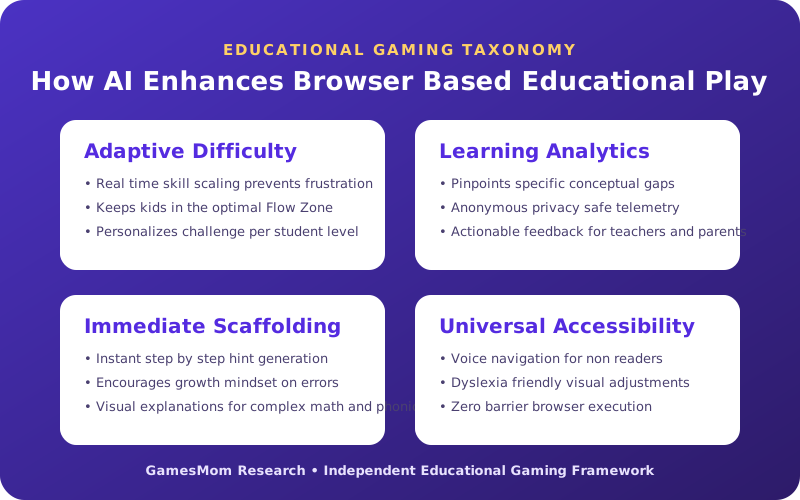
A game that runs in a browser, with nothing to download and no account to make, is one of the lowest barrier ways to reach a child with real learning. A little AI can make that play smarter without touching a child's privacy, in three ways:
- Adjusting the difficulty: nudging the speed or the hardness of a problem up and down so the child stays in that sweet spot where a game is neither boring nor overwhelming.
- Keeping it private: working out how the child is doing entirely on their own device, with nothing about them sent away or stored.
- Offering a hint at the right moment: showing the next small step when a child is stuck on a logic grid or a word match, rather than handing over the answer.
Platforms like GamesMom show how learning games for kids, quizzes, science quiz questions and true or false quizzes can be genuinely useful while collecting nothing about the child at all.
14. Universal Benefits of AI for Children
The Real Opportunities, in Plain Terms
- Tutoring for everyone: the kind of one to one help that used to cost money can reach a child whatever their family can afford.
- Crossing language barriers: instant translation can help an immigrant or refugee child take part in a classroom in a language they are still learning.
- An easier way into coding: children can build simple games and scripts by describing what they want in plain words, which lowers the first step into computer science.
- An always ready answer to why: a safe, well designed tool can feed a child's endless curiosity about science and nature without a grown up having to know everything.
15. AI for Children With Disabilities (Case Studies)
Case Study 1 - Support for Dyslexia
For a child with dyslexia, AI tools can break a dense paragraph into smaller, cleaner chunks, widen the spacing between letters, and read the words aloud while highlighting each one, so the eyes and ears work together and a wall of text becomes something a child can climb.
Case Study 2 - Speech and Hearing Access
AI can translate sign language into spoken words and turn a classroom discussion into live captions on a screen, so a deaf or hard of hearing child can follow along in the moment rather than after the fact.
Case Study 3 - Practice for Autistic Children
For some autistic children, an AI program offers a calm, predictable place to practice the social skills that feel risky in a busy room, such as reading facial expressions and taking turns, without the pressure of getting it wrong in front of others.
16. Misinformation, Hallucinations and Bias
Current Evidence
AI chatbots sometimes make things up. The polite word for it is a hallucination: the tool states a wrong date, a botched sum or a false fact with exactly the same confidence it uses for the truth (Common Sense Media, 2025). Children are especially at risk here, because they tend to believe a grown up sounding, confident voice, and an AI always sounds sure of itself.
17. Privacy, Biometrics and Child Data Law
Current Evidence and Data Rights
Children's voice prints, facial images, typing patterns and chat logs are sensitive personal data. In the United States they fall under the Children's Online Privacy Protection Act (COPPA), which a proposed update known as COPPA 2.0 would strengthen. In Europe and the UK they fall under the GDPR and the Age Appropriate Design Code, the UK's Children's Code. Commercial education tools that harvest this data for targeted advertising or to train models run against those protections.
18. Child Safety, Deepfakes and Online Protection
Current Evidence
The same tools that can make a fun cartoon can also fake a photo or a voice. That opens new doors for cruelty: bullying with doctored images, pretending to be someone a child trusts, and worse. Keeping children safe means several things at once, tight filtering of what an AI will produce, clear labelling of images and audio that a machine made, and teaching children, in plain terms, how to recognize and report something that feels wrong.
19. Academic Integrity and Cognitive Independence
Current Evidence
When a student has AI write the whole essay or solve the whole problem, they skip the very work the task was set to do: building an argument, ordering their thoughts, and coming to grips with the idea underneath. The grade may look fine, but the learning did not happen.
20. Digital Wellbeing and Attention
Current Evidence
Many apps are built to hold a child's attention for as long as possible, and that design can eat into sleep, chip away at the ability to focus, and push out time that would have been spent running around outside. Simple, firm limits still matter: no screens at meals and none in the hour before bed protect the rest and the downtime a growing brain needs.
21. Responsible AI and Explainable Systems
Framework Principles
An AI tool a child uses should meet five plain tests. It should be open about what it is and how it works (transparency). It should treat every child fairly (fairness). Someone should be answerable when it goes wrong (accountability). A human should stay in charge of the important decisions (human oversight). And it should be able to show, in terms a person can follow, why it did what it did (explainability).
22. Children's Rights and the UN Convention
Current Evidence
In 2021 the UN Committee on the Rights of the Child issued General Comment No. 25, which made something important explicit: a child's rights, to privacy, to safety, to education, to play and to be treated equally, apply just as much online and inside AI systems as they do offline. It is the clearest statement yet that the digital world is not a place where children's rights are set aside.
23. Global AI Regulations (EU Act, US, UK, UNESCO)
Regulatory Synthesis
The European Union AI Act (Regulation (EU) 2024/1689) treats many child facing AI systems as high risk, requiring safety audits, transparency and limits on biometric use. Alongside it, the US Children's Online Privacy Protection Act (with COPPA 2.0 proposed to extend it), the UK's Age Appropriate Design Code, and UNESCO's Recommendation on the Ethics of Artificial Intelligence set out clearer boundaries for how children's data may be handled.
24. Childhood in 2035 - Three Future Scenarios
Optimistic Scenario
AI serves as an accessible, privacy-safe universal learning companion, democratizing elite education worldwide while preserving physical human play.
Balanced Scenario (Most Likely)
Targeted regulatory oversight enforces child privacy and safety, while schools adopt hybrid human AI pedagogical models with structured screen limits.
Pessimistic Scenario
Unregulated commercial AI increases screen addiction, cognitive dependency, data surveillance, and global educational inequality.
25. 10 Essential Skills Every Child Will Need
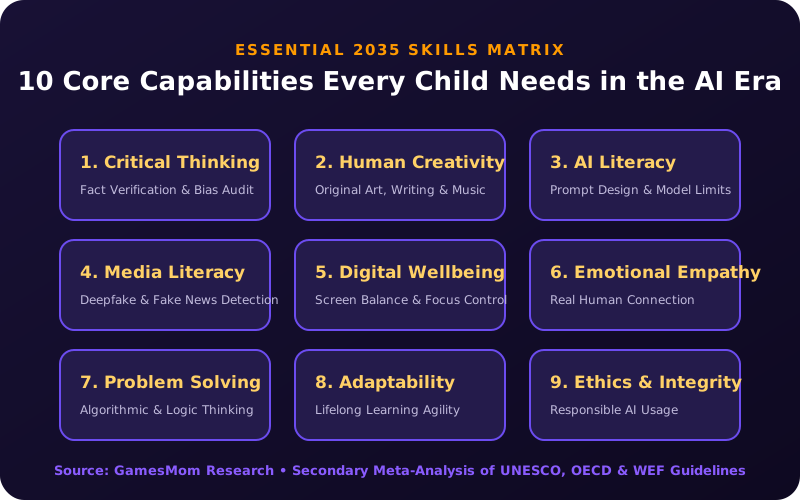
- Critical Thinking and Verification: Evaluating sources, identifying hallucinations, and questioning algorithmic outputs.
- Human Creativity and Originality: Cultivating personal artistic expression beyond automated text or image prompts.
- AI and Algorithmic Literacy: Understanding how neural networks function, their training data limits, and prompt engineering.
- Media Literacy and Deepfake Detection: Recognizing synthetic audio, altered photography, and algorithmic manipulation.
- Digital Wellbeing and Attention Control: Managing screen habits, preserving focus, and protecting sleep hygiene.
- Emotional Intelligence and Empathy: Nurturing genuine face-to-face human bonds and social teamwork.
- Computational Problem Solving: Breaking complex challenges into logical, step-by-step algorithmic solutions.
- Adaptability and Learning Agility: Embracing continuous lifelong learning in a rapidly shifting technological landscape.
- Ethical Responsibility and Integrity: Respecting copyright, intellectual property, and privacy rights when using AI tools.
- Collaborative Communication: Articulating ideas clearly to both human teammates and AI cocreators.
26. Actionable Stakeholder Recommendations
| Stakeholder | Immediate Priorities | Long Term Strategic Actions |
|---|---|---|
| Parents | Enforce screen-free bedrooms and meals; coengage with children on AI tools. | Teach AI literacy at home; select privacy-safe, zero-tracking learning apps. |
| Teachers and Schools | Shift grading to process based and oral defense; use AI for lesson differentiation. | Integrate mandatory digital ethics and AI critical thinking into K to 12 curricula. |
| EdTech Developers | Build privacy by design systems with zero data selling; implement age gated guardrails. | Create transparent, explainable algorithms that promote productive struggle. |
| Policy Makers | Enforce COPPA and EU AI Act standards; ban commercial biometrics in AI toys. | Fund public digital infrastructure and subsidize AI access for low income districts. |
Conclusion and Future Research Priorities
Artificial intelligence is not, on its own, either a threat or a cure. It is a powerful tool, and like any tool its worth comes down to the choices people make around it: how it is designed, what rules it is held to, and how it is used with children.
Put a child's privacy first, protect real, hands-on play, teach children to think for themselves, and keep a caring adult at the center of learning, and AI can genuinely help raise a curious, creative and thoughtful generation. Forget those things, and it will not. The future here is not something that happens to us; it is something the adults in a child's life get to shape.
About GamesMom research reviews
GamesMom publishes free, child-safe browser games, printables and practice activities for children from preschool through elementary school. There are no accounts, no downloads and no ads inside the play area.
Our research reviews exist because the guidance parents and teachers need is published, public and nearly unreadable. Each review reads a small number of authoritative sources, states what they say, links them, and says where the evidence stops. They are written by the GamesMom editorial team, checked against the live sources on the publication date, and corrected when a source changes. They are not medical guidance, and they are not original research. If something about your child worries you, the people to ask are the ones who know your child: their teacher, and their doctor. The other reviews are in our research library.
This review draws on UNESCO, UNICEF, the OECD, the World Health Organization, the World Bank, the Pew Research Center, Common Sense Media and the UN Committee on the Rights of the Child. Every document is listed below, linked to the original.
References
Every source this review draws on, linked to the original document rather than to a summary, so you can check any claim yourself.
Links checked on September 20, 2026. If one has moved since, the publisher's own search will find the document from the citation above.
Appendices - Glossary and Policy Matrix
Appendix A - Glossary of Core AI Terms
- Algorithm
- A step-by-step set of rules or mathematical instructions given to a computer to solve a problem or perform a task.
- Generative AI
- Artificial intelligence models capable of creating new original content (text, imagery, audio, code) based on user prompt data.
- Hallucination
- A phenomenon where an AI language model generates inaccurate, fabricated, or factually incorrect information while presenting it with high confidence.
- Large Language Model (LLM)
- A deep learning neural network trained on massive text datasets to process, understand, and generate human like language.
- Productive Struggle
- An educational concept where learners experience effortful, analytical problem-solving that strengthens neurological neural pathways before receiving hints or solutions.
Appendix B - List of Abbreviations
AI: Artificial Intelligence | COPPA: Children's Online Privacy Protection Act | GDPR: General Data Protection Regulation (EU) |LLM: Large Language Model | OECD: Organisation for Economic Co-operation and Development | UNESCO: UN Educational, Scientific and Cultural Organization | UNICEF: UN International Children's Emergency Fund | WEF: World Economic Forum | WHO: World Health Organization