
Secondary Research Review by gamesmom.com, 2026 Edition
Learning Through Play
Play, Creativity and Digital Activities in Children's Learning
Executive summary
Children have always learned through play. Long before a child sits at a desk, they learn by touching, building, pretending, sorting and asking why. This review gathers what is well established about learning through play and sets out a practical, balanced view of where digital activities fit alongside it.
Our central finding is simple. Screen-free play, reading, outdoor time, sport, art, music and family conversation remain the foundation of a healthy childhood, and nothing should replace them. At the same time, a small amount of well-designed, screen-based learning can add real value when it asks a child to think, make and solve rather than sit and watch. The question is not screens or no screens. The question is balance and quality.
To make that balance practical, this review introduces ten original frameworks that parents, teachers and schools can use to plan, choose and reflect: the GamesMom Learning Ecosystem, the Balanced Learning Wheel, the Skill Development Map, the Learning Progression Framework, the Digital Wellness Framework, the Parent Decision Framework, the Curiosity Cycle, the Teacher Implementation Model, the School Readiness Framework, and the Educational Activity Matrix.
How We Made This Review
This is a secondary review. We ran no study of our own. We read what the American Academy of Pediatrics, the World Health Organization, UNESCO and the National Association for the Education of Young Children have already published on play, screens and early learning, checked what each one actually says, and set it out in plain English for parents and teachers.
What we included: position statements and clinical reports from recognized health and education bodies, and guidance aimed at families and schools rather than at specialists.
What we left out: company marketing, opinion posts and any claim we could not trace back to a named, public document. Where a popular figure rests on weak evidence, we say so rather than repeating it.
What this review cannot tell you: which activity will suit one particular child. The frameworks here are our own way of organizing published guidance, not findings of our own, and they are no substitute for knowing the child in front of you.
Introduction: why learning through play matters
Play is not the opposite of learning. It is one of the main ways learning happens in the early years. When a child plays, they set their own small goals, test ideas against reality, and adjust when something does not work. That loop of try, check and adjust is the same one behind reading, mathematics and problem solving later on, which is why play-based learning has such a strong and lasting effect.
The purpose of this review is to be useful rather than to promote anything. It is written for parents, teachers, homeschool families, school leaders and anyone who cares about how children grow. Throughout, we point to free activities that put the ideas into practice, but the ideas stand on their own. If you take one message from these pages, let it be this: keep learning playful, keep it balanced, and keep the child at the center.
1. The science of learning through play
Research across early childhood education points consistently in the same direction. Young children learn best when they are active participants, not passive receivers. A child who counts real objects, sorts shapes with their hands or acts out a story is doing the mental work that builds understanding. A child who only watches is not.
Play comes in several forms, and a rich childhood includes all of them. No single kind of play does everything, which is the central reason balance matters so much.
Physical play
Running, climbing, throwing and balancing build the large muscles, coordination and spatial sense that a child needs to move through the world with confidence. Physical play also sharpens the mind. A child who has moved and burned off energy settles and focuses far better than one who has sat still all day, which is why the best classrooms and homes weave movement through the day rather than saving it for the end.
Hands-on play
Building, threading, drawing and fitting pieces together build fine motor skills, the small and precise movements a child needs to hold a pencil and, in time, to write. Hands-on play also teaches cause and effect in the most direct way there is. The child does something, the world responds, and a small idea about how things work takes shape.
Pretend play
Making up stories, taking on roles and turning a cardboard box into a spaceship build language, imagination and empathy. When a child pretends to be someone else, they practice seeing the world through another person's eyes, which is the root of kindness and cooperation. Much of a child's richest language happens not in lessons but in the middle of an invented game.
Games with rules
Board games, card games and simple digital games teach a child to follow a shared set of rules, take turns, plan a step ahead and cope with winning and losing. This is where strategy and patience begin, and where many children first learn to lose without falling apart and to try again. A game with rules is a small, safe rehearsal for the give and take of the wider world.
Quiet play and rest
Not all play is busy. Looking at a book, drawing alone or simply daydreaming gives a child time to absorb what they have taken in and to let their imagination wander. Downtime is not wasted time. It is when much of the quiet work of learning happens, and a child whose every minute is filled has no room left to make sense of it all.
Digital activities can support some of these, especially games that involve real thinking such as puzzles, word games and number games. They are one tool among many, useful in the right amount, and never a substitute for the movement, mess and human contact of the rest of a child's day.
2. The GamesMom Learning Ecosystem
The GamesMom Learning Ecosystem is a simple model for keeping the whole picture in view. It places the child at the center, surrounds them with play as the main mode of learning, and then maps the four skill domains a child develops and the four supports that help them grow.
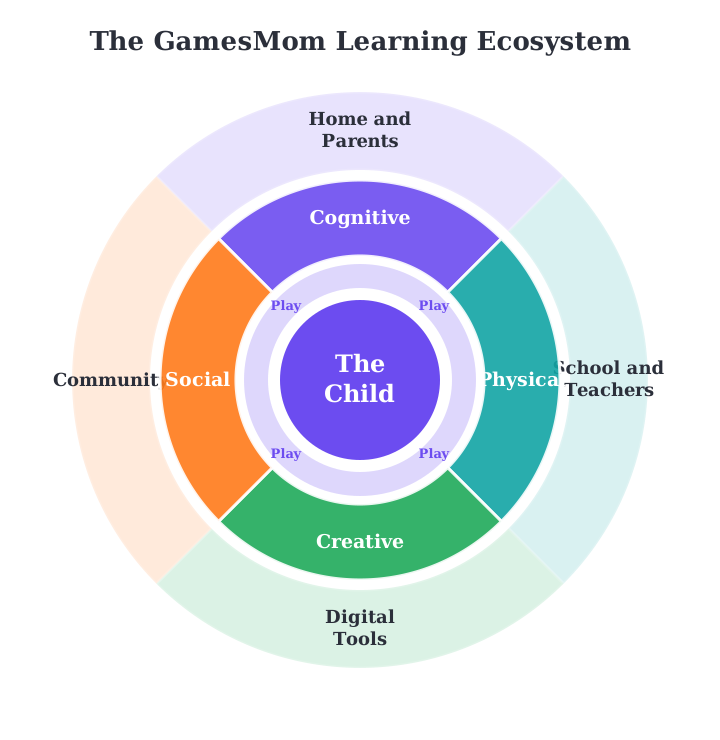
The four domains, cognitive, physical, creative and social-emotional, grow together rather than one at a time. The four supports, home and parents, school and teachers, digital tools and the wider community, all have a part to play. Digital tools are deliberately shown as one support among four, not the center. Used this way, a free set of learning games for kids becomes a small, helpful part of a much larger and healthier whole.
The value of seeing the whole ecosystem is that it stops any single part from taking over. A parent worried that their child is behind can see that cognitive skill is only one quarter of the picture, and that a child who is thriving physically, creatively and socially is doing well even if reading comes slowly. A school leaning hard on screens can see that digital tools are one support of four, and that teachers, families and the wider community carry the rest. Kept in view, the ecosystem is a quiet reminder that a child grows on every side at once, and that the task is to tend the whole child rather than any single skill.
3. The Balanced Learning Wheel
If the ecosystem shows the parts, the Balanced Learning Wheel shows the proportions. It divides a child's week into six areas that together make a rounded childhood, and it is a quick way to notice when one area has crowded out the others.
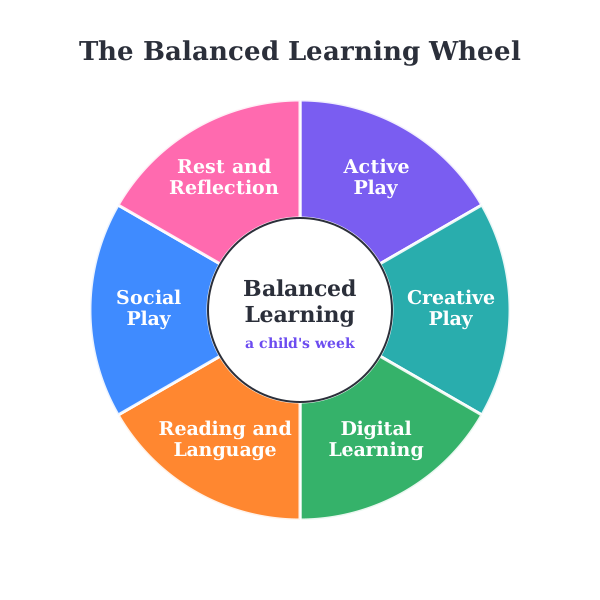
The point of the wheel is that digital learning is one slice, not the hub. When a week is heavy on screens and light on active or social play, the wheel is out of balance, and the fix is not guilt but adjustment. Swap twenty minutes of passive video for twenty minutes outdoors, or trade a second game session for reading a story together. A short, focused burst of an educational game such as typing games earns its place precisely because it is kept in proportion to everything else.
A balanced week does not need to be measured to the minute. A simple way to read the wheel is to glance back over the last few days and ask whether every slice got a turn. Did the child run around outside, make or draw something, read or listen to a story, play with others, rest, and spend a little time on a game that made them think? If one slice has swallowed the others, the wheel points to the fix. Usually the answer is not to add more, but to trade a little of the largest slice for the one that has been missed.
4. Cognitive and academic benefits
When a child plays a game that asks them to think, several mental muscles work at once. These are the same skills that carry a child through school and daily life, and good games exercise them without it ever feeling like practice.
Working memory
Working memory is the mind's short-term workspace, the place a child holds a phone number, a sum, or the first half of a sentence while they finish it. It is one of the strongest predictors of how well a child does at school, and it grows with use. Memory and pattern games ask a child to hold something in mind and act on it, which is exactly the exercise working memory needs. Short rounds suit it best, because the workspace tires quickly.
Executive function
Executive function is the set of skills that let a child plan, wait, and change course. It is what stops a child grabbing the first answer, helps them hold on to a goal, and lets them switch strategy when the first one fails. Strategy games and puzzles give this a gentle workout, rewarding the child who thinks before acting and adjusts when a plan does not work.
Attention and focus
Attention is the ability to stay with one thing and set distractions aside, and it is under more pressure than ever. A game with a clear goal and a short loop teaches a child to give something their whole mind for a few minutes, then come back for more. The trick is to keep sessions short, because focus strengthens through brief, regular use rather than long strain.
The academic gains are just as concrete, and they show up across every subject a child studies.
Mathematics
Number games build fluency with counting, addition and times tables, so the facts become quick and automatic and free up a child's attention for harder problems. A game of math games turns drill into something a child chooses to repeat, which is exactly how number facts settle into long-term memory.
Reading and vocabulary
Reading and word games grow vocabulary and spelling by turning them into puzzles rather than tests. A word search quietly sharpens the letter-pattern recognition that fluent reading depends on, and picture-to-word games link new words to meaning, which is how a reading vocabulary is built.
Spelling and writing
Games that ask a child to build or unscramble words practice spelling patterns in a low-pressure way, and the same letter play that helps reading also feeds early writing. A child who enjoys tinkering with words carries that confidence into their own sentences.
Typing and keyboard skills
Typing is a genuinely useful skill for the school years ahead, and it is easier to learn young, before two-finger habits set in. Turning practice into a game with typing games builds accuracy and speed while a child chases a score rather than grinding through drills.
Logic and reasoning
Deduction games train a child to reason step by step and rule out what cannot be true. A game of Sudoku is the clearest example, rewarding patient, careful thinking, the same habit behind strong mathematics and, later, early coding.
Two points keep all of these benefits real. First, the game has to ask for thought rather than reward mindless tapping. Second, short and regular beats long and occasional, because skills settle through repetition, not marathons. Ten focused minutes most days does more than an hour once a week.
5. Creativity and social growth
Learning through play is not only about academic skill. Some of the most valuable growth is creative and social. Making something from nothing, whether a drawing, a story or a tune, teaches a child that their ideas have worth and that a blank page is an invitation rather than a threat. Simple, open activities such as coloring pages give a child room to choose, invent and take pride in a finished piece.
Social and emotional growth comes from the games children play together. Taking turns, winning and losing gracefully, and reading how another person feels are learned through practice, not lectures. Two-player and group games give a child that practice in a low stakes way. The aim across both creativity and social play is the same: a confident child who is willing to try, comfortable being stuck for a moment, and kind to the people they play with.
Resilience deserves a special mention, because games teach it so naturally. A child who loses a round, runs out of moves, or fails a level meets a small, safe setback and gets to try again straight away. Over many small tries, a child learns that being stuck is temporary and that effort pays off, which is the quiet foundation of confidence. A game that lets a child fail gently, and come back, does more for their character than one they always win.
6. How skills grow, ages 3 to 12
Children do not learn everything at once, and matching an activity to a child's stage is one of the most useful things a parent or teacher can do. The Skill Development Map lays out how skills tend to grow from age three to twelve, and the Learning Progression Framework turns that map into a simple rule: meet the child where they are, then offer the next small step.
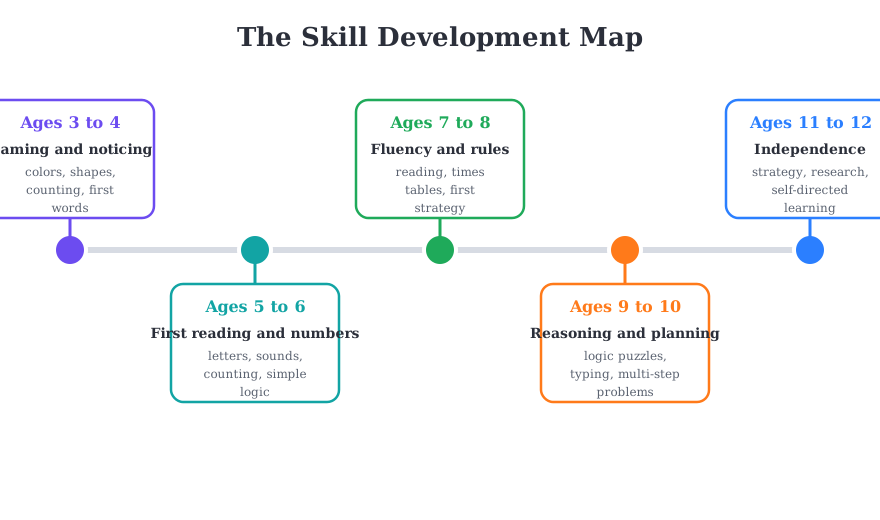
At three and four, the work is naming and noticing: colors, shapes, first numbers and first words. At five and six, first reading and counting take hold. By seven and eight, children gain fluency and can follow rules and first strategy. At nine and ten, reasoning and planning deepen. By eleven and twelve, many children can work independently and direct their own learning. The Learning Progression Framework asks one question at each stage: is this activity a gentle stretch, hard enough to hold attention but not so hard it defeats the child? When the answer is yes, learning moves forward. Our age guides, from games for 4 year olds onward, follow the same progression.
7. Digital activities done right
The honest question for any family is not whether screens are good or bad, but how to use them well. The Digital Wellness Framework answers it with three tests. First, quality: does the activity ask the child to think, make or solve? Second, quantity: is it kept to a sensible, agreed amount? Third, context: is it balanced by plenty of screen-free time and, where possible, shared with a grown-up?
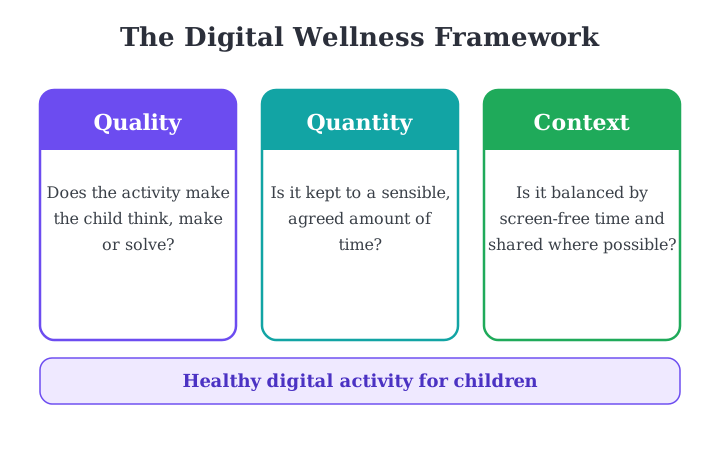
The three tests work together, and a weakness in any one is enough to think again. A high-quality game played for too long, or a good game that crowds out the park and the bookshelf, has failed the framework as surely as a mindless one. Used as a quick check before and after screen time, the three questions keep a family honest without turning every decision into a debate.
Guidance from respected health bodies supports this balance. The American Academy of Pediatrics advises avoiding screens for the youngest children, apart from video calls, and keeping to about an hour of high-quality content a day for ages two to five, with clear limits after that. The World Health Organization makes similar points and stresses active play and sleep. UNESCO, looking at education worldwide, underlines the value of play-based learning in the early years. None of these bodies say screens are required, and neither do we. They say that when screens are used, quality and moderation are what matter.
Browser games, apps and passive video
Not all screen time is the same, and the differences matter. Passive video asks nothing of a child: they watch, and the program moves on with or without them. A downloaded app often arrives with accounts, notifications and design meant to keep a child coming back, sometimes with adverts or purchases attached. A browser game that runs with no download and no sign-up sits at the healthier end: it starts in a click, asks the child to think and act, and stops cleanly when the tab is closed. None of this makes browser games required, but when a family does choose a digital activity, the format is worth weighing alongside the content.
Applied simply, the framework favors browser based educational games that need no download and no account, that run in short sessions, and that leave a child having thought rather than just watched. It treats passive video very differently from an active puzzle, and it always keeps the rest of the week larger than the screen.
8. A framework for parents
Parents make dozens of small decisions about activities every week, often in a hurry. The Parent Decision Framework makes those decisions easier with four quick checks before handing over a device: is it safe, with no chat, ads in the play area or data collection; is it worthwhile, asking the child to think or create; is it the right level for the child; and is it balanced against the rest of the day. If an activity passes all four, it has earned its place.
The four checks take only a moment once they become a habit, and they are worth teaching to a child as they get older, so that in time the child begins to ask the questions for themselves. The order matters too. Safety comes first, because nothing else counts if an activity is not safe. Balance comes last, because even a perfect activity has no place in a day that is already full of screens. A parent who runs through the four checks is not being strict. They are simply making sure a child's time, which is limited and precious, is spent well.
Underneath the decisions sits something deeper, which we call the Curiosity Cycle. A curious child asks a question, explores an answer, discovers something, and that discovery sparks the next question. The parent's job is not to supply every answer but to keep the cycle turning: notice what a child is drawn to, offer a next step, and celebrate the effort more than the result. A well-timed activity, from a set of flashcards to a nature walk, is fuel for that cycle rather than the cycle itself.
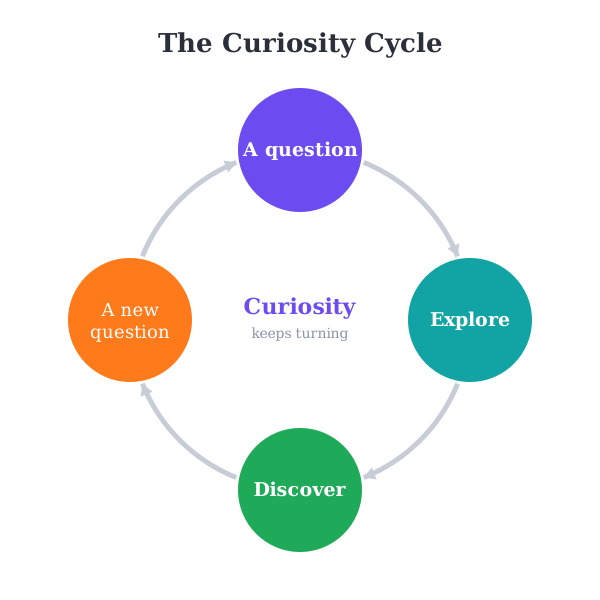
The cycle is easy to break and easy to protect. It breaks when a child is handed answers before they have wondered, or when a wrong guess is met with correction rather than encouragement. It grows stronger every time a parent follows a child's lead, sits with them in the not-knowing for a moment, and lets the small thrill of working something out carry them to the next question. Protecting that spark matters more than any single fact a child learns.
9. A framework for teachers and schools
In a classroom, the constraints are different: many children, little time, and a curriculum to cover. The Teacher Implementation Model keeps digital activities useful rather than disruptive with three roles for a short game. As a brain break, it resets focus between tasks. As a transition, it fills the gap between activities with something purposeful. As reinforcement, it practices a skill the class has just been taught. Kept to a few minutes and tied to a clear purpose, a game supports the lesson instead of competing with it, which is exactly how our free classroom games are designed to be used.
Each of the three roles has its own rhythm. A brain break is short and a little playful, meant to lift energy and reset attention, so it works best when it asks nothing of the lesson itself. A transition is practical, a way to fill the awkward gap between activities with something calm and purposeful while the next task is set up. Reinforcement is the most powerful of the three, because it takes a skill the class has just been taught and gives it one more repetition in a different form, which is what helps a new skill stick. Knowing which role a game is playing in the moment keeps it useful rather than a distraction.
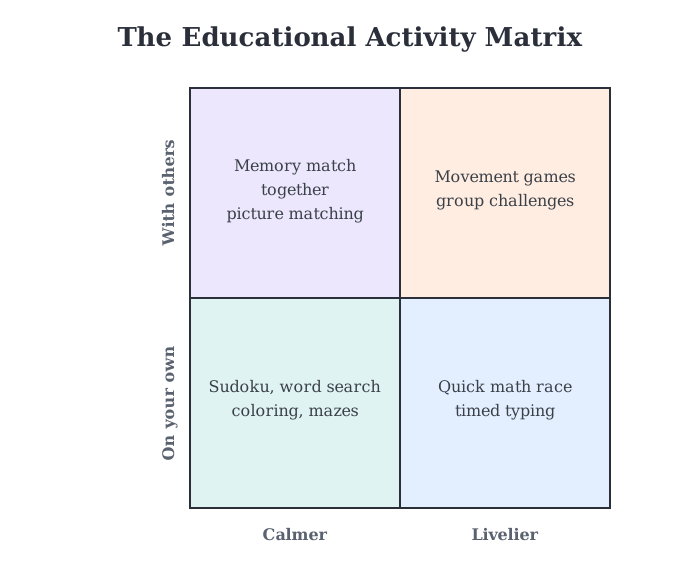
The Educational Activity Matrix helps a teacher choose well by mapping activities against two simple questions: is it calm or lively, and is it done alone or together. A calm solo puzzle suits the quiet end of a lesson, a lively group game suits a mid-morning slump, and a calm shared activity settles a restless room without sending it to sleep. Matching the activity to the moment is often the difference between a game that helps and one that derails the class.
For the youngest learners, the School Readiness Framework sets out the foundations that matter before formal schooling: fine motor control for holding a pencil, early language, number sense, the ability to focus for a few minutes, and the social skills to share and take turns. Play, not worksheets, is how most of these are built, which is why a good early years classroom looks busy and hands-on rather than quiet and still.
10. Digital literacy and online safety
Any conversation about digital activities has to include safety, because a young child cannot judge what is safe on their own. For the youngest children, a safe activity has clear traits: no chat with strangers, no advertising inside the play area, no data collection beyond an anonymous visit count, no links that lead away, and no way to spend money. When an activity meets that bar, a parent can hand over a device without hovering over every tap.
Digital literacy is the skill that grows out of safe early experiences. It means learning, step by step and at the right age, to use technology thoughtfully: to tell a trustworthy source from an untrustworthy one, to protect personal information, and to know what to do when something feels wrong. Young children build the foundations of this simply by spending their screen time in calm, ad-free, well-chosen places, with a grown-up nearby to talk things through. Good early habits are far easier to build than bad ones are to break.
11. Choosing a quality educational game
With so many activities competing for a child's attention, the real skill for a parent or teacher is choosing well. A quality educational game is easy to spot once you know what to look for, and the following checklist turns the judgment into a few quick questions.
- Is it safe, with no chat, no ads in the play area, no sign-up and no data collection?
- Does it ask the child to think, make or solve, rather than just watch or tap?
- Is it pitched at the right level, hard enough to hold attention but not so hard it defeats the child?
- Does it run on any device with no download, so the technology never gets in the way?
- Is it free of anything unsuitable for children, in both content and tone?
- Does it fit into a balanced day, rather than crowding out reading, movement and play?
An activity that passes all six has earned its place. The test is deliberately strict, because a child's time is worth protecting, and a single well-chosen game used often is worth more than a dozen mediocre ones tried once.
12. Practical recommendations
The frameworks above lead to a short list of practical steps, grouped by who they are for.
For parents: keep the Balanced Learning Wheel roughly even across a week, and glance back every few days to see which slice has been missed. Choose a few quality activities rather than many, run each one through the four checks of the Parent Decision Framework, play alongside younger children when you can, and stop while it is still fun. Treat any screen-based game as one small slice of the day, and protect the reading, movement, family time and free play that make up the rest.
For teachers: use short games with a clear purpose, tie them to the lesson, and keep them to a few minutes. Decide in advance whether a game is a brain break, a transition or reinforcement, and pick it to match the energy of the room. Favor activities that run on any school device with no download or sign-up, so the technology never gets in the way of the teaching, and never let a game run so long that it becomes the lesson rather than a support to it.
For homeschool families: match each activity to the child's stage using the Skill Development Map, and follow the child's interests wherever the Curiosity Cycle leads. Use short games as practice or a small reward around the hands-on projects, reading and outdoor time that homeschooling does so well, and keep the digital part as one tool among many rather than the spine of the day.
For schools and organizations: value play-based learning in the early years, give teachers simple, safe, ad-free tools, and judge digital activities by whether they build real skills rather than by how long they hold a child's attention. Provide the same free, no-download resources to every child, so that access does not depend on a family's budget. The goal is not more screen time but better learning.
13. Accessibility and inclusion
One of the quietest strengths of free, browser based learning is that it removes barriers. There is no price, no app store, no subscription and no account, and the activities run on an old laptop, a shared school tablet or a parent's phone. For a child in an under-resourced home or classroom, that difference is not small. It can mean access to the same practice and the same fun that a better-off child takes for granted. Learning that every child can actually reach is learning that does the most good.
Inclusion runs deeper than cost. Games that start easy and build up, that lean on pictures and sounds rather than dense text, and that never punish a wrong answer, suit a wide range of children, including those who find traditional formats hard. A child who freezes at a worksheet will sometimes light up at the same skill dressed as a game. Clear design, large buttons, adjustable difficulty and the freedom to try again are what make an activity welcoming to every learner, not only the confident ones.
14. For homeschool families
Homeschool families work differently from a classroom, and their needs are specific: flexible resources, an affordable budget, and materials that suit one child or several at once, on their own schedule. Free browser activities fit that life well. There is nothing to install, nothing to renew, and a family can dip into an activity for five minutes of practice or use it as a small reward at the end of a lesson.
The frameworks in this review apply neatly at home. The Skill Development Map helps a parent pitch an activity at the right level for each child. The Curiosity Cycle is often even stronger in a homeschool, where there is room to follow a child's interest wherever it leads. And because homeschooling already leans on hands-on projects, reading and the outdoors, a short digital activity slots in as one more tool rather than the center of the day, which is exactly where it belongs.
15. Putting it into practice
The following short scenarios are offered as illustrations, not as data. They show how the ideas and frameworks in this review come together in ordinary life.
A parent of a four year old notices the week has drifted toward screens and passive video. Using the Balanced Learning Wheel, they trade one video session for a trip to the park and keep a single short game of counting or matching, chosen with the four quick checks of the Parent Decision Framework. The child ends the day having moved, played and thought, with the screen a small part of a full day.
A teacher with a restless class after lunch reaches for the Teacher Implementation Model. A two minute true or false game as a brain break resets the room, and a quick word search at the end of the lesson sends the class out calm. Neither takes more than a few minutes, and both tie to the day's learning rather than competing with it.
A homeschool family follows the Curiosity Cycle. A child's question about animals leads to a matching game, a library book and a nature walk, and the game's small win sparks the next question. The digital activity is fuel for curiosity, not a substitute for it.
16. The future of learning through play
Technology will keep changing. Activities are becoming more adaptive, adjusting to a child's level as they play, and tools that personalize practice will only improve. Used well, this is a genuine opportunity: an activity that meets each child exactly where they are, and that frees a teacher or parent to spend their attention where it matters most.
There is a real risk alongside the opportunity. Some technology is designed to hold attention rather than to teach, and an activity that is merely addictive takes more than it gives. The task for parents, teachers and schools will be the same as it is today, only more important: to tell the tools that build real skills from the ones that simply capture time.
What will not change is how children learn. Whatever the device, learning still happens through play, through curiosity, through trying and adjusting, and through the warmth of a grown-up who cares. The technology is only ever a tool. Keep the child at the center, keep the week balanced, and keep screen-free play and human connection at the heart of childhood, and the future of learning through play looks bright.
The ten frameworks at a glance
For quick reference, here are the ten original frameworks introduced in this review, each in a single line. They are offered freely for parents, teachers and schools to use and cite.
- The GamesMom Learning Ecosystem: the child at the center, surrounded by play, four skill domains and four supports.
- The Balanced Learning Wheel: six areas of a balanced week, with digital learning as one slice among six.
- The Skill Development Map: how thinking, reading and reasoning tend to grow from age three to twelve.
- The Learning Progression Framework: meet the child where they are, then offer the next small step.
- The Digital Wellness Framework: judge any screen activity by quality, quantity and context.
- The Parent Decision Framework: four checks before a device, is it safe, worthwhile, the right level, and balanced.
- The Curiosity Cycle: a question leads to exploration, to discovery, and to the next question.
- The Teacher Implementation Model: use a short game as a brain break, a transition or reinforcement.
- The School Readiness Framework: the foundations of motor skills, language, number sense, focus and social skills, built through play.
- The Educational Activity Matrix: choose an activity by the skill it builds and the energy it brings to the room.
Conclusion
Children learn through play, and they always have. The arrival of screens does not change that truth, it only adds one more tool that can be used well or badly. Used well, in small and thoughtful amounts, an educational game can sharpen a skill and light a spark of curiosity. Used badly, as a substitute for movement, books and human contact, a screen takes more than it gives.
The ten frameworks in this review are all, in the end, ways of holding on to that balance. The Learning Ecosystem and the Balanced Learning Wheel keep the whole child in view. The Skill Development Map and the Learning Progression Framework keep activities at the right level. The Digital Wellness Framework, the Parent Decision Framework and the Curiosity Cycle guide the choices at home, and the Teacher Implementation Model, the School Readiness Framework and the Educational Activity Matrix guide them in the classroom. None of them is complicated. Each is simply a way to make a good instinct easier to act on.
The path forward is balance. Keep screen-free play, reading, outdoor time and family life at the heart of childhood. Let digital learning play its small, supporting part. Keep the child, not the device, at the center. That is the whole of this review, and it is enough.
About GamesMom research reviews
GamesMom publishes free, child-safe browser games, printables and practice activities for children from preschool through elementary school. There are no accounts, no downloads and no ads inside the play area.
Our research reviews exist because the guidance parents and teachers need is published, public and nearly unreadable. Each review reads a small number of authoritative sources, states what they say, links them, and says where the evidence stops. They are written by the GamesMom editorial team, checked against the live sources on the publication date, and corrected when a source changes. They are not medical guidance, and they are not original research. If something about your child worries you, the people to ask are the ones who know your child: their teacher, and their doctor. The other reviews are in our research library.
This review draws on the American Academy of Pediatrics, the World Health Organization, UNESCO and the National Association for the Education of Young Children. Every document is listed below, linked to the original.
References
Every source this review draws on, linked to the original document rather than to a summary, so you can check any claim yourself.
Links checked on September 20, 2026. If one has moved since, the publisher's own search will find the document from the citation above.