
How to Play Solitaire, with Easy Rules and Winning Moves
Solitaire is the card game almost everyone has played and almost nobody was properly taught. You pick it up by watching someone else, get the general idea, and muddle through. This guide fixes that. By the end you will know exactly how the game is set up, what every move does, and a handful of tips that turn a frustrating deal into a winnable one. If you would rather learn by doing, you can play a free Solitaire game right in your browser and follow along.
What is Solitaire?
Solitaire, also called Klondike, is a game for one player using a standard deck of 52 cards. The name covers a whole family of single player card games, but when people say Solitaire they almost always mean Klondike, the version that has sat on computers for decades. It is a quiet, thinking game of sorting and planning, which is part of why it has kept people company for so long.
The goal of the game
Winning Solitaire means moving all 52 cards onto four foundation piles, one for each suit. Each foundation starts with an ace and builds up in order, so hearts would go ace, two, three, all the way to the king. When all four suits are stacked from ace to king, the game is won. Everything you do on the table is really just working toward freeing the cards you need to send home.
Not every deal can be won, even with perfect play, because the shuffle sometimes buries a card you need under cards you cannot move. A skilled player still loses some games, so a loss now and then is normal and not a sign that you played badly.
Setting up the board
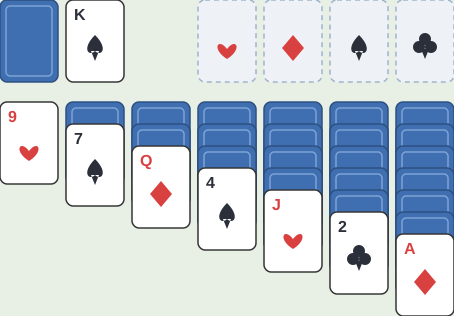
Deal seven piles across the table, called the tableau. The first pile gets one card, the second gets two, and so on up to seven cards in the last pile. In each pile, only the top card is turned face up and the rest stay face down. The 24 cards left over become the stock, which sits in the corner and feeds you fresh cards during play. Above the tableau you leave four empty spaces for the foundations you will build.
How to play, move by move
On the table you build downward and in alternating colors. That means a red six can only go on a black seven, and a black five can only go on that red six. You move cards, or ordered runs of cards, from one tableau pile to another to uncover the face down cards hiding beneath them. Every time you move a card off a face down one, you turn that hidden card up, and that is where new options come from.
When you cannot find a move on the table, you turn over cards from the stock and play them onto the tableau or straight up to a foundation. An ace always goes up to start a foundation, and after that you add the next card in the same suit whenever it becomes free. A completely empty tableau column is valuable, but only a king, or a run starting with a king, may move into it.
The rules that trip people up
A few rules catch new players out. You build down in alternating colors on the table, but you build up in a single suit on the foundations, so the two directions are easy to mix up at first. You may move a whole ordered run of cards at once, not just a single card, as long as the run is already in the right down and alternating order. And an empty column is not a free space for any card you like. Guarding that king only rule is one of the biggest differences between a beginner and a steady winner.
Simple tips to win more often
Turn over your face down cards as early as you can, because those hidden cards are the whole point and you cannot plan around what you cannot see. Try not to empty a column unless you have a king ready to fill it, since an open space with no king to move in is wasted room. Move an ace or a two up to the foundations the moment it appears, but hold your higher cards back a little, as a card is often more useful stacking on the table than sitting up top too soon. And there is no clock, so read the whole table before you commit to a move rather than grabbing the first one you see.
Fun variations to try
Once the standard game feels comfortable, there is a wider world to explore. Spider Solitaire uses two decks and asks you to build runs within a single suit, which makes for a longer, meatier game. FreeCell gives you four open cells to park cards in, and because almost every deal can be solved, it rewards careful planning over luck. Even sticking with Klondike, you can make it harder by turning three cards at a time from the stock instead of one. Each version keeps the same calm, sorting feel while changing the puzzle just enough to stay fresh.
Is Solitaire good for kids?
Solitaire is a genuinely useful game for a child, and not only a way to pass the time. It quietly teaches number order, color sorting and planning a few moves ahead, all inside a game that a young player can enjoy at their own pace. Because it is a game for one, it is a calm choice for a quiet afternoon or a settle down moment, with no arguing over whose turn it is. Our other free card games for kids follow the same idea, keeping the classic feel of a real deck while being simple enough to pick up.
Once the rules click, the best way to improve is simply to play, since every deal teaches you something about which cards to free first. Set aside a few quiet minutes, deal a fresh game, and put these tips to work.