
Multiplication Tables Mastery Sequence Guide
Learn the stress-free cognitive order for mastering multiplication tables from easy patterns and doubling tricks to tricky facts.
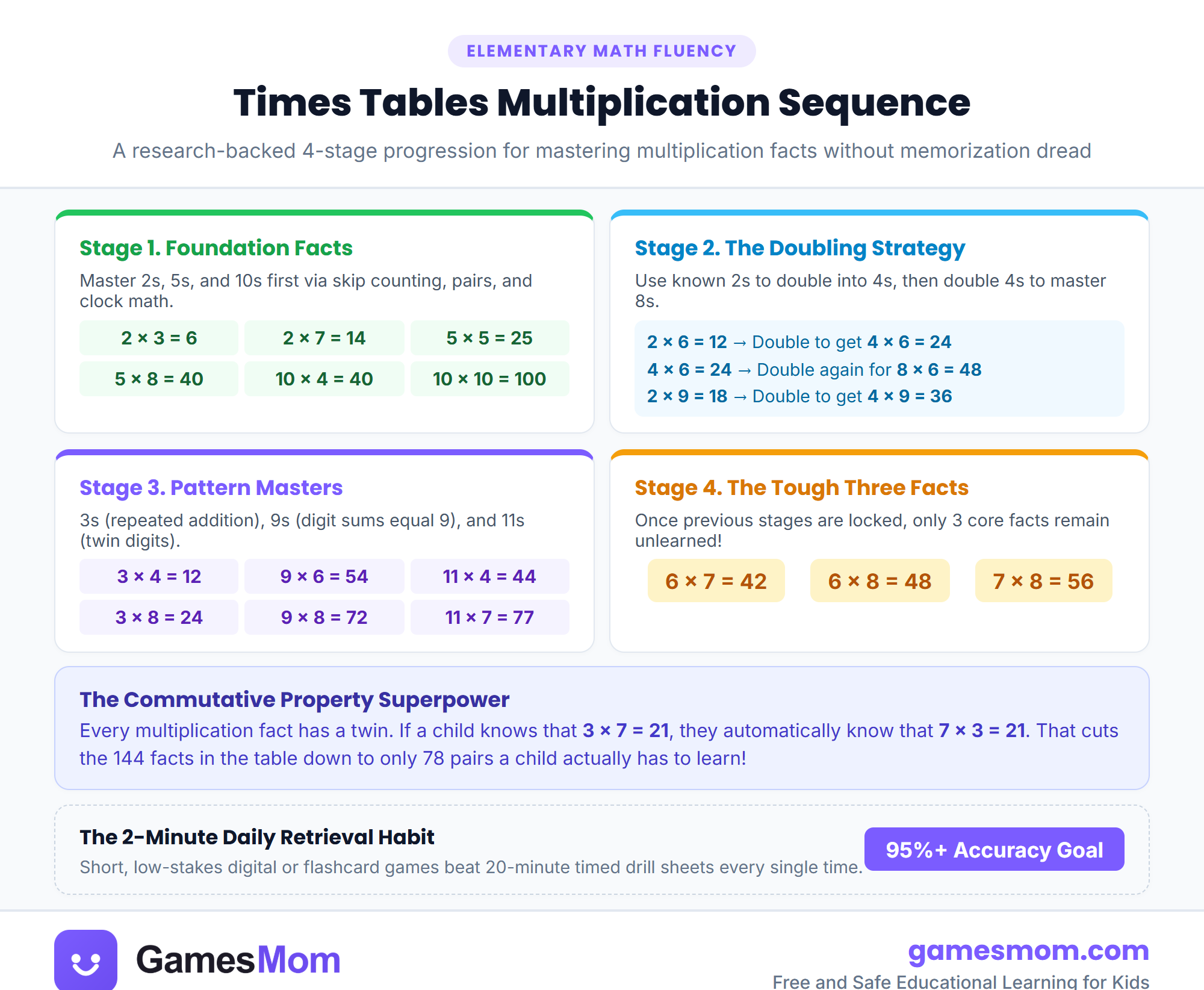
- Learning times tables in numerical order from 1 to 12 is inefficient and creates math anxiety.
- The commutative property (3x7 = 7x3) immediately cuts the memorization load in half.
- Doubling strategies connect known 2s to 4s, and 4s to 8s.
- Only three hard facts remain once patterns and doubling strategies are mastered (6x7, 6x8, 7x8).
- NCTM Developing Fluency with Basic Multiplication Facts
- Boaler Fluency Without Fear: Research Evidence on the Best Ways to Learn Math Facts
Why numerical order makes multiplication unnecessarily hard
Most parents remember memorizing multiplication tables row by row: the ones, the twos, the threes, and so on up to the twelves. While this seems logical on paper, it ignores how children learn mathematical patterns. Forcing a third grader to memorize the tricky seven times table before they have mastered doubling strategies leads directly to math anxiety. Explore our detailed guide in times tables practice online.
The first breakthrough is understanding the commutative property: order does not matter in multiplication. Three times eight and eight times three both equal twenty-four. Demonstrating this on an interactive grid eliminates fifty of the one hundred basic facts immediately.
When children see that half the chart is a mirror reflection of the other half, the task transforms from a mountain of memorization into a series of achievable patterns.
The four tier mastery sequence
Tier 1 begins with the rhythmic easy facts: the twos, fives, and tens. Children learn these quickly because they link directly to skip counting. Multiplying by ten simply shifts digits one place to the left, while multiplying by five always ends in zero or five.
Tier 2 introduces the doubling strategy. Once a child knows their twos, they can double those answers to solve the fours. For example, two times six is twelve, so four times six is double twelve: twenty-four. Doubling the fours gives you the eights in the exact same way. Review printable practice grids in our printable multiplication table charts.
Tier 3 covers the pattern tricks: the threes, elevens, and nines. The eleven times table features double digits (four times eleven is forty-four), while the nine times table features digit sums that always equal nine. Finally, Tier 4 focuses on the remaining three tricky facts: six times seven is forty-two, six times eight is forty-eight, and seven times eight is fifty-six.
The power of two minute daily retrieval practice
Cognitive psychology shows that long, painful study sessions on weekends do not build long term recall. Brains retain mathematical facts through brief, frequent retrieval. Spending just two minutes a day practicing multiplication flashcards or playing interactive grid games locks facts into automatic memory.
Avoid timed pressure that induces panic. When a stopwatch ticks aggressively, working memory freezes. Provide supportive games where speed is rewarded as a fun personal challenge rather than a punitive cutoff. Try our free quick math game online.
Celebrate effort and logical strategies. When a child forgets seven times eight, show them how to multiply seven by seven (forty-nine) and add one more seven. Knowing how to rebuild forgotten facts gives children permanent mathematical confidence.
Frequently asked questions
What is the best order to learn multiplication tables?
The recommended sequence is: 1s, 2s, 10s, 5s first, followed by doubling rules (4s and 8s), pattern tricks (3s, 9s, 11s), and finally the remaining hard facts (6s, 7s, 12s).
How does the commutative property help kids learn times tables?
The commutative property states that a x b = b x a. Knowing that 3 x 8 is the same as 8 x 3 cuts the number of facts a child must memorize in half.
What should I do if my child freezes during timed math tests?
Timed tests trigger math anxiety by shutting down working memory. Focus on un-timed visual grids, doubling strategies, and low-pressure digital games to build confidence before speed.