
Strategic Problem Solving and How Puzzles Train Logic Guide
Learn how classic logic puzzles like Sudoku, Sliding Tiles, and Minesweeper train deductive reasoning and executive function in kids.
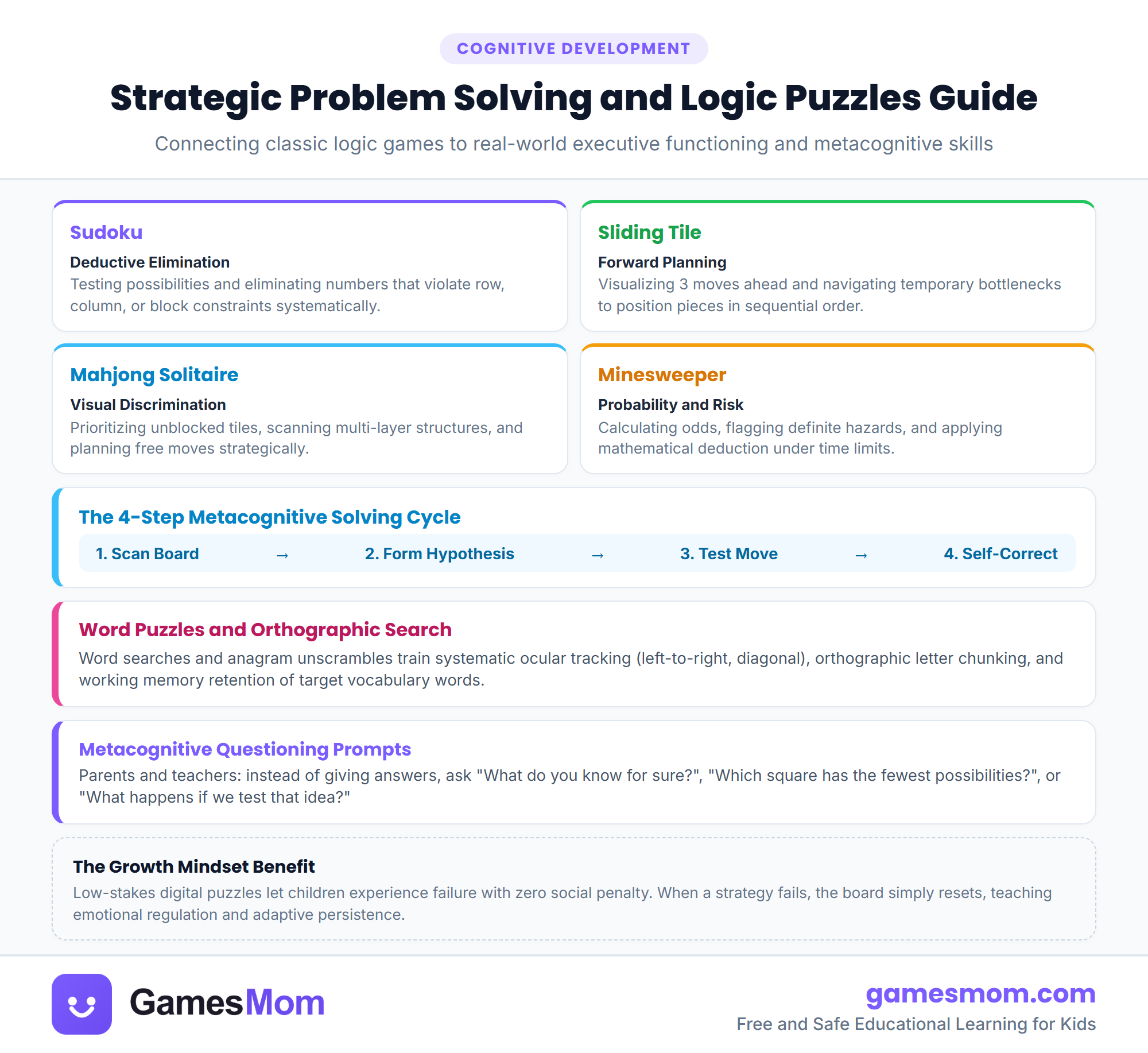
- Logic puzzles teach children that problems have structured rules and rational solutions.
- Sudoku builds deductive elimination by forcing players to prove why a number must fit.
- Sliding tile puzzles develop multi-step look-ahead planning and patience.
- Puzzles provide a low-stakes arena where mistakes are neutral learning data rather than failure.
- Stanovich What Intelligence Tests Miss: The Psychology of Rational Thought
- Polya How to Solve It: A New Aspect of Mathematical Method
Why logic puzzles build rational thinkers
In standard school curriculums, children are frequently given problems with single, formulaic answers. While calculation is necessary, it does not always teach lateral thinking or deductive reasoning. Logic puzzles provide a completely different mental workout. In a puzzle, the challenge lies in discovering the path forward, formulating hypotheses, and systematically testing alternatives. Read our educator guide in teaching kids sudoku online.
Puzzles require metacognition, which is the ability to think about one own thinking. A child working through a puzzle constantly asks themselves: What do I know for sure? What is impossible? What should I test next?
This structured reasoning translates directly into real life, helping children tackle complex academic assignments, troubleshoot computer code, and navigate social conflicts rationally.
The distinct cognitive benefits of classic puzzles
Different puzzle types develop different neural circuits. Sudoku is the gold standard for deductive elimination. A player cannot guess; they must scan rows, columns, and blocks to prove that only one number can logically inhabit a cell. This exercises working memory and attention to detail.
Sliding tile puzzles require forward planning. To move a specific tile into position, the child must deliberately move other tiles out of the way, sometimes moving backward temporarily to make forward progress. Try our interactive version in the free sliding tile puzzle game.
Mahjong solitaire trains visual discrimination and layering awareness. Players must evaluate which tiles are unblocked and prioritize moves that free deep stacks. Minesweeper teaches probability and risk assessment, showing kids how to deduce safe cells from numerical clues.
Cultivating patience and emotional recovery
The greatest benefit of puzzle play is emotional rather than purely mathematical. In a digital puzzle, making an incorrect move carries zero shame. The board simply resets, inviting the child to analyze where their logic broke down.
When a child gets stuck, resist the urge to solve the puzzle for them. Ask guiding questions: What numbers have you checked in that row? What happens if you look at the corner first? Empowering the child to find the solution builds genuine self-efficacy.
Celebrate the process of struggle. A puzzle solved instantly taught very little; a puzzle that took twenty minutes of deep reflection built real intellectual resilience.
Frequently asked questions
What age can a child start solving Sudoku puzzles?
Children can begin with 4x4 mini Sudoku grids using numbers or shapes around age five or six. Classic 9x9 Sudoku is typically enjoyed around ages eight and up.
How do logic puzzles help with math problem solving?
Logic puzzles teach systematic elimination, pattern recognition, and hypothesis testing, which are the exact skills needed to break down multi-step word problems.
What is the best way to help a child who gives up quickly on puzzles?
Start with easier grid sizes (like 4x4 grids) to ensure quick wins, model think-aloud strategies alongside them, and praise their persistence rather than quick completion.