
Sight Words vs Phonics and Decoding Heart Words Guide
Learn why flashcard drilling fails and how orthographic mapping with heart words helps kids decode high frequency words with confidence.
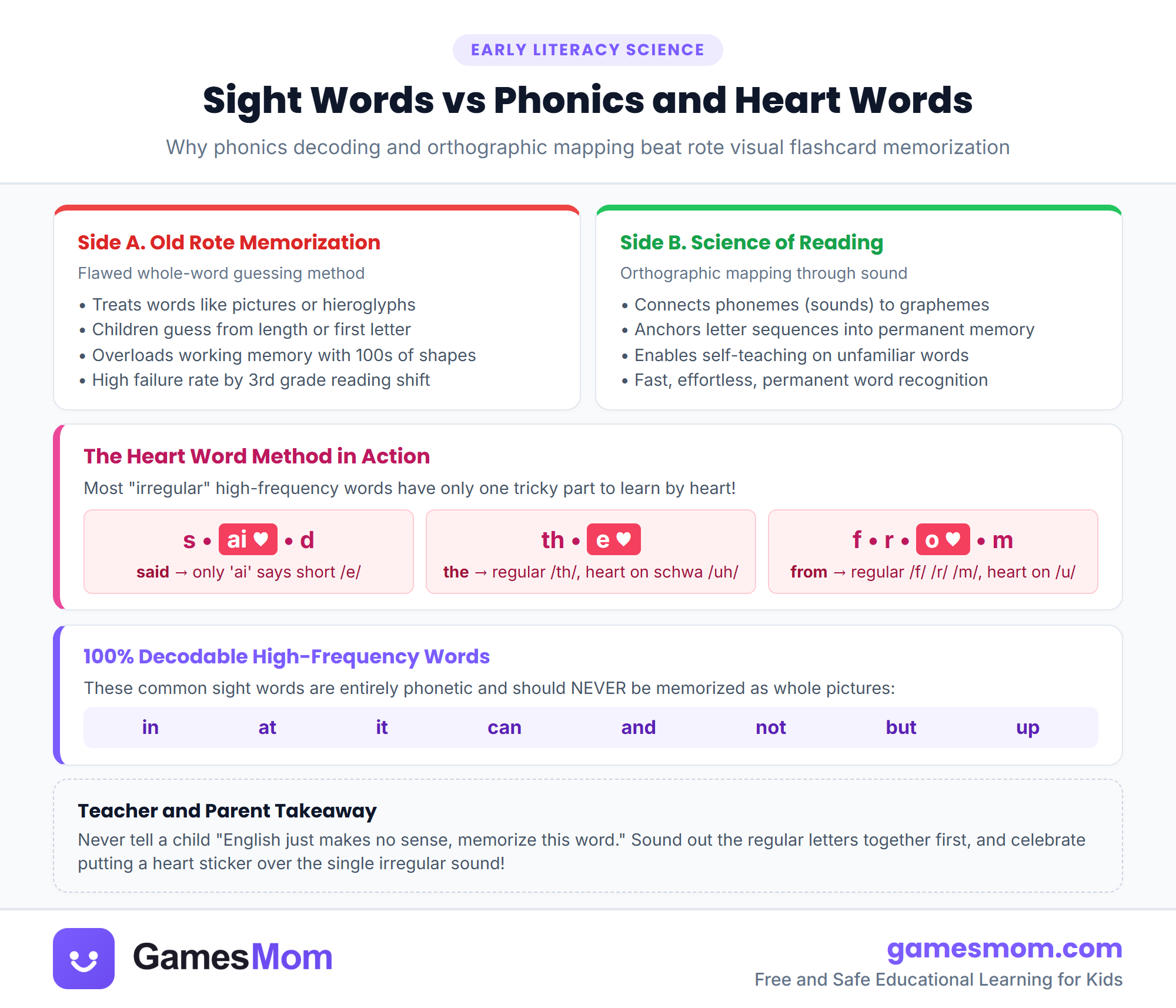
- The brain does not read words as visual pictures; it reads through phoneme-grapheme mapping.
- Over eighty percent of high-frequency sight words are completely decodable using phonics rules.
- Irregular words only contain one or two tricky letters, called the heart parts.
- Sounding out regular letters first makes reading automatic and permanent.
- Kilpatrick Equipped for Reading Success and Orthographic Mapping
- Flanigan The Heart Word Method for High-Frequency Words
- Ehri Orthographic Mapping in the Acquisition of Sight Word Reading
Why rote flashcard memorization creates reading struggles
For decades, schools sent home stacks of sight word flashcards with instructions to memorize them on sight. Children were told to look at the whole shape of words like said, the, and were. However, cognitive neuroscience has proven that the human brain is not wired to memorize words as visual pictures. Treating words like visual logos forces the visual memory system to carry an unsustainable load. Review our insights in how to teach sight words.
When children rely on visual memorization, they frequently confuse words with similar outlines. A student might guess where for were, or that for what. When they encounter unfamiliar words in storybooks, their guessing strategy collapses.
True reading fluency happens through orthographic mapping, which is the mental process our brains use to turn unfamiliar written words into automatically recognized sight words.
Understanding the heart word method
The heart word method bridges phonics and high-frequency words. It teaches children that almost every word has regular, decodable parts. Consider the word said. The first letter S makes its normal /s/ sound, and the last letter D makes its normal /d/ sound. Only the middle letters AI make an unexpected short /e/ sound.
Instead of memorizing the whole word as an arbitrary shape, the child only needs to learn the heart part: the unexpected /e/ sound spelled with AI. Drawing a small heart above AI reminds the student that this part must be learned by heart.
This simple shift empowers young readers. They realize that English is structured and logical rather than random. Practice sight vocabulary in our free sight words flashcards hub.
Step by step heart word routine for home and class
Begin by saying the word aloud: said. Have your child tap out the sounds they hear: /s/ /e/ /d/, counting three distinct sounds on their fingers.
Next, look at the letters. Ask what letter makes the first sound /s/, and write S. Ask what letter makes the final sound /d/, and write D. Finally, point out that in this word, AI spells the middle sound /e/. Draw a heart over AI.
Have your child trace the letters while speaking each sound aloud. Engaging the voice, eyes, and writing hand simultaneously locks the word into permanent memory.
Frequently asked questions
What is a heart word in kindergarten reading?
A heart word is a high-frequency word with an irregular spelling pattern where one or two letters make an unexpected sound that the child must learn by heart (such as AI in said).
Are sight words and high-frequency words the same thing?
High-frequency words are the most commonly used words in English (like the, was, and of). A sight word is any word a reader recognizes automatically without conscious decoding.
How many heart words should a first grader practice at a time?
Introduce no more than three to five new heart words per week. Mastery and deep orthographic mapping are far more effective than rushing through long lists.