
Preventing Educator and Parent Burnout Guide
Discover four sustainable self-care habits, healthy teaching boundaries, and realistic daily expectations for homeschoolers and teachers.
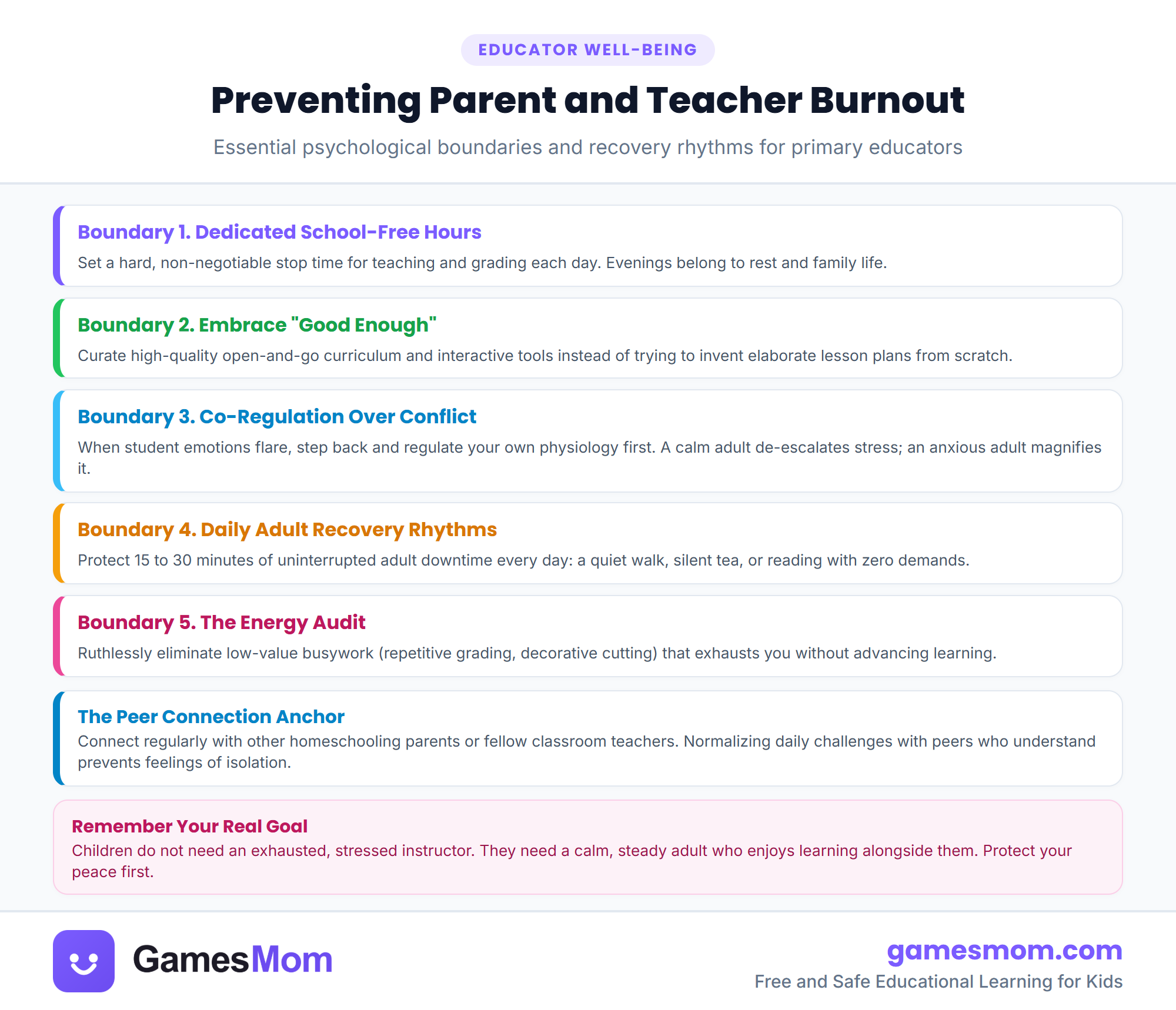
- Children need a calm, steady adult far more than they need a stressed perfectionist.
- Daily 5-minute micro-resets between lessons restore emotional equilibrium.
- The 80% sufficiency rule: a good-enough lesson completed with joy beats a stressful perfect lesson.
- Institute hard closing hours to protect evening family rest and prevent exhaustion.
- Maslach Burnout Inventory and Educator Emotional Exhaustion Studies
- Neff Self-Compassion in Parental and Instructional Roles
The hidden pressure on homeschooling parents and teachers
Educating children is emotionally demanding work. Homeschool parents carry a double burden: they are responsible for both academic instruction and 24/7 household management. In an age of picture-perfect social media classrooms, parents feel immense pressure to create elaborate sensory crafts, cook organic meals, and maintain flawless academic pacing. Read our realistic perspective in homeschool daily schedule.
Chronic perfectionism leads to emotional exhaustion, irritability, and burnout. When an adult is running on empty, even minor learning hurdles trigger frustration.
Sustaining a joyful learning home requires protecting the parent emotional health with the same seriousness given to student curriculum.
Four essential habits for sustainable teaching
Habit 1 is taking daily five-minute micro-resets. Step away from the kitchen table between heavy subjects. Drink a glass of water in silence, step into the backyard for fresh air, or take five deep diaphragmatic breaths.
Habit 2 is embracing the eighty percent sufficiency rule. Perfection is an illusion. A steady, good-enough math lesson completed with laughter is far more educational than a six-page drill finished in tears.
Habit 3 is setting hard closing hours. At a set time each afternoon (such as 3:00 PM), pack away curriculum books, close teacher planners, and declare the school day officially closed. Reclaim your home as a sanctuary.
Habit 4 is instituting a daily independent quiet hour. During this forty-five-minute block, children read books, solve puzzles, or engage in quiet drawing while the parent recharges without interruptions. Browse our quiet activities in brain games for kids.
Remembering the real goal of home education
At the end of your child educational journey, they will not remember whether you finished every page of a third-grade workbook. They will remember the atmosphere of your home, the conversations around your kitchen table, and how it felt to learn alongside you.
Give yourself permission to simplify. If a day goes completely off the rails, put away the books, take a walk to the park, and bake cookies together.
Protecting your own joy and peace is the greatest educational gift you will ever give your children.
Frequently asked questions
What are early warning signs of homeschool parent burnout?
Frequent irritability, dreading school time, feeling guilty about unfinished curriculum, and comparing your home to social media accounts are classic burnout signs.
How do you establish a daily quiet hour with young children?
Start small with fifteen minutes of quiet room time with picture books or building toys. Gradually extend it to forty-five minutes, keeping it consistent at the same time each afternoon.
What should I do if my child refuses to do their schoolwork?
Step back and lower the temperature. A power struggle never produces learning. Take a physical movement break, reduce the assignment size, and return to the topic with a fresh perspective later.