
Pre-Writing Strokes Roadmap for Preschoolers Guide
Learn the developmental progression of pre-writing lines and pencil grip stages before teaching formal handwriting to preschoolers.
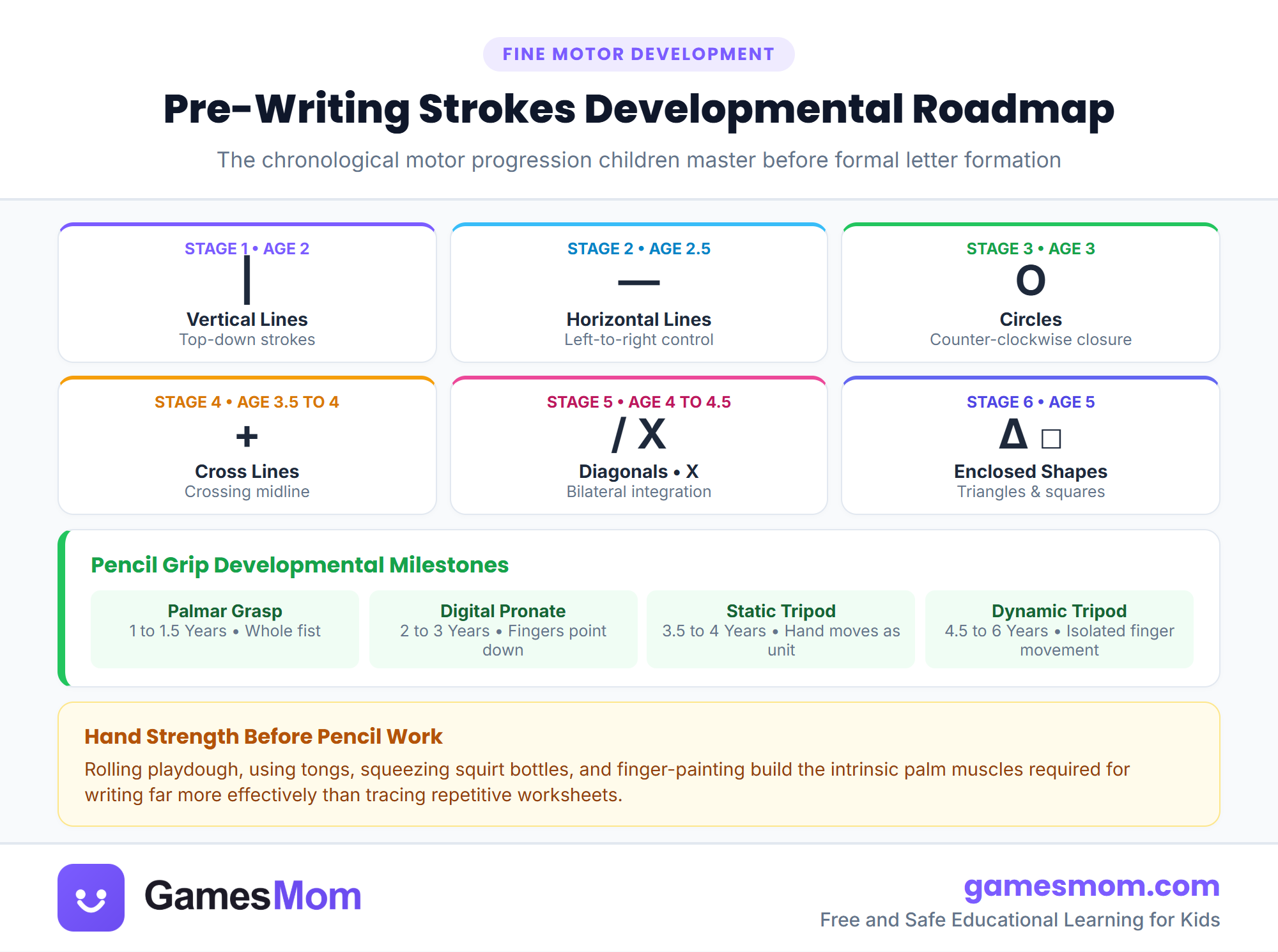
- Children must master basic pre-writing strokes before attempting formal alphabet letters.
- Vertical lines emerge around age two, followed by horizontal lines and circular motions.
- Crossing the physical midline with crosses and diagonal lines develops between ages three and five.
- Handwriting readiness requires shoulder stability, wrist extension, and a relaxed tripod grasp.
- Beery-Buktenica Developmental Test of Visual-Motor Integration (VMI)
- American Occupational Therapy Association (AOTA) Early Childhood Motor Benchmarks
Why pencil strokes precede alphabet letters
Many eager parents jump straight into teaching letter formation as soon as a toddler picks up a crayon. However, writing alphabet letters requires complex motor coordination that develops in a predictable sequence. Forcing letter tracing before the hand is developmentally ready can lead to awkward pencil grips, hand fatigue, and frustration. Discover early milestone activities in our guide to pre writing skills for preschoolers.
Every letter in the alphabet is built from nine fundamental strokes: vertical lines, horizontal lines, circles, cross shapes, right-slanted diagonals, squares, left-slanted diagonals, X shapes, and triangles. When children master these nine building blocks through joyful play, letter writing becomes a natural next step.
Gross motor stability precedes fine motor precision. Before a child can control the small muscles of their fingers, they need strong shoulders and core muscles developed through crawling, climbing, and playground swinging.
The developmental sequence of line formation
The roadmap begins around age two with spontaneous vertical marks. Toddlers move their entire arm from the shoulder to pull downward lines. Around two and a half years, horizontal strokes appear as children master left-to-right scanning and side-to-side arm movements.
By age three, circular scribbles close into distinct circles, laying the groundwork for letters like O, C, and Q. Between ages three and a half and four, children learn to combine vertical and horizontal lines into a cross (+), which marks an important neurological milestone known as crossing the midline.
Diagonals and X shapes emerge between ages four and five because they require coordinating both vertical and horizontal directions simultaneously. Try interactive tracing lines in our free letter tracing tool to reinforce these strokes playfully.
Supporting a healthy pencil grip without tears
Pencil grasp also follows a developmental progression. Toddlers begin with a fisted grasp, using their whole hand. By age three, they transition to a digital pronate grasp with fingers pointed downward. Between ages four and five, children naturally settle into a mature three-finger tripod grasp.
Avoid forcing tiny fingers into unnatural positions. Instead, offer broken crayons, short golf pencils, and chunky chalk. Short writing tools naturally force the fingers into a tripod position because there is no room for the palm to grasp the shaft.
Sensory tracing in cornmeal, finger painting on vertical easels, and squeezing play dough strengthen intrinsic hand muscles far better than repetitive paper drills.
Frequently asked questions
What age should a child start practicing pre-writing lines?
Children can begin scribbling and exploring vertical marks as early as eighteen months to two years. Structured pre-writing line practice typically begins around ages three and four.
Why are diagonal lines harder for children to draw than straight lines?
Diagonal lines require visual-motor integration across both horizontal and vertical axes, as well as crossing the body midline, which matures later in neural development.
How does letter tracing on a screen help with physical handwriting?
Interactive digital tracing teaches correct stroke direction and start-at-the-top habits, which helps prevent bad handwriting habits like forming letters from the bottom up.