
Phonemic Awareness Milestones for Early Readers Guide
Track the four essential auditory stages of phonemic awareness from rhyming and syllable clapping to phoneme manipulation.
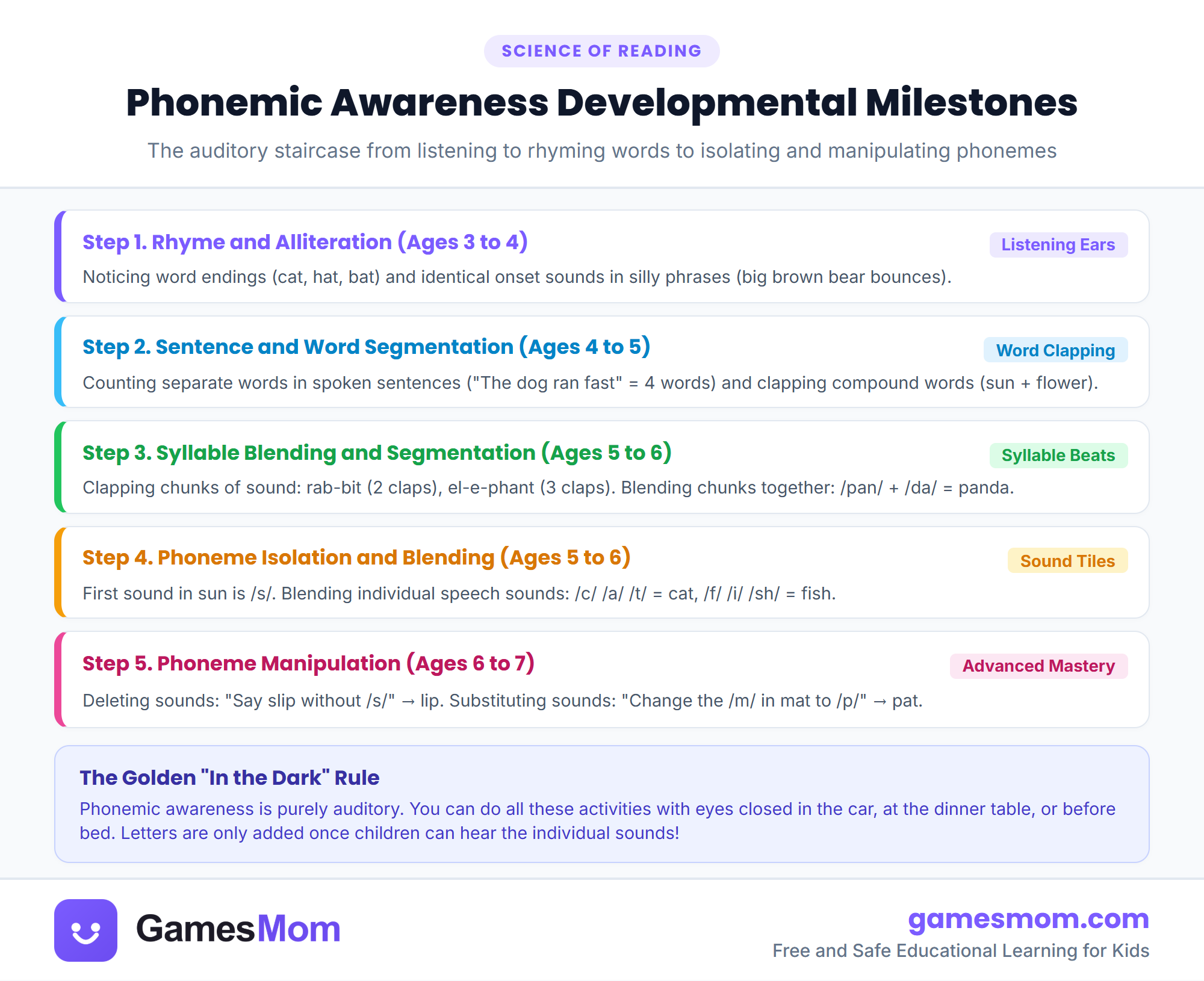
- Phonemic awareness is purely auditory and focuses on spoken sounds rather than printed letters.
- Rhyming and alliteration build early sound sensitivity in preschool children.
- Syllable clapping teaches children that spoken words consist of rhythmic chunks.
- Phoneme blending and segmenting are the direct mechanical precursors to decoding text.
- National Reading Panel Report on Phonemic Awareness Instruction
- Ehri Phases of Word Learning and Grapheme-Phoneme Connections
- Adams Beginning to Read: Thinking and Learning About Print
The auditory foundation of all future reading
Before a child ever looks at printed letters, reading begins in the ear. Phonemic awareness is the ability to hear, identify, and manipulate individual sounds in spoken words. Research synthesized by the National Reading Panel confirms that preschool auditory sensitivity is the single strongest predictor of reading success in first and second grade. Review early rhyme benefits in our article on the benefits of nursery rhymes for kids.
Parents often confuse phonics with phonemic awareness. Phonics involves the relationship between printed letters and sounds. Phonemic awareness, by contrast, can be practiced completely in the dark. It deals purely with the sounds that come out of our mouths.
When a child understands that the spoken word cat consists of three separate sounds, they are ready to attach those sounds to the printed letters C, A, and T.
The four sequential milestones of sound awareness
The progression starts with rhyme and alliteration between ages three and four. Children notice that hat and bat end with the same sound, and that Peter Piper features repeated initial sounds. Singing playful poems and traditional rhymes tunes the ear to language patterns.
Next comes sentence and word segmenting. Children learn that a spoken sentence is not one continuous sound, but a chain of distinct words. Practicing hopping or clapping for each word in a sentence builds this concept.
By age four and five, children master syllable clapping. Breaking elephant into three claps helps them navigate longer spoken words. Finally, phoneme isolation and manipulation emerge, where a child can tell you that the first sound in dog is /d/. Explore our auditory learning tools in the phonics sounds guide.
Simple ways to practice sound games at home
You do not need flashcards or worksheets to build phonemic awareness. Turn everyday routines into sound hunts. While driving, play the I Spy sound game: I spy something that begins with the sound /m/.
Practice robot talk at dinnertime by breaking words into sounds: please pass the /f/ /o/ /r/ /k/. Have your child blend the sounds together to guess the secret word. This playful exercise directly trains the blending skill needed for decoding.
Celebrate approximations and keep games short and positive. Just three to five minutes of sound play each day builds the neural pathways required for confident reading.
Frequently asked questions
What is the difference between phonological awareness and phonemic awareness?
Phonological awareness is the broad umbrella covering rhymes, syllables, and words. Phonemic awareness is the specific, narrow skill of isolating and manipulating individual speech sounds (phonemes).
How can I tell if my four year old has good phonemic awareness?
A four year old with good awareness can recognize rhymes (identifying that cat and bat rhyme), clap out the syllables in their name, and tell you the first sound in simple words like sun.
Can digital games help develop phonemic awareness?
Yes, interactive games with clean audio pronunciation and spoken prompts help children hear distinct phonemes and match them to phonetic concepts.