
Number Bonds to 10 and 20 Visual Guide for Kids
Master number bonds to 10 and 20 with visual ten-frames, part-part-whole models, and inverse fact families for mental math fluency.
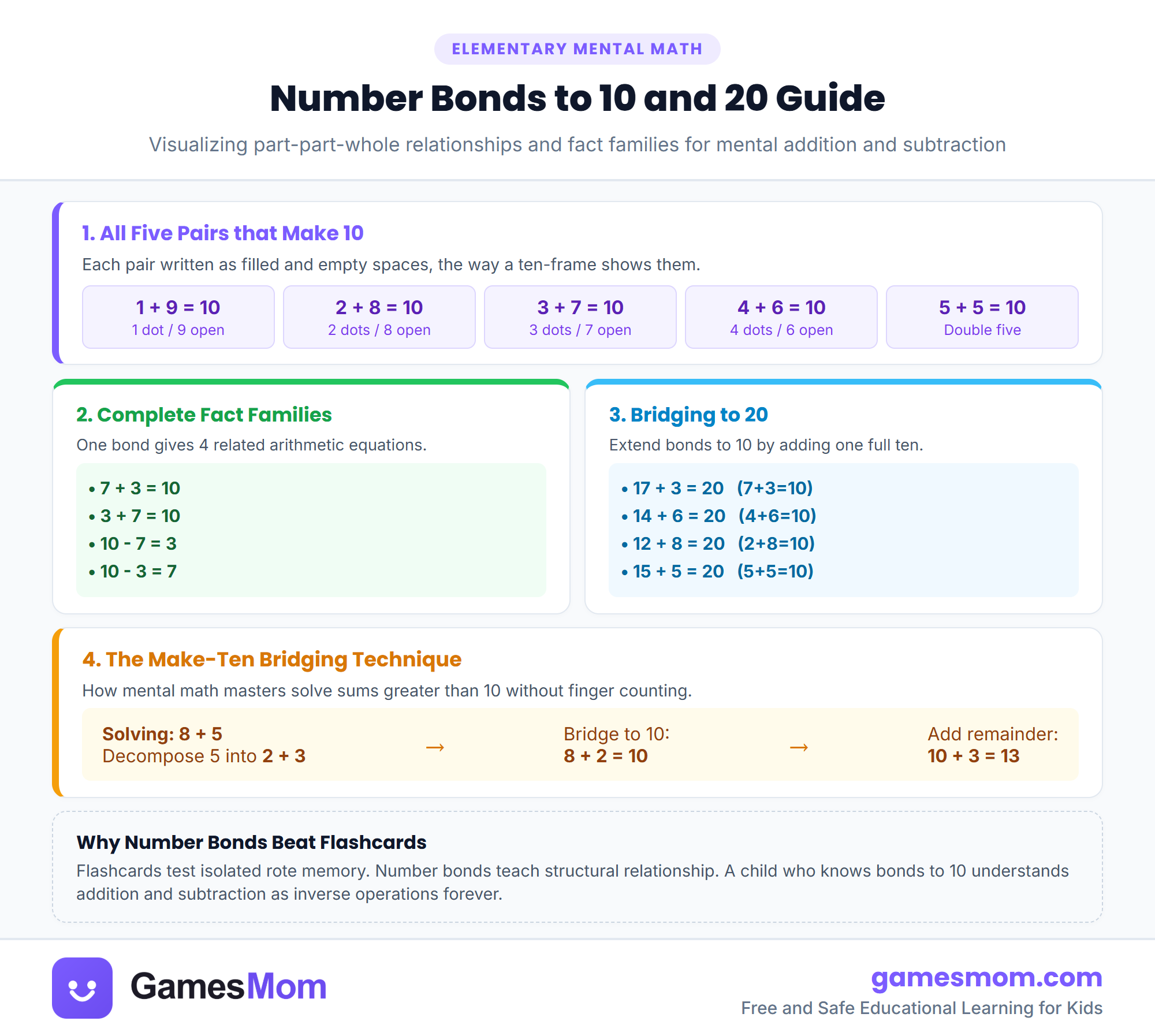
- Number bonds reveal the flexible relationship between a whole number and its parts.
- The bonds to ten form the computational backbone for all future base-ten arithmetic.
- Part-part-whole circles visually link addition and subtraction as inverse operations.
- Knowing bonds to ten makes mastering bonds to twenty effortless through place value patterns.
- Singapore Ministry of Education Primary Mathematics Syllabus
- NCTM Developing Number Concepts with Number Bonds
- Carpenter Children Mathematics: Cognitively Guided Instruction
Why number bonds replace finger counting
If you watch a child solve basic addition, finger counting is often the first strategy they employ. While fingers are wonderful concrete tools in preschool, lingering on finger counting through second grade slows calculations down. Number bonds represent the mental pairs that join to make a total. When a child internalizes bonds to ten, they look at seven and instantly recall that its partner is three. Review this in our dedicated article on what are number bonds.
The five magic pairs that make ten are one and nine, two and eight, three and seven, four and six, and five and five. Because our entire numbering system is organized into tens, these five pairs keep paying dividends across decimals, percentages, and algebraic equations.
Seeing these pairs visually on a ten-frame cements the concept. A child sees seven filled boxes and three empty boxes, locking in the fact without rote memorization.
Understanding part-part-whole diagrams and fact families
A part-part-whole diagram features one large circle representing the whole number, connected by branches to two smaller circles representing the parts. If ten sits in the top circle, four and six sit in the branches below.
This visual layout reveals that addition and subtraction are two sides of the same coin. From a single bond of ten, four, and six, children can write four related facts: four plus six is ten, six plus four is ten, ten minus four is six, and ten minus six is four. Explore related practice in our addition to 10 worksheet.
When subtraction is taught as finding a missing part rather than taking away, children stop fearing minus signs and solve word problems with confidence.
Stepping from bonds to ten to bonds to twenty
Once bonds to ten are automatic, bonds to twenty follow naturally. A child who knows that seven and three make ten can easily see that seventeen needs three to make twenty. The single-digit bond remains exactly the same; only the tens place has shifted.
This principle powers mental addition for large sums. To add thirty-seven plus three, the child simply recognizes the seven and three bond, jumping effortlessly to forty. Test recall speed with our free quick math game online.
Spend two minutes daily reviewing number bonds during breakfast or while setting the table. Consistency and playful repetition turn basic arithmetic into an instinctive habit.
Frequently asked questions
What is a number bond in elementary school math?
A number bond is a visual representation of how a whole number splits into two or more parts (such as 10 splitting into 7 and 3).
How do number bonds help with subtraction?
Number bonds show subtraction as finding the missing part. If the whole is 10 and one part is 3, the child immediately knows the remaining part is 7.
What age should children master number bonds to 10?
Most children begin exploring bonds to 10 in kindergarten and achieve automatic recall by the end of first grade.