
Multi Age Homeschooling and Teaching Siblings Together Guide
Master multi-age homeschooling with four sanity-saving strategies to teach children of different ages at the same kitchen table.
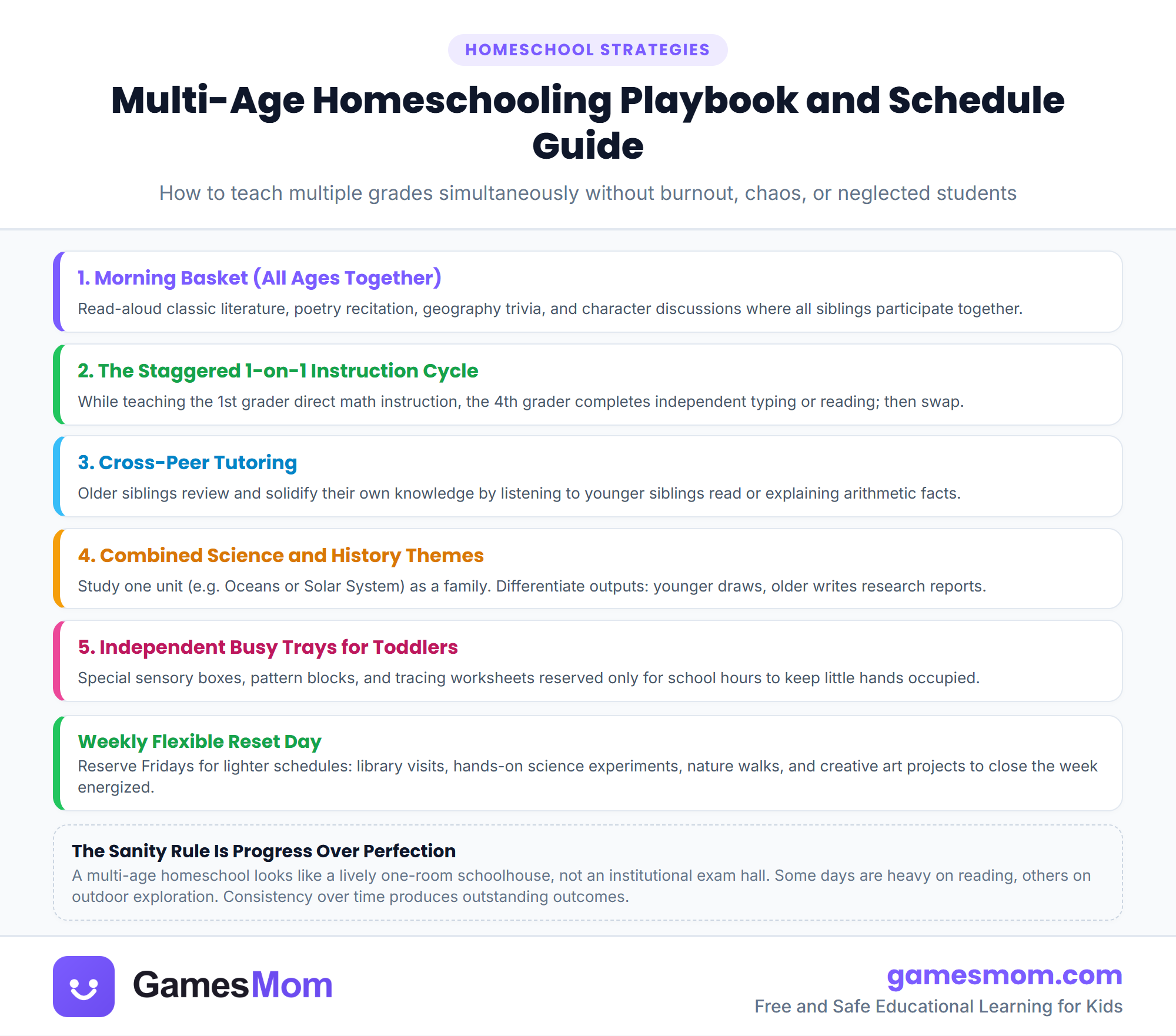
- Do not try to teach separate curriculums for every subject to every child.
- Combine family subjects like history, science, literature, and art in a Morning Basket.
- Stagger one-on-one time for skill-based subjects like math and phonics.
- Older siblings reinforce their own mastery by tutoring and reading to younger children.
- Veenman Cognitive and Noncognitive Effects of Multigrade and Multi-Age Classes: A Best-Evidence Synthesis
- Slavin Cooperative Learning: Theory, Research, and Practice
The multi-age trap and how to avoid burnout
The quickest road to homeschool burnout is attempting to run three separate mini-schools under one roof: teaching third-grade history to one child, first-grade history to another, and preschool social studies to a toddler. A parent cannot teach multiple distinct curriculums simultaneously without collapsing from exhaustion. The secret to joyful multi-age homeschooling is combining subjects wherever possible. Discover social and family balance in homeschool socialization tips.
In traditional one-room schoolhouses, children of all ages learned side by side. Younger students absorbed advanced concepts by listening, while older students solidified their understanding through mentorship.
By dividing your subjects into content subjects (which can be combined) and skill subjects (which require individual attention), family learning becomes manageable and fun.
The four core multi-age strategies
Strategy 1 is the Morning Basket. Gather all your children together on the couch for thirty to forty-five minutes. Read aloud from rich literature, study a historical event, or explore nature study. The kindergartner listens and draws a picture, while the fifth grader writes an in-depth summary paragraph.
Strategy 2 is staggered one-on-one instruction. Math and phonics are skill subjects that require individual pacing. While you spend twenty minutes teaching phonics to the six-year-old, give the ten-year-old independent reading or puzzle practice. Then switch attention to teach fifth-grade fractions.
Strategy 3 is peer teaching. Having an older child listen to a younger sibling read sight word flashcards reinforces patience and pride for both. Check our free sight words flashcards.
Strategy 4 is independent sensory activity bins. Keep rotating tubs of play dough, magnetic tiles, and printable coloring sheets ready for active toddlers while older kids complete quiet math.
Creating quiet learning stations for independent work
Equip your kitchen table with clear visual station boxes. When an older student finishes their math lesson, they know exactly which independent task comes next: ten minutes of typing practice or a logic puzzle.
Digital learning stations provide a wonderful buffer. While you help a child through a challenging writing revision, another child can practice mental addition on our ad clean math games for kids.
Celebrate the unique sibling bonds that multi-age homeschooling fosters. Learning together teaches children empathy, patience, and mutual respect.
Frequently asked questions
Which homeschool subjects should be taught together to siblings?
Content subjects like history, literature read-alouds, science topics, geography, and art appreciation can easily be taught together to children of multiple ages.
Which homeschool subjects require separate one-on-one teaching?
Skill-based subjects like math (number bonds, multiplication) and language mechanics (phonics, spelling, early reading) must be taught at each child individual developmental level.
How do you keep toddlers quiet while teaching older kids?
Keep special toddler-only sensory bins (kinetic sand, water play, large blocks) that are brought out exclusively during older sibling school hours.