
The Ideal Homeschool Daily Rhythm by Age Guide
Discover realistic homeschool daily schedules and rhythms from preschool to sixth grade, balancing academics with play and rest.
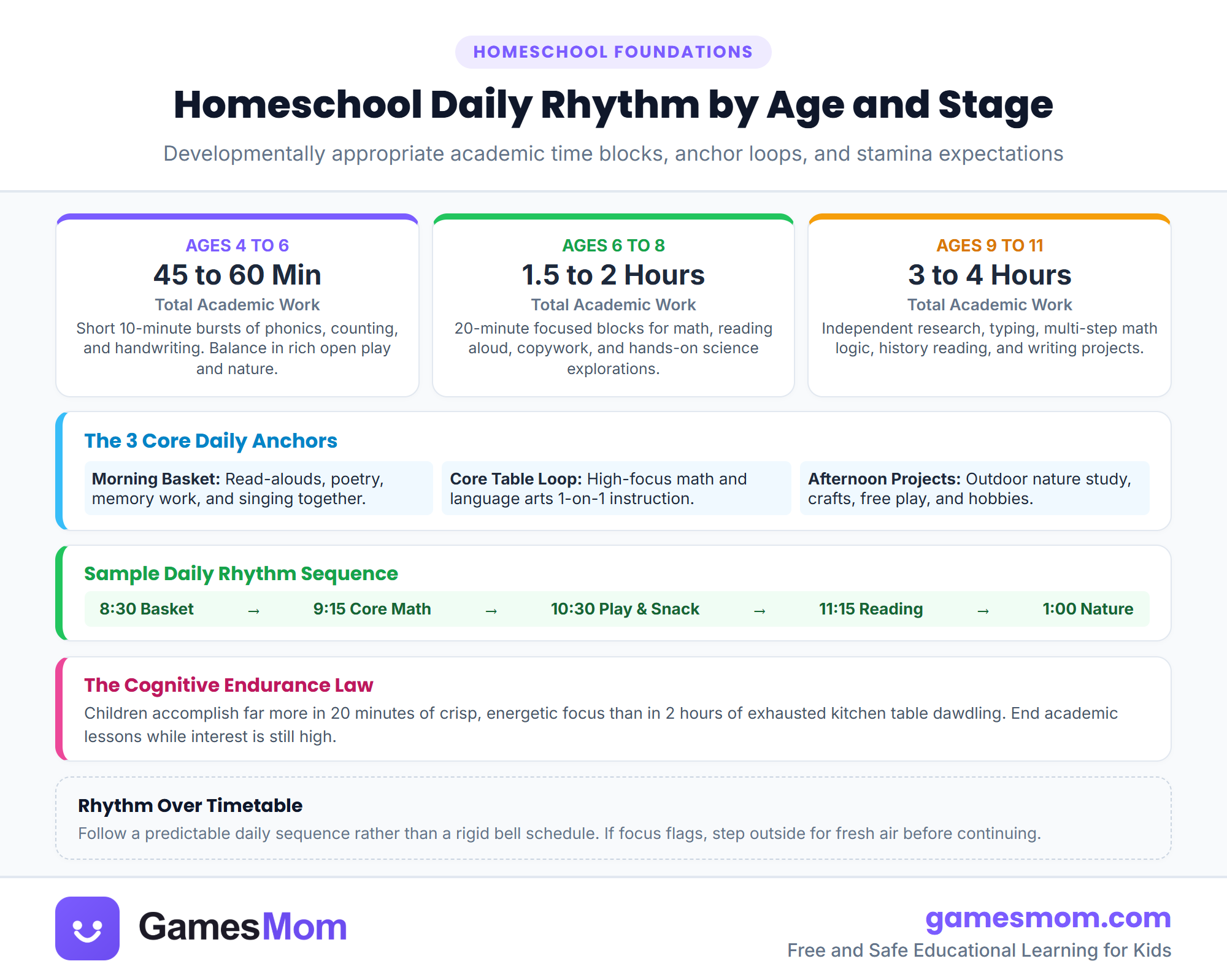
- Homeschooling does not need to duplicate the seven-hour public school day.
- Preschoolers need only one to one and a half hours of guided exploratory learning.
- Elementary students accomplish deep learning in two to three focused hours.
- Loop scheduling prevents subject guilt and accommodates real-world family life.
- Charlotte Mason Educational Philosophy on Short Lessons and Habit Training
Why homeschooling takes far less time than traditional school
New homeschool parents often begin with a rigid schedule: seven hours of study planned from 8:00 AM to 3:00 PM, mimicking a public school classroom. Within three weeks, both parent and children feel exhausted and discouraged. What parents quickly discover is that in a traditional classroom, hours are spent on attendance, lineup transitions, hallway walking, and classroom management. Read our comprehensive schedule in homeschool daily schedule.
With one-on-one attention, a homeschool child accomplishes in two hours what requires an entire school day in a classroom of twenty-five students.
Shifting from a rigid clock schedule to a predictable daily rhythm creates a calm, sustainable home environment where learning feels natural.
Developmental time blocks by age group
For preschool and kindergarten (ages three to five), formal instruction should last no more than one to one and a half hours total per day. Break this into fifteen-minute blocks: a picture book read-aloud, five minutes of letter tracing, hands-on counting with toy bears, and a rhyming song. The remaining ninety percent of the day belongs to outdoor play, sensory bins, and building.
For early elementary (ages six to eight / grades one to three), two to three hours of structured learning is optimal. Anchor the morning with reading, handwriting, and mental math. Keep afternoons free for nature walks, art, and educational games. Explore our free math games for kids.
For upper elementary (ages nine to twelve / grades four to six), three and a half to four and a half hours accommodates independent novel reading, science experiments, history research, and touch typing practice.
The freedom of loop scheduling
When life brings a dentist appointment, a fussy toddler, or a lovely sunny day, rigid block schedules fall apart. Loop scheduling offers an elegant alternative. Instead of assigning subjects to specific days of the week, write your non-daily subjects (history, science, geography, art) on a rotating list.
Whenever you have study time, simply pick up where you left off on the loop. If a Tuesday morning is interrupted, you do not fall behind; you simply complete the next subject on Wednesday. This eliminates guilt and keeps family learning steady.
Frequently asked questions
How many hours a day should a kindergartner homeschool?
A kindergartner needs only one to one and a half hours of guided academic learning per day, broken into short ten to fifteen minute blocks.
What is a loop schedule in homeschooling?
A loop schedule is a rotating list of subjects. Instead of doing science only on Tuesdays, you work through the list in order, resuming wherever you left off whenever time permits.
Can digital learning games count toward homeschool hours?
Yes, purposeful digital games that teach mental math, touch typing, phonics, and geography provide valuable active learning hours.