
The Healthy Homework and Rest Rhythm for Kids Guide
Learn the 10-minute homework rule, healthy afternoon timelines, and how to eliminate evening schoolwork battles for elementary kids.
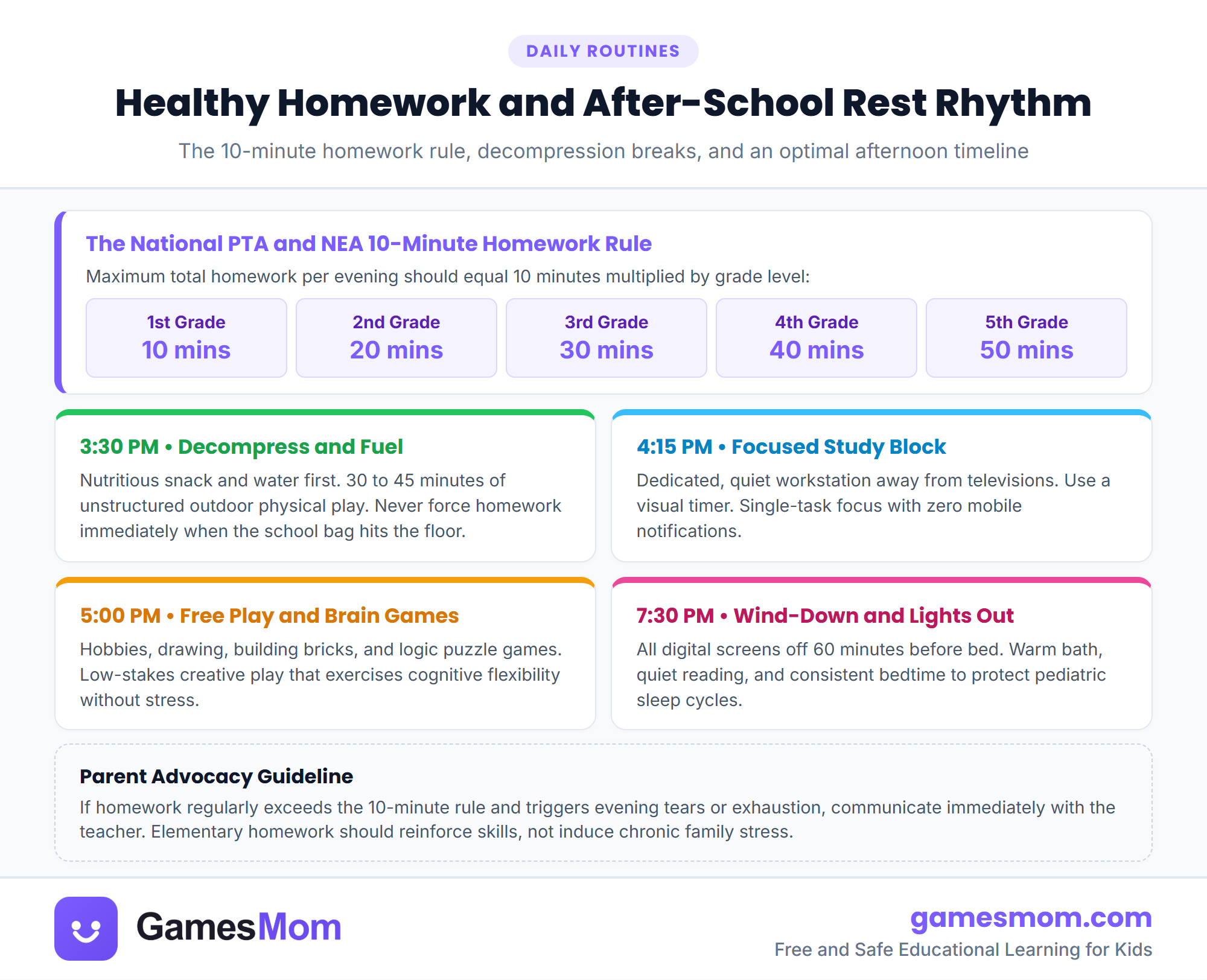
- The research-backed rule recommends 10 minutes of homework per grade level per night.
- Children need 30 minutes of unstructured physical movement and a snack before tackling study.
- Active brain games provide healthy mental downtime between academic tasks and bedtime.
- Screen-free wind-down routines an hour before sleep improve memory consolidation and rest.
- National PTA and NEA Ten-Minute Homework Rule Guidelines
- Cooper The Battle Over Homework: An Evidence-Based Perspective
- American Academy of Pediatrics Recommendations on Unstructured Physical Play
The evidence-based ten minute homework rule
Evening homework battles are one of the most common sources of family stress. Parents watch their children dissolve into tears over worksheets, wondering if the struggle is truly necessary. Educational research led by the National PTA and the National Education Association supports the ten-minute rule: children should have no more than ten minutes of total homework per night per grade level. Learn daily scheduling tips in our homeschool daily schedule guide.
Under this guideline, a first grader should spend ten minutes on homework, a third grader thirty minutes, and a fifth grader fifty minutes. Research shows that homework exceeding these limits does not improve elementary academic achievement, but does increase childhood stress and family friction.
If your child consistently spends twice as long on assignments, reach out to their teacher. Excessive homework usually signals a breakdown in communication or a need for academic adjustments.
The balanced four-part afternoon timeline
Children spend seven hours in structured school environments following directions and sitting still. Demanding that they sit down immediately upon arriving home triggers resistance. A healthy afternoon routine begins with thirty minutes of unwinding: a nutritious snack, physical outdoor movement, and unscripted conversation.
Part two is the focused study block. Set up a well-lit, distraction-free table away from televisions and mobile phones. Encourage your child to tackle the most demanding subject first while their energy is fresh.
Part three introduces active play. Puzzles, building blocks, and creative strategy games allow children to recharge cognitively. Explore our curated favorites in educational games for kids to see how low-pressure games support intellectual curiosity.
Protecting sleep and the bedtime wind down
The final block of the evening is the bedtime wind down. At least sixty minutes before lights out, turn off all tablets, televisions, and gaming screens. Blue light emitted by screens suppresses melatonin production, delaying natural sleep cycles.
Replace screens with calming routines: a warm bath, physical book read-alouds, or quiet drawing. Sleep is when the brain consolidates memories, filings away facts learned during the day.
Consistent evening rhythms reduce bedtime resistance, ensuring children wake up refreshed, alert, and ready for another day of classroom learning.
Frequently asked questions
What is the 10-minute homework rule?
The 10-minute homework rule recommends that students receive 10 minutes of homework per night multiplied by their grade level (e.g., 20 minutes for 2nd grade, 50 minutes for 5th grade).
What should I do if homework takes my child hours every night?
Speak with your child teacher. Homework in elementary school is meant for brief practice, not long labor. Teachers can often reduce worksheet length or clarify instructions.
Why is physical play important before starting homework?
Physical activity oxygenates the brain, releases accumulated stress, and resets dopamine and cortisol levels, making children significantly more focused when they sit down to study.