
Formative Assessment Through Playful Learning Guide
Low-stakes digital checks and playful games that show you what a student understands, without the test anxiety of a formal quiz. See the guide.
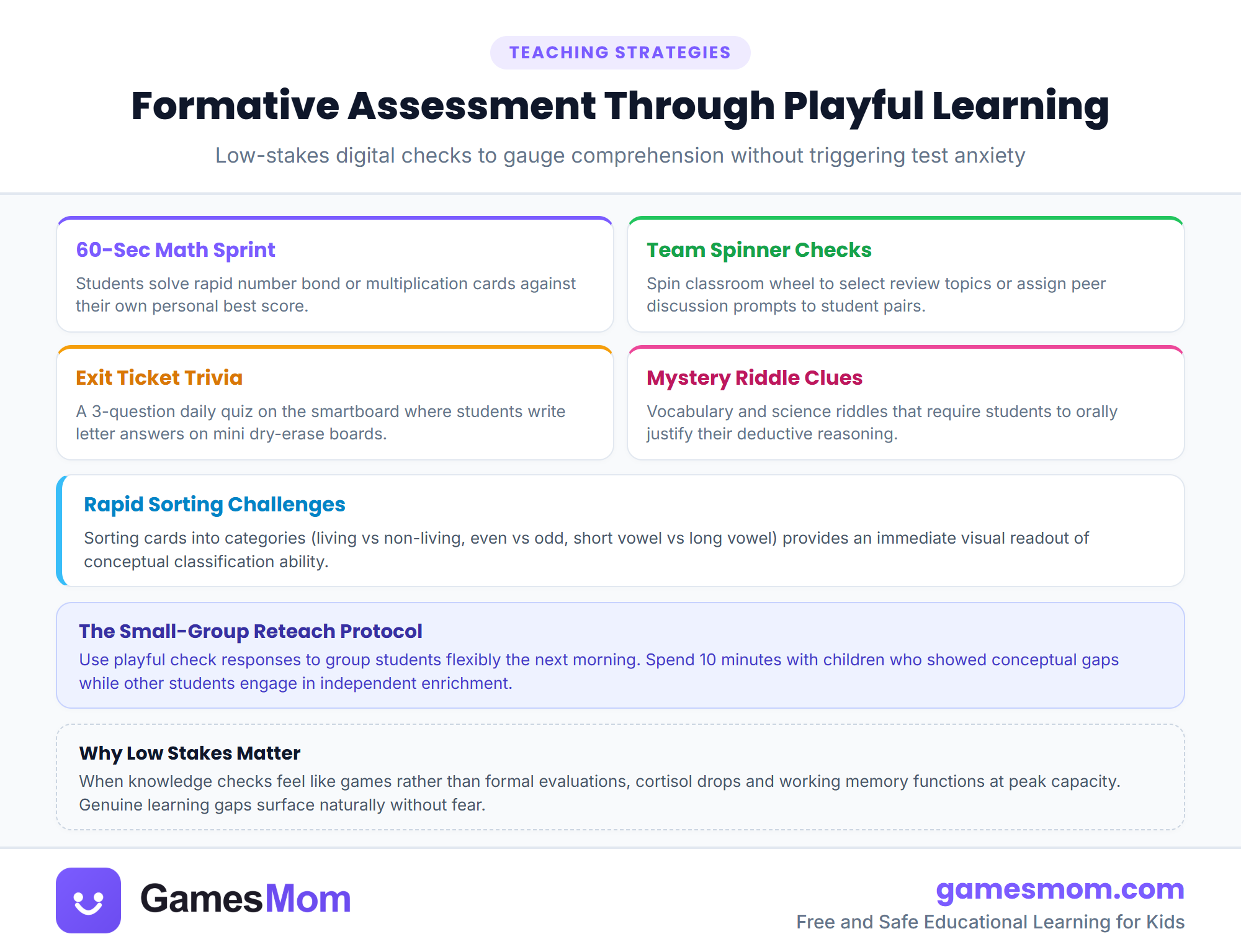
- Traditional tests trigger cortisol spikes that impair working memory and recall.
- Playful formative checks provide real-time diagnostic data to adjust lesson plans.
- Sixty-second math sprints track personal improvement rather than peer competition.
- Classroom spinners and team trivia encourage 100% active student participation.
- Black and Wiliam Inside the Black Box: Raising Standards Through Classroom Assessment
- Hattie Visible Learning: A Synthesis of Over 800 Meta-Analyses Relating to Achievement
Why low stakes checks beat formal pop quizzes
The goal of formative assessment is not to assign a final grade, but to inform instruction. When teachers announce a quiz, students frequently experience stress that restricts working memory. In anxious states, students make careless errors that do not reflect their true conceptual understanding. Discover low-stress classroom activities in classroom game ideas for teachers.
Playful assessment removes the threat of public failure. When knowledge checks feel like games, children engage enthusiastically, and teachers gain an honest snapshot of which concepts need reteaching.
Formative checks must be immediate. Discovering student confusion during an end-of-unit exam is too late; catching it during a playful five-minute check allows immediate correction.
Four engaging classroom assessment games
Game 1 is the sixty-second math sprint. Rather than competing against peers, students solve number bond or times table cards against their personal best score from yesterday. Tracking personal growth motivates students without shame.
Game 2 uses classroom wheel spinners. Put review questions or student names on our digital spin the wheel tool. The anticipation of the spin keeps all eyes glued to the board.
Game 3 is exit ticket trivia. Project a three-question quiz on the smartboard at the end of class. Students write A, B, C, or D on small whiteboards and hold them up simultaneously for an instant visual check of room comprehension.
Game 4 is the mystery clue riddle. Give three conceptual clues: I am an even number, I am greater than twenty, and I am a multiple of six. Students deduce the number on scratch paper.
Using assessment data to guide next steps
When an exit ticket reveals that half the class missed question two, do not move forward to the next textbook chapter. Use the next morning warm-up to revisit the concept with concrete manipulatives or visual models.
Group students flexibly based on game results. Form a quick five-minute small group at your table for students who stumbled, while confident students tackle an extension logic challenge.
Make self-assessment routine. Ask students to show a thumbs-up (I can teach this to a friend), thumbs-sideways (I mostly get it), or thumbs-down (I need a hand) to build metacognitive honesty.
Frequently asked questions
What is the main difference between formative and summative assessment?
Formative assessment happens during learning to guide instruction and catch confusion early. Summative assessment happens at the end of a unit to evaluate cumulative mastery.
How do you assess students who are shy about raising their hands?
Use simultaneous response techniques like mini whiteboards, digital multiple-choice polls, or thumbs-up signals where all students respond at the same time.
Can digital trivia quizzes be saved or printed for gradebooks?
GamesMom quizzes provide instant scores and explanations on screen, making them ideal for quick self-assessment and exit ticket checks.