
The Family Screen Time and Gaming Agreement Guide
Establish clear, healthy digital boundaries with four household rules that prevent gaming battles and protect childhood sleep.
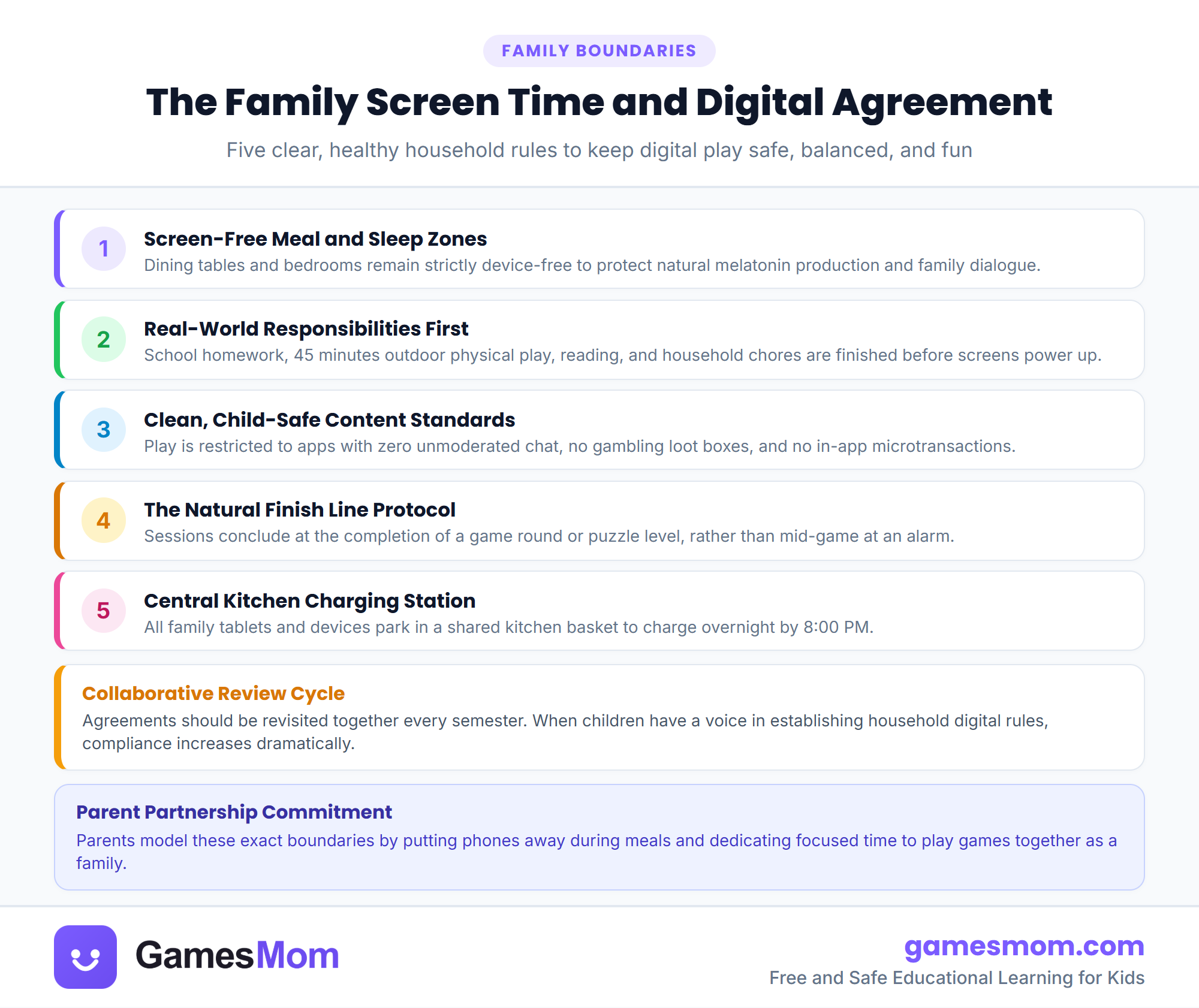
- Clear, collaborative family screen agreements prevent daily arguments and power struggles.
- Physical zones: keep bedrooms and dining tables completely screen-free.
- Require outdoor movement, chores, and schoolwork before digital entertainment begins.
- End gaming sessions at natural level conclusions rather than mid-game alarm bells.
- American Academy of Pediatrics Family Media Plan Guidelines
- Twenge Increases in Depressive Symptoms and Media Use Among Adolescents
- World Health Organization Guidelines on Physical Activity, Sedentary Behaviour and Sleep
Why proactive agreements beat reactive punishments
In many households, screen time discussions happen in the heat of battle: a parent shouting that time is up while an upset child begs for five more minutes. When rules are made impulsively, children view them as arbitrary punishments. A family screen agreement flips this dynamic by establishing transparent, shared expectations during a calm family meeting. Learn practical boundary advice in screen time games that teach.
When children participate in setting rules, they are far more likely to respect them. Walk through the reasons behind boundaries: our bodies need sleep to grow, our eyes need daylight, and our family values face-to-face conversation.
An effective contract is not a list of restrictions; it is a healthy framework that protects time for play, physical activity, and deep family connection.
The four non-negotiable household boundaries
Rule 1 establishes screen-free zones. Dining tables and bedrooms must remain sacred. Keeping tablets and phones out of bedrooms overnight eliminates late-night scrolling and ensures restful sleep.
Rule 2 prioritizes real-world responsibilities first. Homework, outdoor physical play, and daily family chores must be completed before gaming devices are powered on. This simple order establishes healthy work-play balance.
Rule 3 insists on clean, child-safe digital spaces. Agree that kids will only play games free from unmonitored chat rooms, predatory microtransactions, and gambling-style loot boxes. Check out our ad clean brain games for kids as a trusted standard.
Rule 4 institutes the natural finish line habit. Agree that sessions end after this round, after this puzzle, rather than mid-game at an alarm chime, which eliminates sudden frustration.
Modeling healthy digital habits as caregivers
Children learn far more from what parents do than what parents say. If caregivers scroll through social media at the dinner table or glance at phones while children speak, kids notice the double standard immediately.
Establish adult screen-free hours in the evening where parents put phones away to read books, play board games, or cook together. Demonstrating intentional media balance models the self-regulation we expect from our kids.
Review the agreement every six months. As children grow and demonstrate responsibility, adjust boundaries to foster ongoing independence and mutual trust.
Frequently asked questions
What is the natural finish line rule in screen time?
The natural finish line rule means agreeing that play stops when the current game board or puzzle round concludes, rather than interrupting a child in the middle of a level with an alarm.
Why should bedrooms be completely screen-free at night?
Screens in bedrooms suppress melatonin production, delay sleep onset by over an hour, and expose children to unmonitored late-night media.
How do I handle meltdowns when turning off video games?
Give a five-minute warning tied to the current round, acknowledge their feelings calmly, and transition immediately into a physical activity like snack time or outdoor play.