
Executive Function Skills in Kids and How Games Build Brains
Learn how game-based problem solving strengthens working memory, impulse control, cognitive flexibility, and spatial reasoning in kids.
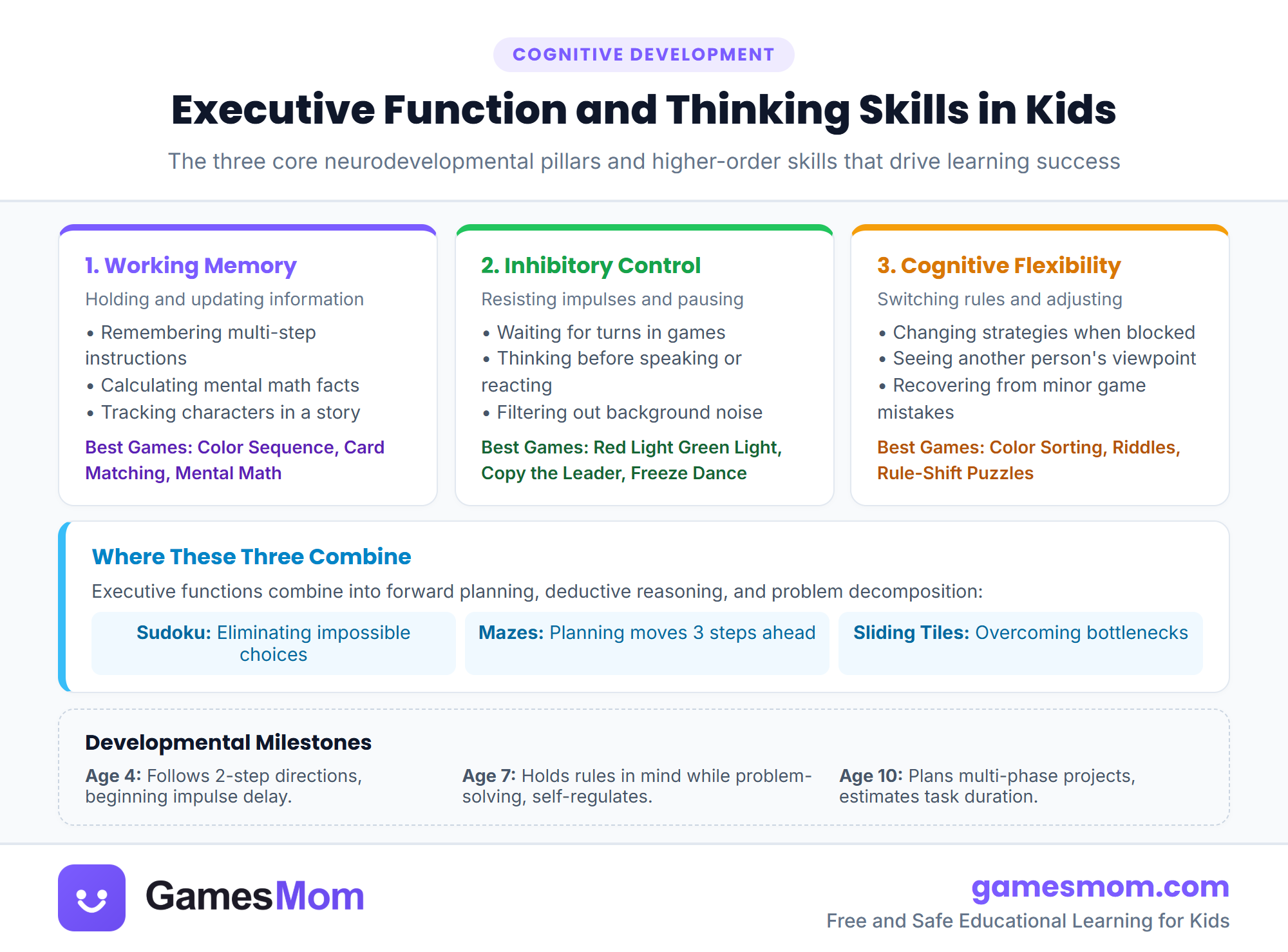
- Executive function operates as the biological air traffic control system of the brain.
- Working memory, impulse control, and cognitive flexibility are learned habits built through play.
- Low stakes digital puzzles allow children to fail safely and learn emotional recovery.
- Spatial reasoning developed through sorting and puzzle games correlates strongly with future STEM achievement.
- Harvard University Center on the Developing Child Executive Function Framework
- Diamond, A. (2013). Executive functions. Annual Review of Psychology, 64, 135-168.
The air traffic control system of the developing brain
Executive function is the suite of cognitive processes that enables us to plan, focus attention, remember instructions, and balance multiple tasks. The Center on the Developing Child at Harvard University describes executive function as the biological air traffic control system of the mind. Children are not born with these skills fully formed; rather, they are born with the potential to develop them through guided practice.
Games provide one of the most effective sandboxes for strengthening executive circuits. In a well designed game, the rules are clear, the feedback is instant, and the consequences of failure are low stakes. This environment lets children experiment with strategies without fear of grades or criticism. Explore our curated favorites in top kids brain games.
When children play puzzles regularly, they build the neural connections required to manage emotions, resist distractions, and persist through complex tasks in school.
Strengthening working memory and impulse control
Working memory allows a child to hold information in mind while actively manipulating it. When playing a memory card matching game or solving a multi-digit arithmetic puzzle, the child constantly updates their mental slate. This directly supports reading comprehension, where readers must hold early sentences in mind while parsing the rest of the paragraph.
Inhibitory control, commonly known as impulse control, is the capacity to pause before acting. In games that test reaction speed, such as waiting for a traffic light to turn green, the child must suppress their instinctive urge to click early. Practice this directly with our free hand eye coordination games.
By practicing patience in a playful digital setting, children learn to pause, evaluate alternatives, and make deliberate choices rather than acting on first impulses.
Developing cognitive flexibility and spatial logic
Cognitive flexibility is the ability to shift gears and adapt when plans fall through. In classic strategy games like Sudoku or sliding tile puzzles, a path that looked promising often becomes blocked. A child with strong cognitive flexibility steps back, re-evaluates the board, and tries another angle without throwing a tantrum. Read our teaching tips in teaching kids sudoku online.
Spatial reasoning involves mentally manipulating two and three-dimensional shapes. Sorting colored liquids into test tubes, fitting puzzle pieces into a grid, or solving geometry tangrams trains the parietal lobes to visualize transformations.
Research confirms that early spatial reasoning ability strongly predicts future success in science, technology, engineering, and mathematics. Playful problem solving builds lifelong intellectual curiosity and academic confidence.
Frequently asked questions
What are the three core components of executive function?
The three core components are working memory (holding and updating information), inhibitory control (resisting impulsive actions and filtering distractions), and cognitive flexibility (adapting strategies when rules or conditions change).
Can digital games improve executive function in children?
Yes, when they are purposeful logic and strategy games. Games that require planning, memory recall, and spatial reasoning strengthen executive circuits, unlike passive video watching or ad-heavy casual games.
At what age does executive function develop most rapidly?
Executive function skills undergo rapid bursts of development between ages three and five, and again during early adolescence between ages nine and twelve.