
The 80/20 Hands-On to Digital Learning Ratio Guide
Learn how to balance eighty percent physical books and manipulatives with twenty percent purposeful digital practice for optimal retention.
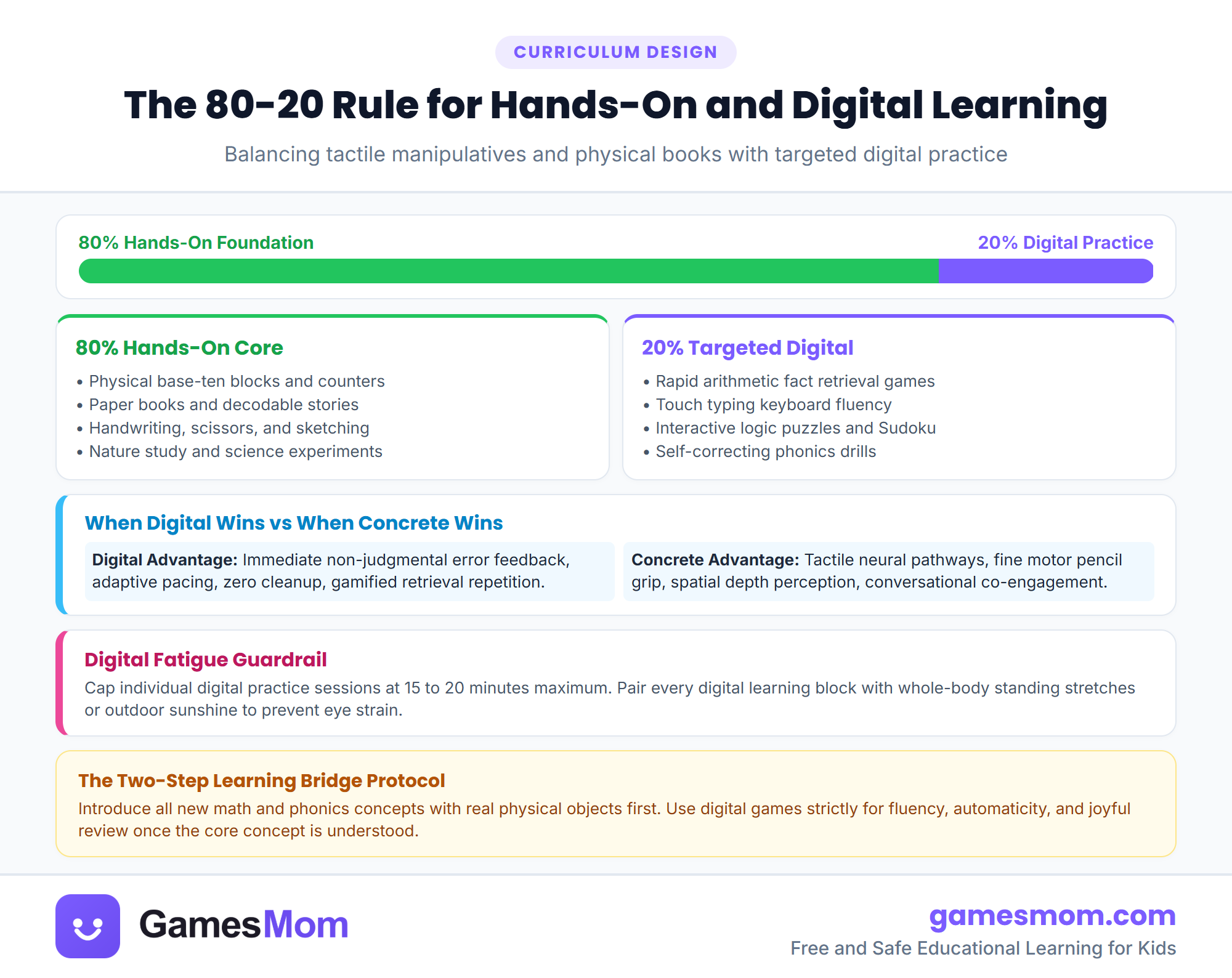
- Children retain deep narrative comprehension significantly better from physical print books.
- Handwriting physically encodes letter shapes and vocabulary in motor memory circuits.
- Digital tools excel at rapid retrieval practice, automated feedback, and spatial puzzles.
- An 80/20 ratio prevents screen fatigue while harnessing digital efficiency.
- Delgado et al. Reading on Paper and Screens: A Meta-Analysis
- James and Engelhardt The Effects of Handwriting on Functional Brain Development
Why physical books and pencil work remain irreplaceable
In an era of tablets and digital curriculums, it is tempting to migrate an entire homeschool or classroom program onto screens. However, cognitive neuroscience has repeatedly demonstrated that the medium matters. When children read long texts on screens, they tend to skim, read faster, and retain less nuanced comprehension than when reading physical paper books. Review our educational philosophy in gamified learning guide.
Similarly, the physical act of forming letters with a pencil on paper activates motor cortex pathways that keyboarding does not. The friction of graphite against paper creates tactile feedback that reinforces spelling and letter recognition.
Physical math manipulatives like wooden counting blocks and fractional tiles provide the concrete experiences necessary before abstract mathematical thought can blossom.
The specific superpower of the twenty percent digital block
If eighty percent of the day belongs to physical books, discussions, and handwriting, what is the role of the twenty percent digital block? Digital tools are accelerators for retrieval fluency, automated testing, and spatial simulation.
A computer excels at rapid math fact recall. In our free quick math game online, a child gets twenty calculation opportunities in sixty seconds with instant feedback, something impossible to replicate on a static paper worksheet.
Digital typing practice, interactive geography maps, and spatial puzzle games provide dynamic simulations that enhance conceptual understanding without replacing physical books.
Implementing the 80/20 balance in your daily routine
Structure your morning around the eighty percent block: read aloud from literature, complete handwriting and math notebooks, and conduct hands-on science demonstrations at the kitchen table.
Save the twenty percent digital block for late morning or early afternoon. Use this time for twenty minutes of touch typing, math fact retrieval, or a child-safe general knowledge quiz. Browse our ad clean quizzes for kids.
This intentional rhythm prevents screen fatigue, keeps family connection at the center of education, and equips children with modern digital fluency.
Frequently asked questions
Why is reading physical books better for comprehension than reading on tablets?
Physical books provide spatial anchors (page turning, physical thickness, tactile layout) that help the brain create mental maps of text, leading to deeper comprehension.
What subjects are best suited for the 20% digital learning block?
Rapid math fact retrieval (addition bonds, multiplication), touch typing practice, interactive geography quizzes, and logic puzzles like Sudoku.
How do you prevent children from demanding screens during the 80% physical block?
Keep devices stored out of sight in a drawer until the scheduled digital block, and establish clear routines so children know screen practice follows completed bookwork.