
Early Number Sense and Subitizing to Ten Frames Guide
Learn how instant dot recognition, five-frames and ten-frames build early number sense before formal addition and subtraction begins. See the guide.
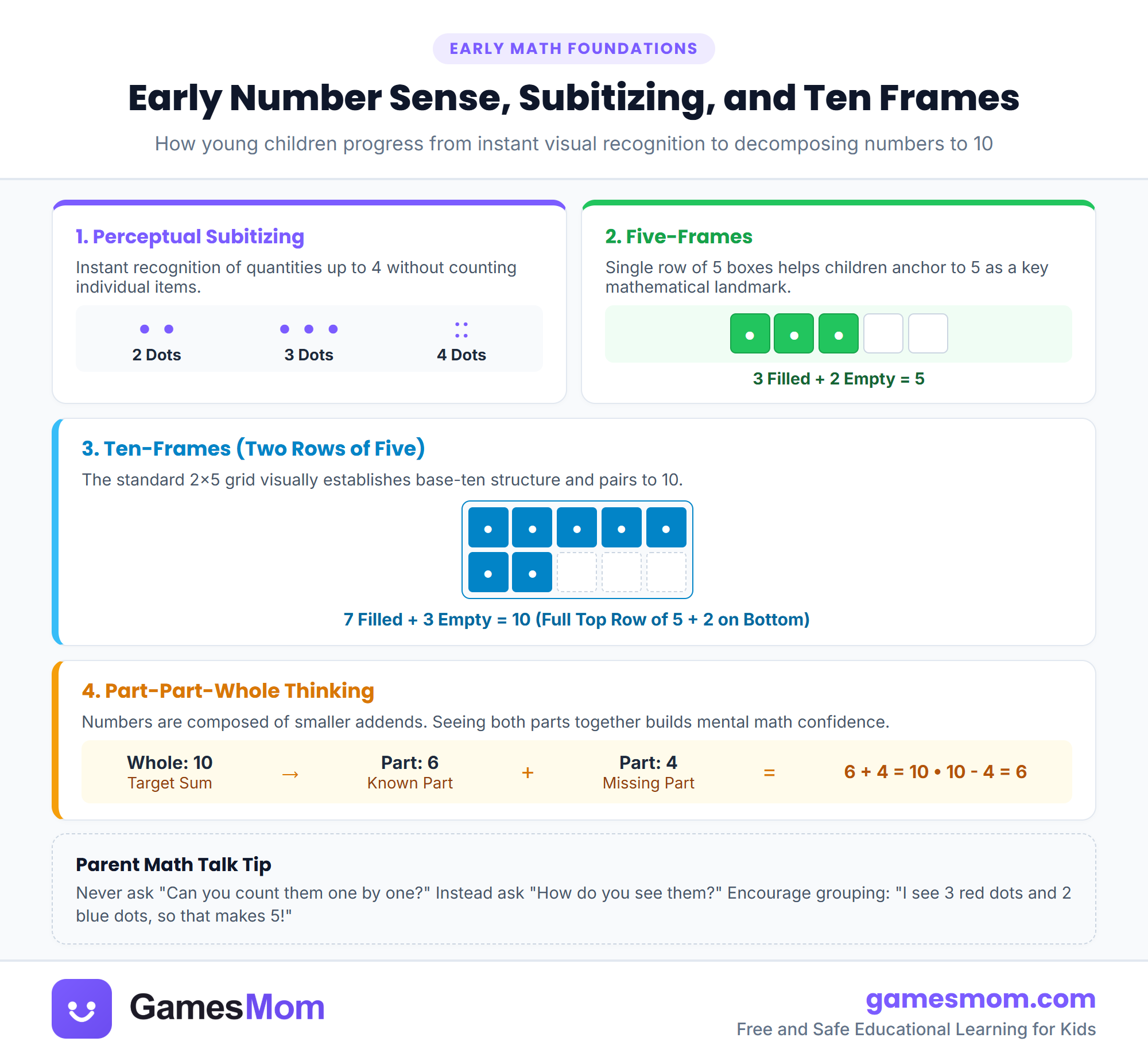
- Subitizing is the foundational superpower of seeing quantities without counting one by one.
- Perceptual subitizing allows toddlers to instantly recognize up to four objects.
- Conceptual subitizing allows older kids to see six as two groups of three.
- Ten-frames anchor arithmetic in the base-ten system, preventing finger-counting dependency.
- Clements Subitizing: What Is It? Why Teach It? Teaching Children Mathematics
- Baroody The Developmental Bases for Early Number and Operation Sense
- NCTM Developing Essential Understanding of Number and Numeration
Why counting by ones can become a math roadblock
When toddlers learn to count, parents are delighted to hear them recite one, two, three, four, five. However, counting by rote memory does not necessarily mean the child understands quantity. Many young children count objects like reciting lyrics to a song, pointing randomly without matching words to items. Discover foundational math principles in our guide to math games for kids.
Subitizing, from the Latin word for sudden, is the ability to instantly perceive the quantity of a small group without counting. When you roll a die and see four dots, you do not count one, two, three, four. You see the pattern of four immediately.
Developing strong subitizing skills before introducing formal addition ensures that children see numbers as collections and groups rather than abstract points on a counting line.
Moving from five frames to ten frames
A five-frame is a simple five-box grid that introduces one-to-one correspondence. Placing physical counters into a five-frame helps children see the landmark of five. They realize that three counters leave two empty spaces, building early part-part-whole awareness.
A ten-frame doubles this grid into two rows of five. This visual structure is essential because our entire mathematical numbering system is base ten. When children see seven represented as a full top row of five and two on the bottom, they visualize seven as five plus two.
This visual anchoring turns addition into pattern recognition. Instead of memorizing that seven plus three equals ten, the child sees the three empty spaces on the ten-frame. Review this in our interactive number bonds game.
Quick subitizing games to play at home
Make paper plate dot cards with patterns of one to five stickers. Flash a card to your child for only two seconds, then cover it. Ask: how many did you see? Quick exposure prevents them from counting by ones and forces them to rely on subitizing.
Play board games using traditional six-sided dice. Rolling dice repeatedly reinforces standard geometric dot patterns, strengthening number visualization.
At mealtime, ask your child if they can see two cherry tomatoes on one side of their plate and three on the other. Connecting subitizing to real food turns dinner into playful math discovery.
Frequently asked questions
What is the difference between perceptual and conceptual subitizing?
Perceptual subitizing is recognizing a small quantity of one to four objects instantly. Conceptual subitizing is seeing a larger number by instantly combining smaller groups (such as seeing six as two groups of three dots).
Why are ten-frames better than standard flashcards?
Flashcards only show abstract digits like 7, requiring rote memorization. Ten-frames provide a concrete spatial representation, showing 7 as five plus two with three empty spots to make ten.
How can teachers use ten-frames in kindergarten centers?
Teachers can laminate ten-frame mats and have students use play dough balls or two-color counters to build combinations for numbers one through ten during math stations.