
Early Literacy and Reading Readiness Pyramid Guide
Explore the five tiers of reading readiness based on the Science of Reading, from phonological rhyme to CVC blending and sight words.
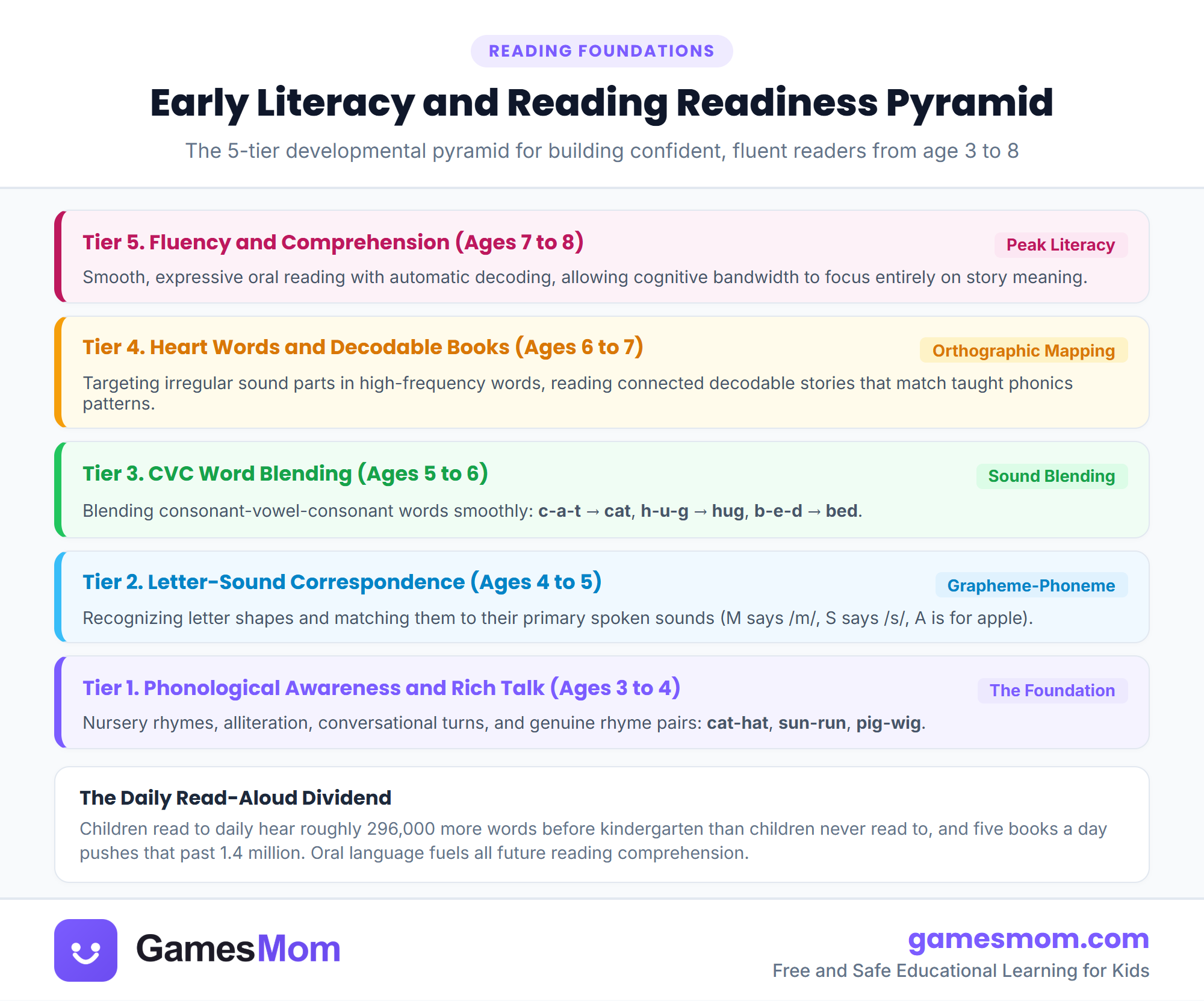
- Reading begins in the ear before it moves to the eye with phonological and phonemic awareness.
- Systematic phonics and CVC blending build the primary neural highway for decodable reading.
- Orthographic mapping connects spoken sounds to printed letter patterns permanently.
- Irregular heart words should be decoded phonetically with special attention on the unexpected letters.
- National Reading Panel Report on Teaching Children to Read
- Scarborough Reading Rope Framework for Word Recognition
- Kilpatrick Essentials of Assessing and Overcoming Reading Difficulties
Building the foundation with rhyme and auditory awareness
Before a child ever looks at a printed alphabet card, reading readiness begins in the ear. Phonological awareness is the ability to recognize, isolate, and manipulate the spoken sounds of language. Research compiled by the National Reading Panel confirms that preschool auditory sensitivity to rhymes and syllables is one of the strongest predictors of future reading success.
Singing traditional songs and rhyming verses teaches children to hear word endings and rhythm patterns. When children play games clapping out the syllables in family names, they begin understanding that words are made of smaller sonic units. Discover our collection of classic verses in the nursery rhymes hub.
Early auditory practice requires zero screens and zero paper. Asking a child what sound begins the word sun while riding in the car builds critical phonemic isolation skills in a relaxed, conversational manner.
Connecting letter shapes to sounds and pre writing
Once auditory awareness is established, children are ready to map those sounds onto visible symbols. Explicit phonics teaches the systematic relationship between letters and sounds. Rather than memorizing words as whole visual pictures, the brain learns that the letter M represents the sound made when pressing the lips together.
Motor memory reinforces phonics recognition. Tracing letters in sand trays, finger painting on textured paper, and practicing pre-writing lines helps children internalize letter formation. Review our developmental motor milestones in the pre writing skills guide.
Pairing uppercase and lowercase letters with familiar concrete objects grounds abstract alphabet concepts in everyday life, preparing children for blending syllables into complete words.
From CVC word blending to high frequency sight words
The transition to independent reading takes off when children blend consonant, vowel, and consonant sounds together. Decoding simple words like cat, bug, and pen teaches the left-to-right blending habit. At this stage, celebrate slow, deliberate sounding out rather than rushing for speed.
As decoding takes root, high-frequency sight words expand reading fluency. Modern cognitive science shows that the brain does not store words as visual silhouettes. Instead, through orthographic mapping, the brain links the spoken sounds directly to the printed letter sequence. Check our curated list in the kindergarten sight words guide.
For irregular words like said or was, point out that most of the word follows normal phonics rules. By highlighting the heart part, children learn to navigate irregular spellings with confidence and curiosity.
Frequently asked questions
What is the Science of Reading and how does it affect early literacy?
The Science of Reading is an evidence-based body of research showing how the brain learns to read. It proves that systematic phonics instruction and phonemic awareness produce vastly superior reading outcomes compared to visual memorization or guessing strategies.
What are CVC words and when should a child learn them?
CVC words consist of a consonant, vowel, and consonant (such as hat, dog, or sun). Most children begin blending simple short-vowel CVC words in late preschool or early kindergarten once letter-sound associations are solid.
How do puzzle games improve reading fluency?
Word searches, crosswords, and anagram puzzles require children to scan letter sequences, recognize orthographic chunks, and retrieve vocabulary rapidly, reinforcing word recognition without boring drills.