
Differentiated Logic Puzzles in the Classroom Guide
Learn how tiered puzzle grids (4x4 to 9x9 Sudoku and word searches) support mixed-ability learners and challenge early finishers.
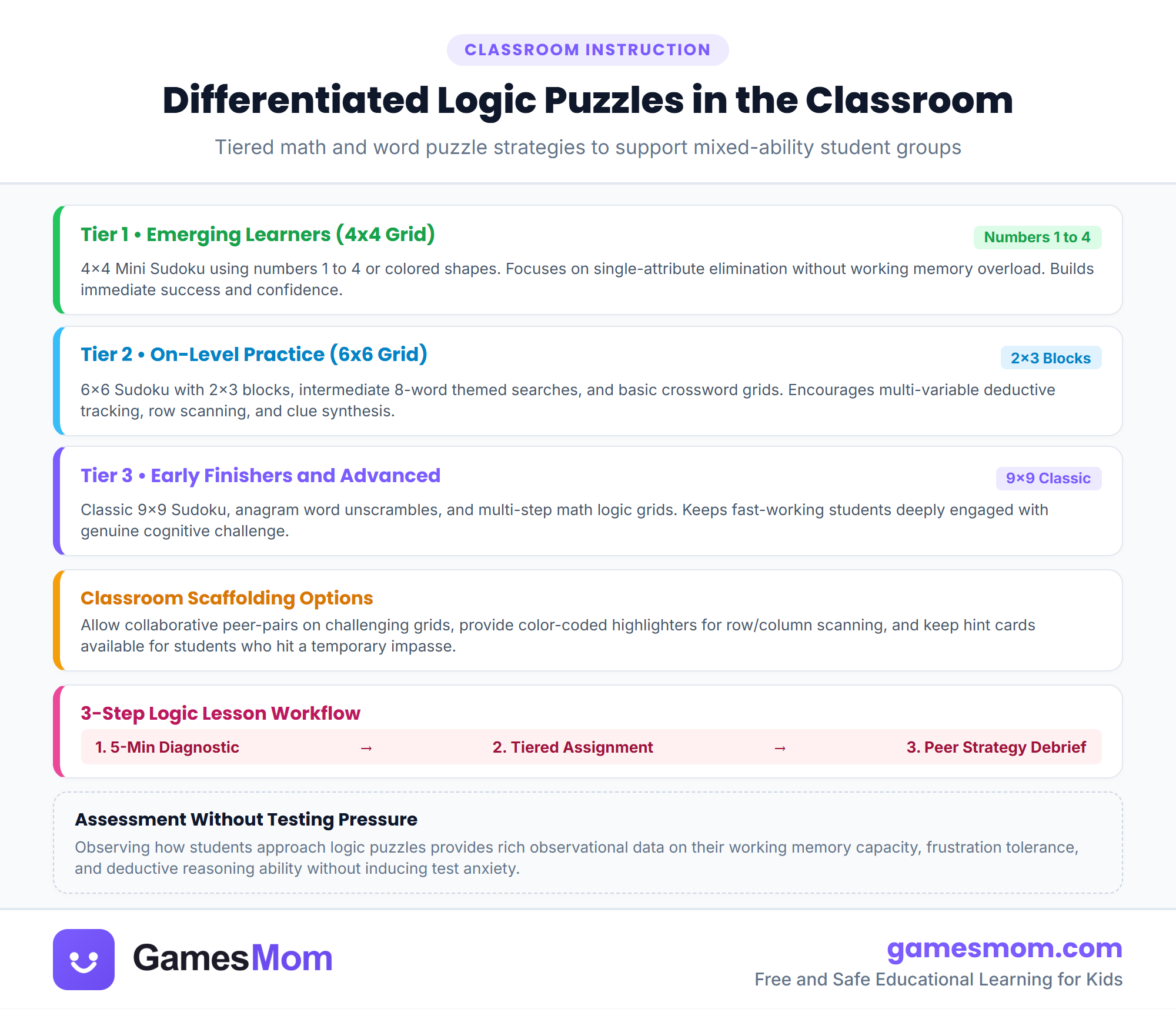
- One-size-fits-all worksheets bore advanced students and frustrate emerging learners.
- 4x4 mini Sudoku grids introduce deductive reasoning without working memory overload.
- 6x6 intermediate puzzles teach multi-variable tracking for on-level elementary students.
- 9x9 classic grids provide meaningful cognitive challenge for fast early finishers.
- Tomlinson The Differentiated Classroom: Responding to the Needs of All Learners
- Vygotsky Zone of Proximal Development in Cognitive Problem Solving
Why differentiated problem solving matters in elementary school
In any classroom of twenty-five students, academic readiness spans multiple grade levels. While some children need hands-on visual support to solve single-digit sums, others finish assignments in five minutes and look around for entertainment. Handing early finishers more of the exact same busywork breeds resentment. Differentiated logic puzzles solve this challenge by offering tiered challenge levels. Explore classroom games in best classroom games.
According to Vygotsky Zone of Proximal Development, learning occurs in the sweet spot between what a child can do unaided and what they cannot do even with help. A puzzle that is too hard causes shutdown; a puzzle that is too easy generates boredom.
Tiering the physical grid dimensions allows every student in the room to work on the exact same mathematical logic at an appropriate personal challenge level.
The three tier grid system explained
Tier 1 serves emerging learners using four-by-four mini Sudoku grids. Using only digits one through four or four distinct colors, children learn the fundamental rule of elimination: every row, column, and two-by-two block must contain each item once. The small grid prevents cognitive overload and builds confidence.
Tier 2 provides on-level practice with six-by-six grids divided into two-by-three blocks. Students must track six possibilities across rows and columns, requiring organized visual scanning and deductive hypotheses.
Tier 3 challenges early finishers with classic nine-by-nine Sudoku grids. Working with eighty-one cells demands sustained concentration and advanced elimination strategies. Direct advanced students to our online sudoku game for kids.
Implementing logic stations in daily math centers
Create color-coded folders in your math center: green for Tier 1, blue for Tier 2, and purple for Tier 3. Allow students to self-select their challenge level, encouraging them to move up once a tier feels comfortable.
Teach think-aloud strategies. Have students partner up and explain their deductive reasoning to a peer: I know this cell must be a three because the row already has a one, two, and four. Verbalizing logic deepens comprehension.
Keep a digital puzzle running on the classroom smartboard for transition periods. Students can step up and fill in verified numbers when they complete their independent work early.
Frequently asked questions
What makes 4x4 Sudoku appropriate for first and second graders?
4x4 Sudoku uses only four numbers and small 2x2 blocks, allowing young students to practice deductive reasoning without getting overwhelmed by large grids.
How do you prevent students from feeling self-conscious about working on lower tiers?
Frame tiers as puzzle flavors or levels in a video game. Everyone is playing Sudoku; students simply choose the level that provides the best mental challenge.
Can these logic tiers be used for spelling and vocabulary?
Yes, word searches can be tiered by grid size and word length (6-word small grids vs 15-word dense grids) to differentiate literacy centers.