
The Concrete to Abstract Math Ladder Guide for Parents
Understand the three stages of mathematical comprehension (Bruner CPA model) to help kids transition from physical counters to mental math.
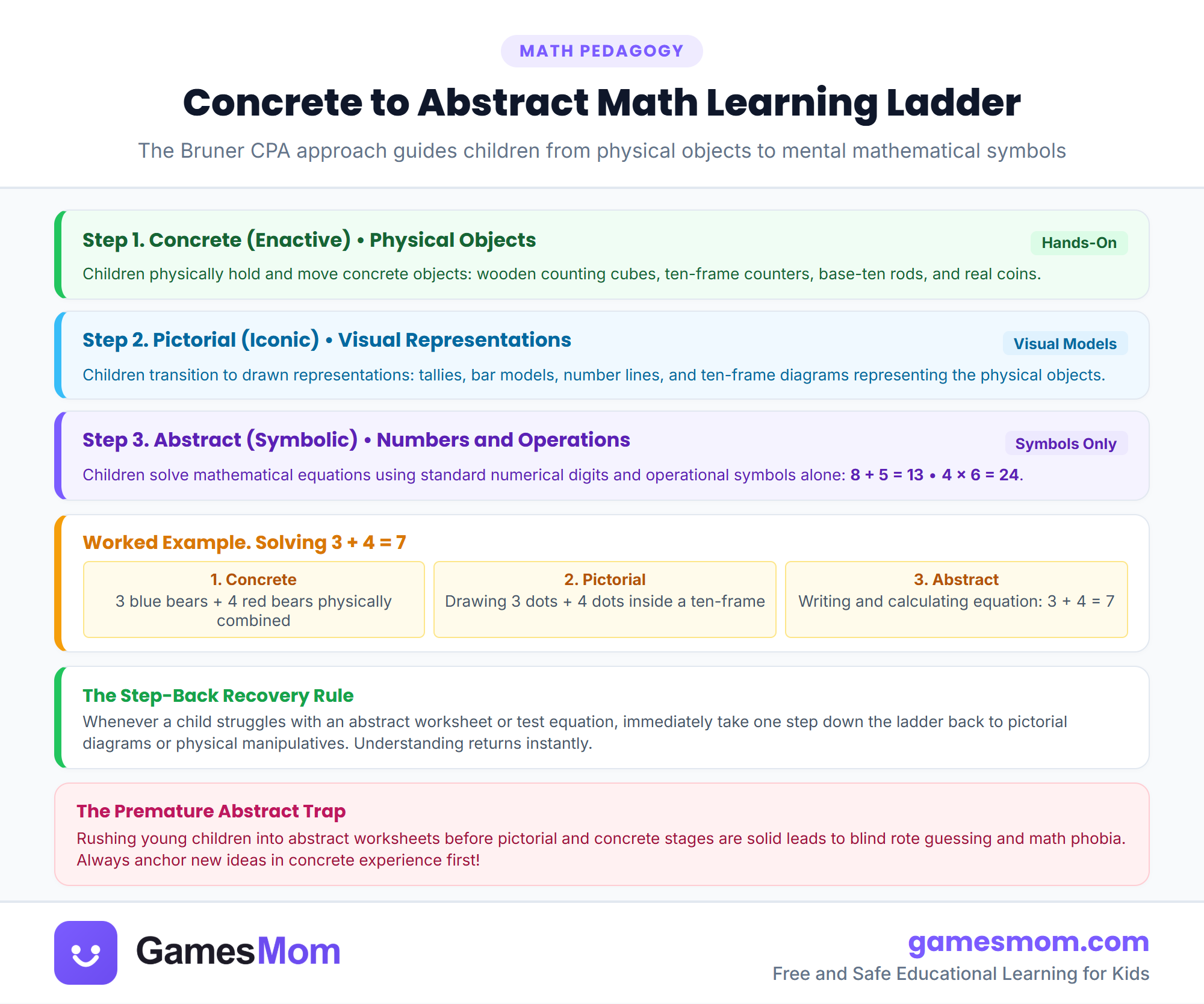
- Rushing children to abstract numerals before understanding concrete objects causes math anxiety.
- Rung 1 (Concrete): Physical manipulation of real blocks, beads, and coins.
- Rung 2 (Pictorial): Visual models like ten-frames, bar diagrams, and dot arrays.
- Rung 3 (Abstract): Symbolic mathematical notation and mental arithmetic.
- Bruner Toward a Theory of Instruction (Enactive, Iconic, Symbolic Representation)
- Singapore Ministry of Education Concrete-Pictorial-Abstract Math Framework
- NCTM Using Manipulatives to Build Conceptual Understanding in Mathematics
Why jumping straight to numbers creates math anxiety
To an adult, the equation eight plus five equals thirteen seems obvious. But to a young child, those numerals are completely abstract symbols. If a student is introduced to addition worksheets before they have physically combined objects with their hands, math feels like arbitrary memorization rather than logical truth. When memory fails, math anxiety sets in. Learn foundational strategies in our guide to math games for kids.
Jerome Bruner cognitive learning theory proves that understanding develops through three distinct stages: enactive (concrete action), iconic (visual pictures), and symbolic (abstract numerals). Singapore Math popularized this as the Concrete Pictorial Abstract (CPA) approach.
By respecting this developmental ladder, parents and teachers ensure that children understand what numbers truly represent before manipulating them on paper.
Climbing the three rungs of the math ladder
Rung 1 is the Concrete stage. Children physically touch and move tangible objects: wooden blocks, toy counting bears, or buttons. Adding means physically pushing two piles together. Subtracting means physically removing objects. This stage grounds math in tactile reality.
Rung 2 is the Pictorial stage. The child transitions from physical toys to visual drawings: ten-frames, tally marks, and bar models. Seeing eight red circles and five blue circles on paper bridges the gap between concrete objects and abstract thought. Check out our visual templates in addition to 10 worksheet.
Rung 3 is the Abstract stage. Students solve problems using mathematical symbols: 8 + 5 = 13. Because Rungs 1 and 2 are rock solid, the numerals are not empty marks; they carry rich mental imagery of ten-frames and physical groups.
How to troubleshoot when a child gets stuck
Whenever a child struggles with a math concept, the solution is almost always to step one rung down the ladder. If your third grader struggles with multiplication word problems on paper, step back to Rung 2 and draw an area grid together.
If they are still confused, step back to Rung 1 and build the problem using real coins or Lego bricks. Once their eyes and hands see the concrete relationship, step back up to the abstract numerals.
Reinforce abstract fluency through joyful digital practice. Once conceptual understanding is secure, fast-paced games like our quick math game online turn knowledge into effortless mental recall.
Frequently asked questions
What is the CPA approach in Singapore Math?
The CPA (Concrete, Pictorial, Abstract) approach is an instructional model where students first learn concepts using physical objects, then visual drawings, and finally abstract numbers.
How long should a child use physical math manipulatives?
Children should use physical manipulatives as long as they need them to understand a new concept. Even middle schoolers benefit from manipulatives when learning algebra and geometry.
What do I do if my child relies on drawing pictures to solve every sum?
Drawing pictures is a healthy pictorial stage. Gradually introduce ten-frames and number bonds to help them transition from drawing individual dots to recognizing visual groups.