
Secondary Research Review by gamesmom.com, 2026 Edition
Why Is Math Important and How Children Learn It
Curiosity, Number Sense, Algebra Readiness, Problem Solving and Daily Practice Across K to 12
Executive Summary
Why is math important for every student from preschool through Grade 12, and why do some students lean forward with curiosity when they meet an unfamiliar problem while others pull back? Across international student surveys and multi-year longitudinal studies, few subjects shape a young person's educational path and career options as strongly as mathematics. Yet in homes and classrooms alike, math is still too often treated either as an inborn talent only some children possess or as a list of disconnected procedures to memorize under a stopwatch.
This is secondary research written for four groups: educators, classroom teachers, parents and K to 12 students themselves. We ran no experiment of our own. We read sixteen landmark publications from the National Research Council, the U.S. Department of Education Institute of Education Sciences, the National Mathematics Advisory Panel, the OECD, McKinsey and Company, the Education Endowment Foundation, the National Association for the Education of Young Children, the National Council of Teachers of Mathematics, and peer-reviewed studies in Science, Developmental Psychology, Psychological Science, Child Development and Pediatric Research. We checked every figure against its original publication and set out what the evidence shows in plain English.
Five Key Findings Across the K to 12 Continuum
- Early math predicts later reading as well as later math. Across six longitudinal datasets analyzed by Duncan and colleagues (2007), a child's understanding of numbers, counting and order at age five predicted later reading scores just as strongly as early reading skills did, and predicted later math scores more than twice as strongly.
- Fractions and division in Grades 4 and 5 are the gateway to middle and high school algebra. In longitudinal cohorts from both the United Kingdom and the United States, Siegler and colleagues (2012) found that a 10-year-old's grasp of fractions and division uniquely predicted high school algebra and overall math achievement five to six years later, even after accounting for general thinking skills, working memory and family income. And as the National Mathematics Advisory Panel (2008) reported, students who complete Algebra II in high school are more than twice as likely to graduate from a four-year college.
- Curiosity acts as an academic equalizer. In a study of 6,200 children published in Pediatric Research, Shah and colleagues (2018) found that higher curiosity in early childhood predicted stronger math and reading achievement at every income level, and narrowed the achievement gap associated with economic disadvantage.
- The highest-performing K to 12 classrooms blend explicit teacher modeling with structured student inquiry. McKinsey and Company's global analysis of PISA data (Mourshed, Krawitz and Dorn, 2017) found that unguided inquiry on its own correlates with lower scores when foundations are missing, while the highest math scores occur when teachers explain core ideas clearly in most lessons and give students open problems to explore and compare in some lessons.
- Low-pressure math stories and linear board games at home change school outcomes. A randomized study of 587 first graders in Science (Berkowitz et al., 2015) showed that short bedtime math stories at home raised children's math growth across the school year and broke the cycle in which a parent's own math nervousness holds back their child.
How We Made This Review
This review was built by reading primary longitudinal studies, randomized field experiments, and consensus practice guides published by national and international education bodies covering preschool through Grade 12, then verifying every statistic and recommendation directly against the source document.
To be included, a source had to meet two tests. First, it had to be either a peer-reviewed empirical study with a publicly verifiable DOI or an official evidence synthesis from a recognized body such as the National Research Council, the U.S. Department of Education Institute of Education Sciences (What Works Clearinghouse), the National Mathematics Advisory Panel, the OECD, the Education Endowment Foundation, NAEYC or NCTM. Second, a reader had to be able to open the original document in one click from our reference list.
We left out commercial product white papers that had not undergone independent peer review, unverified claims about left-brain and right-brain learner types, and social media study hacks that lacked empirical backing. Where a study is observational rather than a randomized trial, this review states that clearly in the text so correlation is never confused with proof of cause.
We are an education website, not a health or clinical service. Nothing in this review is medical, psychological or special-education advice, and nothing here can tell you why an individual student is finding schoolwork hard. We summarize published education research in plain English. If you have concerns about a student's learning or wellbeing, the right people to speak with are their classroom teacher, school counselor and doctor.
1. Why Is Math Important Across K to 12 and Beyond
Math is important across Kindergarten through Grade 12 because each stage opens the door to the next: early number sense predicts elementary reading and math, elementary fractions and division prepare students for middle and high school algebra, and high school algebra opens paths to college graduation and modern quantitative careers.
For decades, early childhood policy focused heavily on letter recognition and early reading while assuming math could wait until formal schooling was well underway. In 2007, Greg Duncan and a team of twelve researchers tested that assumption in Developmental Psychology by combining six large longitudinal datasets tracking nearly 36,000 children across the United States, the United Kingdom and Canada from school entry into later elementary and middle school (Duncan et al., 2007).
The researchers measured children's math skills (counting, number recognition, comparing sizes and spotting ordinal position), reading skills (vocabulary and letter-word knowledge), attention skills, and social behaviors at age five, then checked how those children performed years later while controlling for family income, parent education and prior ability. School-entry math emerged with the largest predictive effect of all (0.34 standardized effect across later achievement), outperforming early reading (0.17) and attention (0.10). Even more striking, early math skills predicted later reading achievement just as strongly as early reading skills did.
Five years later, Robert Siegler and colleagues extended that longitudinal question into high school in Psychological Science (Siegler et al., 2012). Analyzing 3,677 students in the British Cohort Study and 599 students in the United States Panel Study of Income Dynamics, they asked which specific elementary math skills at age 10 predicted high school algebra and overall mathematics achievement at age 15 to 16. Even after holding constant general intellectual ability, working memory, reading achievement, whole-number addition, subtraction and multiplication, and family socioeconomic status, two elementary topics stood out above everything else: fractions and division. And at the upper end of the K to 12 journey, the National Mathematics Advisory Panel (2008) documented that high school students who complete Algebra II are more than twice as likely to graduate from a four-year college as students with less mathematical preparation.
| Stage of K to 12 | Core Mathematical Milestone | What the Longitudinal Evidence Shows | Primary Source |
|---|---|---|---|
| Ages 14 to 46 months | Hearing and using number words for visible sets of 1 to 10 items | Children whose parents frequently count and label sets of 4 to 10 objects during everyday play understand cardinal number meaning significantly better by age nearly four, independent of family income. | Levine et al. (2010), Developmental Psychology |
| Preschool and Kindergarten | Counting, comparing quantities, number lines and early number sense | School-entry math is the single strongest predictor of later elementary math and reading achievement across six national cohorts totaling nearly 36,000 children. | Duncan et al. (2007), Developmental Psychology |
| Ages 4 to 6 (Curiosity) | Eagerness to ask questions, try unfamiliar puzzles and explore patterns | Higher early curiosity predicts higher kindergarten math and reading achievement and narrows the score gap linked to socioeconomic disadvantage across 6,200 children. | Shah et al. (2018), Pediatric Research |
| Grades 1 to 3 (Ages 6 to 9) | Part-whole number bonds, place value and fluent addition and multiplication | Children who talk through short math stories at home with parents gain significantly more math skill over the school year, even when parents feel nervous about math. | Berkowitz et al. (2015), Science |
| Grades 4 to 5 (Ages 9 to 11) | Understanding fractions as numbers on a line and multi-digit division | Mastery of fractions and division at age 10 uniquely predicts high school algebra and overall math achievement five to six years later in both UK and US cohorts. | Siegler et al. (2012), Psychological Science |
| Grades 6 to 12 (Ages 11 to 18) | Ratios, linear equations, functions, quadratic equations and mindset | Students with a growth mindset score 18 points higher on PISA mathematics at age 15, and completing high school Algebra II more than doubles four-year college graduation rates. | OECD (2023), PISA 2022; National Mathematics Advisory Panel (2008) |
2. The Importance of Mathematics in Daily Life and Future Work
The importance of mathematics in daily life lies in giving children, teenagers and adults a reliable way to estimate quantities, manage money and time, weigh probabilities, and spot when a claim about numbers does not add up.
In its PISA 2022 Results framework, the Organisation for Economic Co-operation and Development defines mathematical literacy not as the ability to repeat classroom formulas on cue, but as an individual's capacity to reason mathematically and to formulate, employ and interpret mathematics to solve problems in a variety of real-world contexts (OECD, 2023). When K to 12 students see math in everyday life, they stop asking why they have to learn it, because the answer is already in their hands.
| Everyday Domain | How an Elementary Child Uses It | How a Middle or High Schooler Uses It | Underlying Mathematical Concept |
|---|---|---|---|
| Kitchen, Scaling and Chemistry | Doubling a pancake recipe, pouring half a cup, or sharing 12 berries fairly among 3 plates | Scaling recipes by 1.5x, mixing solutions by ratio in science labs, and comparing unit nutrition density | Fractions, ratios, proportional reasoning and multiplicative scaling |
| Money, Budgets and Finance | Counting coins to reach a dollar and figuring out how much change comes back from a five-dollar bill | Comparing compound interest on savings, student loans, paycheck tax deductions and percentage discounts | Decimal place value, percentages, and exponential growth functions |
| Time, Speed and Planning | Reading a clock face in five-minute steps and working out how many minutes remain before soccer starts | Calculating travel time from distance and average speed, and budgeting study hours across exam weeks | Skip counting by 5s, rate equations (Distance = Rate x Time), and linear modeling |
| Design, Sports and Data | Fitting tangram shapes together, folding paper symmetrically, or tracking game scores | Analyzing sports shooting percentages, reading medical or climate graphs, and 3D modeling in geometry | Spatial geometry, area and volume, coordinate planes, probability and statistics |
| Coding, Algorithms and AI | Following step-by-step rules in number patterns and predicting what happens when a rule changes | Writing game physics with linear and quadratic equations, auditing spreadsheet formulas, and checking AI outputs | Algebraic variables, functions, vectors, conditional logic and estimation |
The U.S. Department of Education's National Mathematics Advisory Panel noted in Foundations for Success that proficiency in mathematics is not just a filter for university science and engineering degrees; it is directly tied to individual earnings, informed citizenship, and everyday financial independence (National Mathematics Advisory Panel, 2008).
3. The Power of Mathematical Thinking and Curiosity
The power of mathematical thinking begins with curiosity: the desire to notice a pattern, wonder why it behaves that way, and test whether the same idea holds true on a new number or equation.
In 2018, Prachi Shah and colleagues published a study of 6,200 children from the Early Childhood Longitudinal Study Birth Cohort in Pediatric Research (Shah et al., 2018). They examined how children's curiosity (measured through behaviors such as liking to try new things, showing eagerness to learn, and asking questions about how things work) related to reading and math achievement in kindergarten, separately from effortful control (the ability to sit still and follow instructions).
Two findings from Shah and colleagues matter for every educator, teacher and parent. First, even after accounting for a child's self-control and family background, higher curiosity was significantly associated with higher math and reading achievement at kindergarten. Second, while children from lower-income households scored lower on average than children from higher-income households, children from lower-income families who had high curiosity performed at nearly the same level in math and reading as children from higher-income families. Encouraging curiosity did not merely make school pleasanter; it buffered children against economic disadvantage.
At the secondary school level, the OECD's PISA 2022 survey measured student curiosity alongside persistence across 81 countries and economies (OECD, 2023). Curious 15-year-olds consistently scored higher in mathematics than less curious peers of the same socioeconomic background, because mathematical problems that go beyond routine drill require a student to explore an unfamiliar setup rather than wait to be told which formula to plug in.
4. How Students Learn Mathematics Across Five Strands
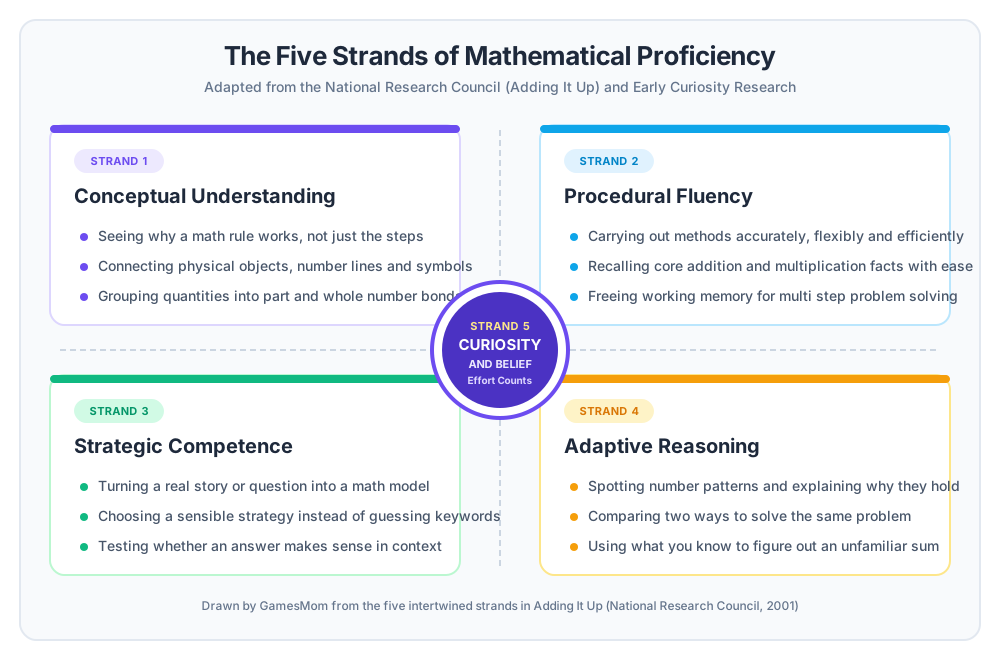
Students from preschool through Grade 12 learn mathematics not as a single ladder of memorized facts, but as five interwoven strands that grow together: conceptual understanding, procedural fluency, strategic competence, adaptive reasoning, and a productive disposition.
When adults argue about how to learn mathematics, they often split into two camps: one demanding basic fact and formula drills, and the other demanding open-ended discovery. In Adding It Up: Helping Children Learn Mathematics, the National Research Council's Mathematics Learning Study Committee reviewed decades of empirical research on pre-kindergarten through eighth-grade math and concluded that this split is a false choice (National Research Council, 2001). True mathematical proficiency requires all five strands braided together so that each one supports the others.
How to Understand Math Instead of Memorizing Disconnected Rules
To understand math means knowing why a method works and how a new idea connects to ideas you already own, rather than holding dozens of separate rules in memory. The National Research Council points out that students who have conceptual understanding actually have less to memorize, because an elementary student sees that 8 + 5, 18 + 5 and 80 + 50 are all versions of making the next ten, and a high school student sees that the distance formula on a coordinate grid is simply the Pythagorean theorem written in x and y coordinates.
- Conceptual understanding: grasping mathematical ideas, operations and relations so a student knows what a fraction, a negative number, a rate of change or a multiplication sign represents in the real world.
- Procedural fluency: carrying out procedures flexibly, accurately, efficiently and appropriately, including knowing core arithmetic facts and algebraic manipulations once their meaning is clear.
- Strategic competence: the ability to formulate, represent and solve mathematical problems that do not come with a label saying which operation or equation to use.
- Adaptive reasoning: capacity for logical thought, reflection, explanation and justification, such as explaining why adding two odd numbers always produces an even number or why a linear equation has one solution, no solution, or infinitely many solutions.
- Productive disposition: the habitual inclination to see mathematics as sensible, useful and worthwhile, coupled with a belief in steady effort and one's own efficacy.
5. What Is Number Sense and When Does It Start
Number sense is a learner's fluid, intuitive feel for what numbers mean, how quantities compare in size, and how numbers can be taken apart and put back together in flexible ways.
Long before a child writes a digit on paper, early childhood mathematics begins with noticing quantity in the world around them. In their joint position statement Early Childhood Mathematics: Promoting Good Beginnings, the National Association for the Education of Young Children and the National Council of Teachers of Mathematics note that young children between ages three and six naturally compare who has more crackers, arrange blocks in repeating patterns, and explore shapes and space during ordinary play (NAEYC and NCTM, 2010).
The U.S. Department of Education's practice guide Teaching Math to Young Children (chaired by Douglas Frye) maps out the specific developmental progression that turns this informal curiosity into solid number sense (Frye et al., 2013):
- Subitizing (instant recognition of small sets): seeing at a glance that three dots on a die or three fingers held up is "three" without counting one by one.
- One-to-one counting: touching or pointing to each object in a line once and only once while saying the number words in order.
- Cardinality (the last number tells how many): realizing that when you count "one, two, three, four, five", the word "five" does not just name the last toy, it names the size of the whole group.
- Magnitude comparison and the mental number line: knowing that 8 is bigger than 6 and sits further along a line, and that moving one step forward on the count list always adds exactly 1.
Number Bonds to 10 and Part Whole Thinking
Once a child can count a group reliably, the next leap in number sense is seeing that any number is made of smaller parts: 7 can be broken into 5 and 2, or 4 and 3, or 6 and 1. Learning number bonds to 10 gives six- and seven-year-olds the building blocks for mental addition and subtraction, because a child who knows instantly that 8 needs 2 to reach 10 can solve 8 + 6 by splitting the 6 into 2 + 4 to make 10 + 4 = 14. Young children can explore early counting and sequencing in our learning numbers from 1 to 20 activity.
6. How Children Learn Math from Concrete Objects to Symbols
Students learn math best when every new topic starts with physical objects they can move, shifts next to visual pictures and number lines, and only then introduces written symbols and equations.
Both the U.S. Department of Education's elementary mathematics practice guide (Fuchs et al., 2021) and the United Kingdom Education Endowment Foundation's guidance reports covering ages 3 to 14 (EEF, 2020; EEF, 2022) highlight this three-step progression, widely known in education research as the Concrete, Representational, Abstract sequence. Math starts to feel hard and arbitrary when a student of any age is handed Step 3 (symbols on a page) without ever experiencing Step 1 or Step 2.
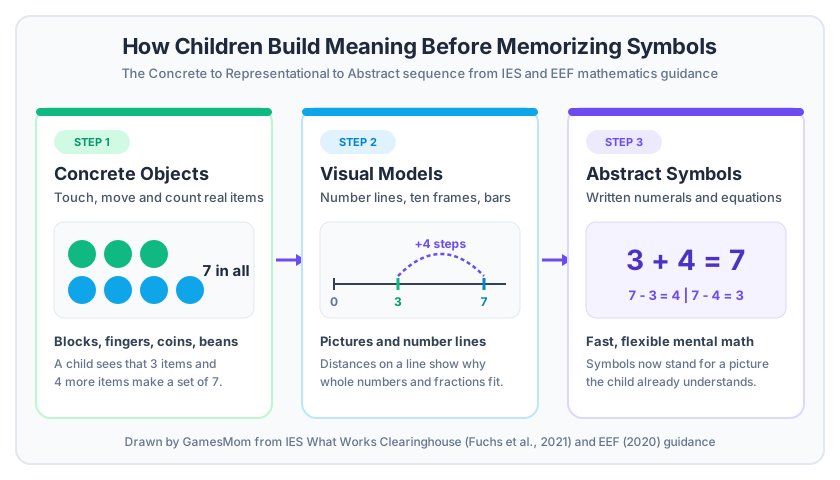
In their review of 49 randomized controlled studies of elementary math instruction, Fuchs and colleagues (2021) singled out one visual representation above all others: the number line. Unlike pie charts or bags of marbles, which many students treat as useful only for whole numbers or simple slices, a number line shows whole numbers, zero, negative numbers, fractions and decimals all living in the same continuous space. A student who can place 1/2, 3/4 and 5/4 on a number line understands that a fraction is a number with a specific size, not two separate whole numbers stacked on top of each other. Interactive part-whole models such as number bonds to 10 and 20 give learners a visual bridge between counting objects and reading equations.
Skip Counting by 2 and Spotting Number Patterns
Pattern recognition is the bridge between early counting and middle school algebra. When children practice skip counting by 2, 5 and 10, or look at a growing sequence such as 3, 6, 9, 12 and ask what changes each time, they are learning to look for a general rule (a linear rate of change) rather than treating every number as a stranger. The IES early math guide recommends teaching patterns and geometry alongside number operations from preschool onward (Frye et al., 2013), a skill children can practice directly by spotting rules in number patterns.
7. How to Get Better at Math for Kids and K to 12 Students
Kids and K to 12 students get better at math when they understand that mathematical skill grows through steady effort, smart strategies and examining mistakes, rather than being a fixed gift you are born with or without.
Few cultural myths do more harm to K to 12 students than the idea that the world is divided into "math people" and "non-math people." The National Mathematics Advisory Panel addressed this directly in its 2008 final report to the U.S. Department of Education (National Mathematics Advisory Panel, 2008). Synthesizing experimental and longitudinal studies, the Panel concluded that students' beliefs about learning are directly tied to their math performance: when students shift from believing that math ability is fixed at birth to believing that effort and strategy make them stronger, they show greater persistence on hard problems and achieve higher scores.
International evidence confirms the size of that difference. In the OECD's PISA 2022 survey, 15-year-old students who reported a growth mindset scored an average of 18 points higher in mathematics across OECD countries than peers with a fixed mindset, even after accounting for socioeconomic status and school profile (OECD, 2023). Similarly, McKinsey and Company's global data analysis of PISA outcomes found that student mindsets had roughly twice the predictive power on student test scores as home environment and demographics (Mourshed, Krawitz and Dorn, 2017).
Four Habits Directly for Students Asking How Can I Get Better at Math
- Treat a wrong answer as a map showing where the rule changed: When you miss a problem, do not erase it right away. Circle the exact line where your steps parted ways with the worked solution and name what happened in plain words.
- Draw the problem before you calculate: Whether it is a Grade 3 multiplication array, a Grade 6 ratio table, or a Grade 10 parabola, sketching a quick visual model turns abstract text into something your eyes can check.
- Ask "Why does this step work?" instead of "What do I type next?": In middle and high school algebra, knowing why you subtract 5 from both sides of 2x + 5 = 17 (to keep a balanced scale equal) means you will never forget the rule under exam pressure.
- Test yourself with the book closed: Looking at a solved example in a textbook feels easy because the author already made the decisions. Close the example and solve a fresh problem on blank paper to see what you truly own.
8. How to Study Math Effectively in Elementary, Middle and High School
To study math effectively across K to 12, a student should pair worked examples with practice problems, mix different problem types in short daily sessions, and compare multiple ways to solve the same equation.
Every month, more than 27,000 students and parents search for how to study math or how to study for a math test. Education research synthesized by the IES practice guides for elementary school (Fuchs et al., 2021) and middle and high school algebra (Star et al., 2015) shows that the most effective study habits look very different from late-night cramming:
- Study worked examples side by side with new problems: In both elementary arithmetic and high school algebra, examining a step-by-step solved problem (including inspecting a deliberately incorrect worked example to spot the error) builds deeper understanding than grinding through thirty unguided problems.
- Space practice across days instead of cramming: Fifteen minutes of focused math practice for kids on four separate days produces far stronger long-term retention than a single sixty-minute marathon the night before a quiz.
- Interleave (mix) problem types once the basics are learned: On a worksheet where all twenty problems are quadratic factoring, a high schooler never has to decide which strategy to use. Mixing linear equations, inequalities and quadratics on the same review sheet trains the student to read the structure of the equation first.
- Compare two strategies for the same problem: As Star and colleagues (2015) show in the IES algebra guide, asking a student to solve 3(x + 4) = 18 first by expanding 3x + 12 = 18 and second by dividing both sides by 3 first (x + 4 = 6) builds flexible algebraic reasoning that transfers to hard problems.
9. Math Problem Solving and Story Questions
Effective math problem solving teaches students from Grade 1 through Grade 12 to recognize the underlying mathematical structure in a story problem rather than hunting for isolated keywords like "altogether" or "left".
Word problems are where many K to 12 students hit a wall. A common shortcut taught in well-meaning classrooms is to circle single words: "more" means add, "less" means subtract, "of" means multiply. In Recommendation 5 of the IES elementary math guide (Fuchs et al., 2021) and the EEF Key Stages 2 and 3 guidance (EEF, 2022), researchers explain why that keyword shortcut breaks down. Consider the question: "Maya has 8 apples. She has 3 more apples than Leo. How many apples does Leo have?" A student trained to add whenever they see the word "more" writes 8 + 3 = 11 and gets the problem wrong.
Instead of keyword hunting, strong evidence supports teaching students to identify the problem structure across grades:
- Combine (Part-Part-Whole): Two or more parts combine to form a total (Part 1 + Part 2 = Total). Used from Grade 1 number bonds to middle school algebraic sums.
- Change over time: A starting quantity increases or decreases (Start + or - Change = End). In high school, this same structure becomes linear growth (y = mx + b) when the change is constant per unit, or exponential growth when the change is a percentage.
- Compare (Difference): Two quantities are compared to find how far apart they sit on a number line (Bigger - Smaller = Difference).
- Equal groups, rates and proportions: A number of groups each hold the same quantity or rate (Groups x Rate = Total), which anchors multiplication in Grade 3, unit rates and ratios in Grade 6, and linear functions in Grade 8 and Algebra I.
10. Mental Math Strategies and Learning Multiplication Fast
Mental math strategies and automatic recall of core number facts work together by freeing up a student's working memory so they can focus on multi-step reasoning, fractions, geometry and algebra.
Why do teachers care whether a third grader knows 7 x 8 = 56 or an eighth grader can simplify 24/36 without reaching for a calculator? The National Mathematics Advisory Panel (2008) explains the cognitive bottleneck: human working memory can hold only a few pieces of information at one time. If a middle schooler trying to factor x^2 + 7x + 12 or add 3/8 + 5/6 has to stop and count on their fingers just to test factor pairs of 12 or multiples of 6 and 8, they lose the thread of the algebra problem before finishing the first step.
However, the research is equally clear about how students learn multiplication tables fast and build mental math fluency without fear (Fuchs et al., 2021):
- Meaning and strategy come before speed: Students should first build facts from ones they already know, such as using 5 x 7 = 35 plus one more 7 to see why 6 x 7 = 42, or doubling the 2s table to get the 4s table, or decomposing numbers to make 10.
- Practice retrieval in brief, low-stakes bursts: Once a student understands how the facts work, 2 to 5 minutes of lively recall in a quick mental math game or flashcard deck builds automatic retrieval far better than long pages of repetitive drill.
- Timed games belong one step below the student's new learning: When a clock is running, asking a child to work out brand-new material creates frustration because working out a new method is naturally slow. Timed practice works best when it asks for facts that are already familiar (last year's core facts plus the easiest of this year's), so the student experiences fast success and builds speed with confidence.
11. Anxiety and Math Confidence at Home and School
Math nervousness is learned, not inborn, and experimental evidence shows that structured, low-pressure math conversations at home and clear instruction at school can reverse it.
Across the OECD, the share of 15-year-old students who agreed or strongly agreed that they get very nervous when solving mathematics problems rose from 31% in 2012 to 39% in 2022 (OECD, 2023). In every single participating country, higher math nervousness went hand in hand with lower math scores and lower willingness to enter quantitative fields.
Where does that nervousness start? Part of the answer sits at the kitchen table. When a parent who felt stressed by math in school tries to help with homework while feeling tense, or casually says "I was never a math person either," children pick up the signal that math is something to fear. In 2015, Talia Berkowitz, Sian Beilock and colleagues tested whether that pattern could be interrupted in a randomized field experiment of 587 first-grade families published in Science (Berkowitz et al., 2015).
Families were randomly assigned to use either a reading app or a bedtime math story app that gave parents and children a short, engaging passage followed by playful math questions at different levels, with no grades and no homework pressure. By the end of first grade, children whose families read and talked through the math stories even once or twice a week gained significantly more math skill than the control group. Most importantly, the biggest gains of all occurred among children whose parents had high math nervousness: giving parents a warm, structured way to talk about numbers with their child completely erased the usual gap. Families looking for practical daily steps can read our guide on helping a child who struggles with math.
12. Math Activities for Preschoolers and Kindergarten Readiness
Effective math activities for preschoolers and kindergartners weave counting, comparing, sorting shapes and spotting patterns into everyday play, stories and routines rather than sitting three-year-olds down for silent desk work.
Both the IES practice guide Teaching Math to Young Children (Frye et al., 2013) and the Education Endowment Foundation's early math guidance (EEF, 2020) emphasize that young children learn math best when dedicated short play sessions are paired with mathematical talk throughout the day.
Kindergarten Math Worksheets, Printables and Hands On Play
Parents and teachers search tens of thousands of times each month for preschool math worksheets (33,100 monthly global searches) and kindergarten math worksheets (40,500 monthly global searches). The research from NAEYC and NCTM (2010) helps clarify what a good early years activity sheet or game actually does: for ages three to six, a printable sheet should invite a child to count pictures, trace numerals, match groups of objects, color by number, or cut and sort shapes with their hands, always alongside real objects they can touch.
- Ages 3 to 4 (Preschool): Focus on subitizing small groups of 1 to 4, counting up to 10 objects in a line with one touch per object, matching basic shapes (circle, square, triangle, rectangle) even when rotated, and copying simple repeating patterns in math activities for preschoolers.
- Ages 5 to 6 (Kindergarten): Count orally to 100 by ones and tens, write numerals from 0 to 20, compare two groups up to 10 to say which has more or fewer, add and subtract within 10 using fingers or objects, and practice partner numbers that make 10 through kindergarten math games.
13. Elementary Progression from First Grade to Fifth Grade
Elementary mathematics builds in a deliberate sequence from additive thinking in Grades 1 and 2, to multiplicative thinking in Grade 3, and to fractions, decimals and division in Grades 4 and 5.
Because each year's math rests directly on the year before, a shaky foundation in Grade 2 place value or Grade 3 multiplication makes Grade 4 long division and fractions feel overwhelming. The table below summarizes the core progression across elementary school, how to spark curiosity at each stage, and what works best for practice.
| Grade Band | Core Skills Being Built | Curiosity Question That Opens the Topic | What Works Best for Practice |
|---|---|---|---|
| Grade 1 (Ages 6 to 7) | Addition and subtraction within 20, making 10, place value (tens and ones), telling time to the hour and half hour, comparing with <, > and = | "How many different ways can we split 10 coins between two pockets?" | Ten-frames, part-whole number bonds, and math games for 1st graders |
| Grade 2 (Ages 7 to 8) | Fluency with addition and subtraction within 20, two-digit sums within 100, odd and even numbers, skip counting by 2s, 5s, 10s and 100s, counting money | "Why do two odd numbers always team up to make an even number?" | Number line hops, real coins, arrays of rows and columns, and math games for 2nd graders |
| Grade 3 (Ages 8 to 9) | Multiplication and division within 100 (especially the 2, 3, 4, 5 and 10 tables first), unit fractions on a number line, area by tiling squares | "If 4 rows of 6 tiles make 24, what happens when we turn the rectangle sideways?" | Visual arrays, connecting multiplication to division, and math games for 3rd graders |
| Grade 4 (Ages 9 to 10) | All multiplication facts to 10 x 10, multi-digit multiplication and division, equivalent fractions, decimals to hundredths, angles and symmetry | "Why is two fourths of a sandwich the exact same amount of food as four eighths?" | Area models for big multiplication, fraction strips on a number line, and 4th grade math games |
| Grade 5 (Ages 10 to 11) | Adding, subtracting, multiplying and dividing fractions and decimals, volume of 3D boxes, order of operations, coordinate grids and early algebra | "How can multiplying by a fraction make the answer smaller instead of bigger?" | Visual fraction bars, real measurement projects, and math games for 5th graders |
The Grade 3 Multiplication Shift
Third grade is the year a child shifts from counting groups one by one to thinking in equal groups. Rather than handing a child a 12-by-12 chart and asking them to memorize 144 separate facts at once, start with the commutative property (showing on a grid of dots that 3 x 8 is the exact same rectangle as 8 x 3, which cuts the number of facts to learn nearly in half), master the 2, 5 and 10 tables first, and build the 3, 4, 6, 7, 8 and 9 tables from known facts using interactive multiplication games.
Teaching division alongside multiplication is equally important. When a third or fourth grader sees that 24 divided by 6 is simply asking "6 times what number makes 24?", division stops looking like a brand-new set of facts and becomes the reverse view of the same rectangle, which children can reinforce in a division practice game.
Fractions and Division Predictors in Grades 4 and 5
As Siegler and colleagues (2012) demonstrated across UK and US longitudinal cohorts, fourth and fifth grade fractions and division are the single strongest elementary predictors of high school algebra success (Siegler et al., 2012). Why? Because fractions force a child to let go of habits that worked only for whole numbers (such as thinking that multiplying always makes a number bigger, or that 8 is bigger than 4 so 1/8 must be bigger than 1/4). Using number lines and visual fractions practice keeps the real size of each fraction visible on screen.
14. Middle and High School Math from Grade 6 to Grade 12
In middle and high school (Grades 6 through 12), mathematics shifts from operating on specific numbers to reasoning about general relationships through ratios, linear equations, functions, geometry, quadratic equations and statistics.
Global search demand shows just how intensely families and students look for support during this transition: math for 6th graders (74,000 monthly searches worldwide; 40,500 US), math for 7th graders (33,100 worldwide; 27,100 US), solving linear equations (18,100 worldwide; 6,600 US) and solving quadratic equations (60,500 worldwide; 18,100 US). In the U.S. Department of Education's practice guide Teaching Strategies for Improving Algebra Knowledge in Middle and High School Students, Jon Star and colleagues synthesized the experimental evidence on what helps Grade 6 to 12 students succeed in algebra (Star et al., 2015).
| Secondary Grade Band | Core Mathematical Focus | Why Students Often Struggle | Evidence-Based Strategy (IES & EEF) |
|---|---|---|---|
| Grade 6 (Ages 11 to 12) | Ratios, unit rates, percentages, dividing fractions, negative numbers on a number line, and one-step algebraic equations | Treating a ratio like 3:4 as two separate whole numbers instead of a multiplicative relationship, or viewing the "=" sign as "write the answer here" | Use double number lines and ratio tables, and practice math for 6th graders so "=" always means both sides have the same value |
| Grades 7 to 8 (Ages 12 to 14) | Proportional relationships, operations with positive and negative rational numbers, solving linear equations, slope as rate of change, and the Pythagorean theorem | Memorizing sign rules ("two negatives make a positive") and slope formulas without connecting the equation, the table of values and the graph line | Show the same linear relationship in three linked views (story table, graph line and y = mx + b equation) and build fluency by solving algebra equations |
| Grades 9 to 10 (Algebra I and Geometry) | Systems of linear equations and inequalities, factoring and solving quadratic equations, exponential functions, geometric proof and similarity | Applying mechanical steps to quadratic equations without noticing structure, or treating geometric proof as a two-column memory test | Teach students to read the structure of an expression before choosing a strategy and pair symbolic proof with interactive geometry practice |
| Grades 11 to 12 (Algebra II, Statistics, Pre-Calculus) | Polynomial, rational, logarithmic and trigonometric functions, statistical inference, probability modeling and rates of change | Shaky elementary fraction or middle school linear fluency overloading working memory during multi-step symbolic manipulation | Pair symbolic manipulation with graphical visualization and real data modeling, and repair specific fraction or factoring gaps with targeted worked examples |
The three recommendations from Star and colleagues (2015) for middle and high school algebra apply equally well in a classroom or at a home study desk: (1) use solved problems (both correct and incorrect) to discuss why each step was chosen, (2) teach students to notice the structure of an algebraic expression (treating a compound expression like 2x + 1 as a single chunk), and (3) teach students to compare and choose deliberately among different algebraic strategies rather than relying on a single rigid procedure.
15. What Parents Can Do at Home Across Every Grade Band
Parents spark math curiosity from preschool through high school by talking about numbers and quantitative choices in daily life, playing linear board games and strategy games, asking how a student reasoned through a problem, and keeping their own language about math encouraging.
You do not need a degree in mathematics to raise a child or teenager who is confident in math. In a landmark observational study published in Developmental Psychology, Susan Levine and colleagues recorded families at home for 7.5 hours between when their children were 14 months and 30 months old (Levine et al., 2010). Some parents used as few as 4 number words across all those hours; others used more than 250. Children who heard more "number talk" (especially counting and labeling visible sets of 4 to 10 items, such as stairs, apple slices or toy cars) had a markedly stronger grasp of cardinal numbers at age 46 months, even after controlling for family socioeconomic status and how much parents talked overall.
Linear Number Board Games at Home
One of the most striking experimental findings in early math comes from Geetha Ramani and Robert Siegler's 2008 study in Child Development (Ramani and Siegler, 2008). Preschoolers played a simple linear board game with squares numbered 1 to 10 in a straight row for just four 15-minute sessions (one hour in total over two weeks). As children moved their token from square 3 to square 5, they said the numbers on the squares out loud: "Four, five."
Compared to a control group who played the exact same game with colored squares instead of numbers, the children who played the numbered board game made large, immediate gains in counting, reading numerals, comparing which of two numbers is bigger, and placing numbers accurately on a 0-to-10 number line, and those gains were still present nine weeks later. Why does a linear board game work so well? Because it links four signals at the same moment: the child sees the written numeral, hears the number word, feels their hand move a physical distance along the row, and notices that higher numbers take more steps and more time to reach.
Practical habits for parents at each stage of K to 12:
- Preschool and Kindergarten (Ages 3 to 6): Count visible sets of 4 to 10 objects out loud, finish with the total ("Six stairs in all!"), and play linear numbered board games where your child names the square numbers as they move their token.
- Elementary School (Grades 1 to 5): Read short bedtime math stories together (Berkowitz et al., 2015), involve your child in cooking measurements and counting change, and combine 10 minutes of interactive play with free printable math worksheets.
- Middle and High School (Grades 6 to 12): Never say "I was terrible at algebra too." When a teen is stuck on homework, ask them to show you a solved example from their notes or textbook and explain what changed from line 1 to line 2. Invite them to compare real household numbers: mobile data plans, car fuel efficiency, sports statistics or compound savings.
16. Building Thinking Classrooms for Teachers and Educators
Teachers and school leaders build thinking classrooms in mathematics by combining explicit, step-by-step teacher modeling of core concepts with structured problems that require students to reason, compare methods and explain their thinking.
Should a math teacher explain methods directly at the board, or let students discover mathematical ideas through inquiry? In 2017, McKinsey and Company's education practice analyzed global PISA data across hundreds of thousands of students to test how teacher-directed instruction and inquiry-based learning actually relate to mathematics achievement (Mourshed, Krawitz and Dorn, 2017).
Their finding resolved a decades-old debate: classrooms that relied heavily on unguided inquiry without strong teacher-directed instruction scored lower on PISA, because students cannot invent millennia of mathematical conventions from scratch without foundational knowledge. However, classrooms reached the highest achievement "sweet spot" when teachers provided clear, structured teacher-directed instruction in most or all lessons and paired it with student inquiry and exploration in some lessons. Teachers can reinforce daily warm-ups using classroom math and thinking games on an interactive board or school Chromebook.
1. Explicit Teacher Modeling First
Introduce new concepts with clear mathematical language, worked examples and visual representations (concrete objects and number lines) so no student is left guessing the basic rules (Fuchs et al., 2021).
2. Calibrated Inquiry and Pattern Spotting
Once foundations are in place, pose "low-floor, high-ceiling" problems where every student can start with a simple example and extend the pattern to explain why a rule always works (McKinsey, 2017).
3. Coherent Visual Models Across K to 12
Use the number line and bar/area models consistently from Kindergarten counting through Grade 5 fractions and Grade 9 algebra so students build one unified mental model (EEF, 2022).
4. Compare Two Student Strategies
Put two valid ways of solving the same problem side by side at the board and ask the class to discuss when each strategy is most efficient (Star et al., 2015).
Actionable Priorities for Educators and School Leaders
For principals, curriculum directors and department heads planning a K to 12 math program, the evidence from the National Mathematics Advisory Panel (2008), IES (2013, 2015, 2021) and EEF (2020, 2022) points to three school-wide priorities:
- Protect daily math time in the early grades: Ensure preschool and early elementary schedules dedicate daily time to structured math play and number talk alongside reading, rather than treating math as an optional afternoon add-on.
- Bridge the Grade 4/5 fraction cliff before middle school: Because elementary fraction and division understanding is the strongest predictor of high school algebra success (Siegler et al., 2012), provide targeted small-group support using number lines in Grades 4, 5 and 6 so students do not enter Algebra I with whole-number misconceptions.
- Align representations across grade levels: When a third-grade teacher uses an area model for 14 x 12, a fifth-grade teacher uses the same area model for 1.4 x 1.2, and a ninth-grade algebra teacher uses the exact same rectangle to multiply (x + 4)(x + 2), students see mathematics as one connected subject across K to 12.
17. Why Linear Board Games and Interactive Math Games Work
Well-designed math games work because they turn repetitive fact retrieval and algebraic reasoning into a purposeful decision, provide immediate feedback without penalty, and adjust the challenge to sit just within the student's reach.
Not every digital activity labeled "educational" helps a student learn math. Some are arcade games that pause every two minutes to interrupt the player with a sum unrelated to the game, while others hold a child stuck on the same wrong answer until they give up. Drawing on the EEF (2020, 2022), IES (2013, 2021) and game-based learning research, our free math games for kids are built around four design rules that separate effective practice from digital filler:
- The math is the move: Picking the next number in a pattern, comparing two fractions, solving for x in an equation, or finding the missing number bond is the action that advances the round, not a commercial break interrupting another activity.
- Wrong answers show the right answer and move on: When a player taps a wrong choice, the game briefly shows the correct answer so the student learns from it, and immediately deals the next question. A game that freezes until a frustrated child guesses every button stops being a learning tool.
- Varied dealing with no back-to-back repeats: Questions are dealt from a shuffled pool so the same answer never appears twice in a row and the right choice never sits in the same button slot repeatedly, preventing mechanical tapping.
- Age-calibrated fluency ladders: Untimed modes let students explore new grade-level rules at their own pace, while timed modes ask for facts one step below the current grade's frontier so speed practice builds confidence rather than panic.
Pathway A. Curiosity and Mastery
What happens: New ideas start with objects and number lines, parents and teachers ask "how did you see it?", and short daily games build fluent recall.
Result: Strong conceptual understanding, fast recall without fear, and readiness for fractions, algebra and higher math.
Pathway B. The Calibrated Classroom
What happens: 15 minutes of clear teacher explanation and worked examples followed by 10 minutes of partner problem solving and strategy comparison.
Result: Matches the McKinsey PISA sweet spot, lifting both struggling and advanced K to 12 learners together.
Pathway C. High-Pressure Rote Drill
What happens: Symbols and keyword tricks are taught without visual models, and timed tests are given before students understand the facts.
Result: Fragile rules that collapse on multi-step word problems and rising math nervousness by middle and high school.
18. Planning a K to 12 Homeschool Math Curriculum
An effective K to 12 homeschool math curriculum balances conceptual visual models with brief daily review, and paces progress by the student's mastery of each building block rather than by the calendar date.
Families searching for a homeschool math curriculum (27,100 monthly searches) or a k12 math curriculum (6,600 monthly searches) typically face one main structural choice: a mastery program (which stays on one topic, such as multiplication, fractions or linear equations, until it is thoroughly understood before moving on) versus a spiral program (which introduces a small piece of a topic and revisits it alongside many other topics across the year).
The research reviewed by the National Mathematics Advisory Panel (2008) and the IES practice guides (2013, 2015, 2021) suggests that the best home routine borrows the strength of each approach: teach a new concept to genuine mastery using physical objects, visual number lines and worked examples before moving forward, and keep a 5-minute daily warm-up of mixed review (two or three questions from earlier topics, or a short round of flashcards or a math game) so earlier skills stay fresh all year. Families building their own home plan can explore our free online homeschool curriculum guide.
19. What This Review Cannot Tell You
Every honest review of education research has clear boundaries that educators, teachers, parents and students should keep in mind.
- Group averages are not individual predictions: Longitudinal studies such as Duncan et al. (2007), Siegler et al. (2012) and Shah et al. (2018) describe strong statistical patterns across thousands of students. They do not lock in the future of any individual student, and learners who start slowly in elementary or middle school regularly thrive when given clear, patient support.
- Observational correlations vs. randomized experiments: PISA mindset and instructional comparisons (OECD, 2023; McKinsey, 2017) and longitudinal cohort studies (Duncan et al., 2007; Siegler et al., 2012) are observational, even when they control carefully for family income and prior ability. The randomized field experiments in this review (such as Ramani and Siegler, 2008, Berkowitz et al., 2015, and the randomized trials synthesized in Fuchs et al., 2021 and Star et al., 2015) provide the direct causal proof of what specific instructional practices achieve.
- Curriculum standards vary by country: While early number sense milestones and secondary algebra structures are similar worldwide, the exact grade in which long division, fraction operations, linear equations or quadratic functions are introduced varies between the United States, the United Kingdom, Canada, Australia, India and other school systems.
- This review is not a clinical guide: Some students experience persistent, specific difficulties with processing number quantities that go beyond ordinary classroom gaps. This review does not cover clinical evaluation or specialized therapy; a student's teacher, school specialist and doctor are the right professionals to consult whenever a family is concerned.
Simple Glossary of Mathematical Learning Terms
- Cardinality
- Understanding that the last number word you say when counting a group of objects tells you the total number of objects in the whole group.
- Concrete to Representational to Abstract (CRA)
- A three-step teaching sequence that introduces a math concept first with physical objects (counters, blocks), next with visual drawings (number lines, ten-frames, bar diagrams), and finally with written digits and algebraic symbols.
- Growth Mindset in Mathematics
- The belief that mathematical skill is not fixed at birth and can be developed through effort, good strategies, and help from others.
- Linear and Quadratic Equations
- Core middle and high school algebraic equations: a linear equation (such as y = 2x + 3) models a constant rate of change and graphs as a straight line, while a quadratic equation (such as y = x^2 - 4x + 3) includes a squared variable and graphs as a U-shaped curve called a parabola.
- Number Bonds
- Pairs of numbers that combine to make a target whole (such as 6 and 4 making 10), showing at a glance how a whole quantity can be broken into parts and recombined.
- Number Sense
- A person's flexible, intuitive understanding of what numbers mean, how their sizes compare on a mental number line, and how operations affect them.
- Procedural Fluency
- The ability to carry out mathematical methods and recall core facts accurately, efficiently and flexibly, freeing up working memory for higher-level problem solving.
- Subitizing
- Instantly recognizing how many items are in a small group (usually 1 to 4 items, such as dots on a die) without counting them one by one.
About GamesMom research reviews
GamesMom publishes free, child-safe browser games, printables and practice activities for children and students from preschool through Grade 12. There are no accounts, no downloads and no ads inside the play area.
Our research reviews exist because the guidance parents, teachers and educators need is published, public and nearly unreadable. Each review reads a small number of authoritative sources, states what they say, links them, and says where the evidence stops. They are written by the GamesMom editorial team, checked against the live sources on the publication date, and corrected when a source changes. They are not medical guidance, and they are not original research. If something about your child worries you, the people to ask are the ones who know your child: their teacher, and their doctor. The other reviews are in our research library.
This review draws on the National Research Council, the U.S. Department of Education Institute of Education Sciences, the National Mathematics Advisory Panel, the OECD, McKinsey and Company, the Education Endowment Foundation, NAEYC and NCTM, alongside peer-reviewed studies in Science, Developmental Psychology, Psychological Science, Child Development and Pediatric Research. Every document is listed below, linked to the original.
References
Every source this review draws on, linked to the original document rather than to a summary, so you can check any claim yourself.
Links checked on October 9, 2026. If one has moved since, the publisher's own search or the DOI resolver will find the document from the citation above.