
Secondary Research Review by gamesmom.com, 2026 Edition
The State of Modern Homeschooling
Academic Outcomes, Socialization, Neurodiversity and Family Learning at Home
Executive Summary
Home education has grown from a small movement into a mainstream option. In the United States it now accounts for roughly one child in sixteen, and the families choosing it are far more varied than the stereotype suggests.
This review pulls together what the research actually says, including the parts that are less settled than headlines imply. It covers who homeschools and why, what the test score evidence does and does not prove, how children learn at home, the curriculum and online options available, the legal picture in the United States and abroad, what it costs, and how families keep going without burning out.
Five Key Takeaways
- Test scores are consistently high, but the evidence has a known limit. Homeschooled students score well above test norms. The studies are observational, and families who choose home education and agree to be tested differ from those who do not, so the gap cannot be read as proof that homeschooling itself causes it.
- Safety and environment drive the decision more than academics. Concern about the environment of other schools is the reason parents cite most often, and the single most important reason for the largest group.
- Curriculum choice is genuinely wide. Families pick from boxed packages, accredited virtual academies, tuition-free state online schools, faith-based programs, and complete open-source curricula that cost nothing.
- Home learning suits many neurodivergent children. Pace, sensory environment and movement can all be adjusted in ways a class of thirty cannot easily match.
- Public funding is expanding. Education Savings Accounts now operate in eighteen states, though the rules on whether homeschoolers can use them, and what accepting one changes legally, vary a great deal.
Key Verified Numbers
How We Made This Review
This is a secondary review of existing research, not a new study. GamesMom did not collect data, run surveys or test any students. Everything here comes from published sources, and every figure is linked to the organization that produced it so you can check it yourself.
We drew on peer-reviewed research in the Peabody Journal of Education, federal survey data from the National Center for Education Statistics, figures from the National Home Education Research Institute, legal information from HSLDA and the UK Parliament, and health guidance from the World Health Organization and the American Academy of Pediatrics.
Where sources disagree we say so rather than picking the friendlier number. Where a finding is widely repeated but rests on weak evidence, we flag that too. GamesMom makes free learning tools and has an obvious interest in home education, which is exactly why the numbers here are sourced rather than asserted. A handful of our own free tools are linked where they genuinely fit the topic being discussed.
1. What Is Homeschooling Today
Homeschooling is parent-directed education, where a family takes responsibility for a child learning outside a conventional school and chooses the routine, the materials and the goals. The word now covers a much wider range of arrangements than it did twenty years ago, and several of them involve professional teachers.
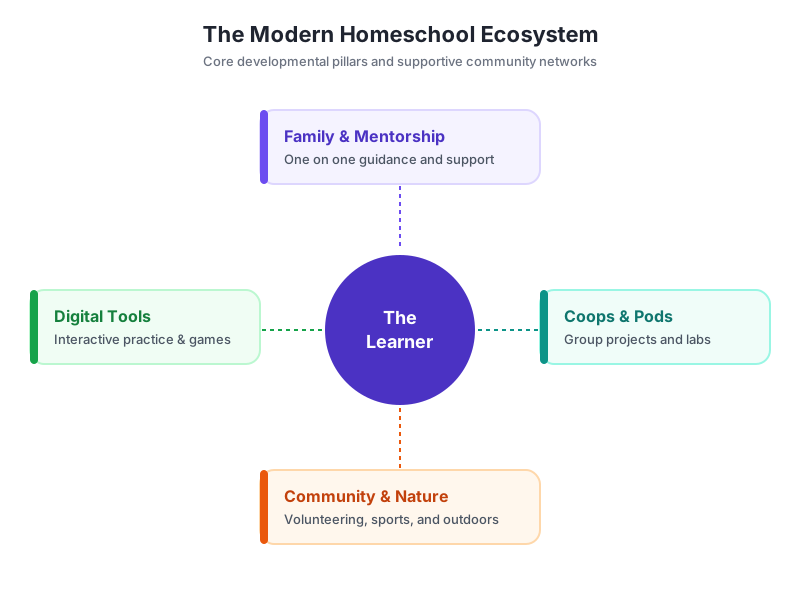
Families practice home learning in several ways, and many combine them:
Independent Learning
Parents choose the books, teach the lessons and keep whatever records local law requires. The most flexible option and the most work.
Homeschool Cooperatives
Families meet weekly and share teaching, often for science labs, art, drama, public speaking and team sports.
Hybrid Programs
Students attend small classes two or three days a week with a teacher and work at home the rest of the time.
Microschools and Pods
Small groups of roughly five to twelve children learn together in a neighborhood space with one paid teacher or a rota of parents.
One distinction matters legally and causes constant confusion. A child enrolled in a tuition-free state online school is a public school student taught at home, subject to attendance and testing rules. A child being homeschooled independently is not. Section 13 covers the difference in detail, and our homeschool resources hub groups practical material by grade and subject.
2. Who Chooses Home Education and Why
Home education is no longer concentrated in one region, income band or religious group. The most reliable national picture comes from the National Center for Education Statistics, which surveys households directly rather than relying on volunteers.
The share of children taught at home rose from 3.7% in 2018 to 2019 to 5.2% in 2022 to 2023. NHERI, using a different method, estimates about 3.4 million students, or 6.3% of the school-age population, in 2024 to 2025. The two figures come from different years and different approaches, so treat the range rather than either number as the answer.
| Reason Given for Homeschooling | Share of Parents Citing It | What Sits Behind It |
|---|---|---|
| Concern about the environment of other schools | 83% | Safety, bullying and peer pressure. Also the single most important reason for 28% of parents, the largest group. |
| To provide moral instruction | 75% | Teaching family values, character and in many cases religious faith alongside academics. |
| To emphasize family life | 72% | More time together, and a schedule that fits work, travel, sport or music. |
| Dissatisfaction with academic instruction | 72% | Pace that does not fit the child, or subjects taught in a way that is not working. |
Parents could select every reason that applied, which is why the shares add up well beyond 100%. Read the first column as how common a concern is, not as a ranking of importance. Source: Parent and Family Involvement in Education, NCES 2023.
3. Academic Results and What They Show
This is the most cited and most misreported area in home education, so it is worth being precise.
The most recent large study is by Brian Ray and Braden Hoelzle in the peer reviewed Peabody Journal of Education, published in 2026 and the first nationwide achievement data on homeschooled students in more than fifteen years. It is open access, so you can read the whole paper rather than taking anyone's summary of it, including ours.
Across reading, language, mathematics, social studies and science, the homeschooled students in the sample recorded mean percentiles of 75 to 79. On a test where the norm group sits at the 50th percentile, that is roughly 25 to 29 percentile points above average.
The more interesting analysis is the second one. The authors compared the homeschooled students with the conventional school norm group while controlling for socio economic status and race or ethnicity, the two factors most often raised to explain the gap away. The advantage held, at weighted mean percentiles of 74 to 82.
Two further patterns appear consistently across this literature. Children taught by parents without a teaching qualification score about as well as those taught by certified teachers, and scores stay high across a wide range of household incomes.
What the evidence does not show
This is still an observational study. Nobody assigned children at random to home or school, so the comparison is between two groups that differ at the outset in ways no statistical control fully removes. Families who choose home education, and who then agree to have their children tested for a study, may simply not resemble families who do not.
Controlling for income and ethnicity, as this study did, closes off the two most obvious objections and makes the finding harder to dismiss. It does not touch the others. Parental involvement, family stability, motivation, hours spent teaching and the willingness to take part in research at all could each account for some of the remaining gap, and none of them were measured.
NHERI, which both produced much of this research and advocates for home education, states the limit in its own summary: current research designs do not prove that homeschooling causes these outcomes, and methodologically stronger studies are needed.
The honest reading is that homeschooled children in these samples do well, that there is no evidence of academic harm, and that the size of any effect caused by homeschooling itself is unknown. That is a good deal more encouraging than the fears families are often met with, and it is not the same as a guarantee.
4. How Children Learn and Why Pacing Helps
Children learn best when a lesson meets them where they actually are. A class of thirty has to move at one speed, which is too fast for some children and too slow for others on the same morning. At home a child can stay on a tricky concept until it lands, or move through familiar material quickly.
Three practical effects follow:
- Less competition for attention: a quiet room lets a child spend their working memory on the problem rather than on filtering out noise.
- Interest carries effort: children who are following a real question, about space or animals or how engines work, will read harder material than they would otherwise attempt.
- One to one is efficient: most elementary aged children finish their core seated work in two to three hours, because almost none of the time goes on transitions and class management.
That efficiency is why home days look short compared with a school timetable, and why a family running six hours of table work usually has a scheduling problem rather than a diligent child. Short practice on the things that need daily repetition works better than long sessions, which is the thinking behind our free learning games for kids.
6. Emotional Wellbeing and Mental Health
Learning at home removes several common sources of daily stress, and adds one for the parent. Both are worth naming.
- Sleep that matches biology: adolescents naturally fall asleep and wake later. A home schedule can protect eight to ten hours of sleep, which affects mood, concentration and health more than almost any study technique.
- Lower social threat: children who have been bullied or made anxious by school often settle quickly once the daily source of it is gone.
- Progress measured against yourself: comparing this month with last month, rather than with the rest of a class, tends to build steadier confidence.
The counterweight is that the parent absorbs a load the school used to carry, and isolation is a real risk for both parent and child in families without a coop or a regular activity. Section 23 covers keeping that sustainable.
7. Support for ADHD, Autism and Dyslexia
Home learning gives a family control over the exact variables that make a classroom difficult for neurodivergent children: noise, lighting, transitions, sitting still, and the requirement to keep pace with everyone else.
- Movement for ADHD: working from a standing table, moving between short blocks or running outside between subjects is straightforward at home and disruptive in a class.
- Predictability for autism: a settled routine and a quiet, controllable sensory environment reduce the load a child is managing before any learning starts.
- Time for dyslexia: structured phonics programs work when a child gets as many repetitions as they need rather than as many as the timetable allows. Short daily sessions such as phonics games suit this better than long ones.
- Two speeds at once: twice exceptional children can work above grade level in one subject while getting patient support in another, which is difficult to arrange in a single classroom.
One practical warning. Withdrawing a child from school usually means giving up the assessments, therapies and legal entitlements attached to an individualized education plan. Some districts still provide services to homeschooled children and many do not, so find out what you would be giving up before you withdraw rather than after.
8. Five Popular Teaching Styles
There is no single method. Most families start with one approach, discover it does not fit the child in front of them, and end up blending two.
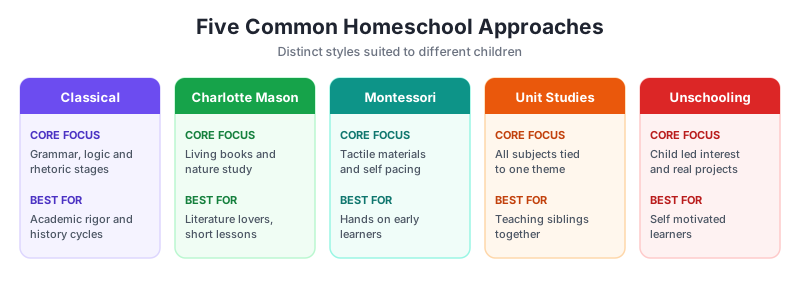
| Teaching Style | How It Works | Suits |
|---|---|---|
| Classical Method | Three stages: memorizing facts, learning to argue, then learning to express. Heavy on history, literature and language. | Children who like structure, strong readers, families who want a clear long-term plan. |
| Charlotte Mason | Living books rather than textbooks, nature journals, narration, and short lessons of around fifteen minutes. | Younger children, families who want gentle rhythms and a lot of time outdoors. |
| Montessori at Home | Hands on materials, practical life skills and long uninterrupted blocks the child directs. | Early years children who learn by handling things and choosing their own work. |
| Unit Studies | All subjects organized around one theme such as oceans, weather or ancient Egypt. | Families teaching several children of different ages at the same time. |
| Unschooling | Learning driven by the child's own questions and real projects, without a set curriculum or tests. | Self motivated children, and parents comfortable without external checkpoints. Hardest to evidence in high regulation states. |
9. Daily Schedules Across Different Ages
Experienced home educators run a rhythm rather than a timetable. Focused bookwork grows with age, and stays far shorter than a school day at every stage.
| Age Group | Focused Bookwork | What the Day Looks Like |
|---|---|---|
| Preschool and Kindergarten (3 to 6) | 30 to 60 minutes | Mostly play. Stories read aloud, drawing, singing, building, and as much time outdoors as the weather allows. |
| Early Elementary (6 to 9) | 1.5 to 2 hours | Morning phonics, handwriting and number facts. Afternoons open for play, projects and nature walks. |
| Middle Grades (9 to 14) | 2.5 to 3.5 hours | Independent reading, pre algebra, history, science experiments, and a weekly coop or club. |
| High School (14 to 18) | 4 to 5.5 hours | Advanced subjects, lab sciences, college classes, languages, sport, work and volunteering. |
Two rules save more days than any schedule design. Put the hardest subject first, while everyone is fresh, and decide in advance what a bad day looks like so that a difficult morning does not write off the whole week. A visible countdown timer also ends a block without an argument, because the clock stops the lesson rather than the parent.
Building the week around those two rules is the subject of our guide to a homeschool daily schedule, including what to drop first on a day that falls apart.
10. Healthy Screen Time and Active Play
Digital tools earn their place when they are doing something a book cannot, and stop earning it when they become the default. The useful distinction is not hours but what the child is doing.
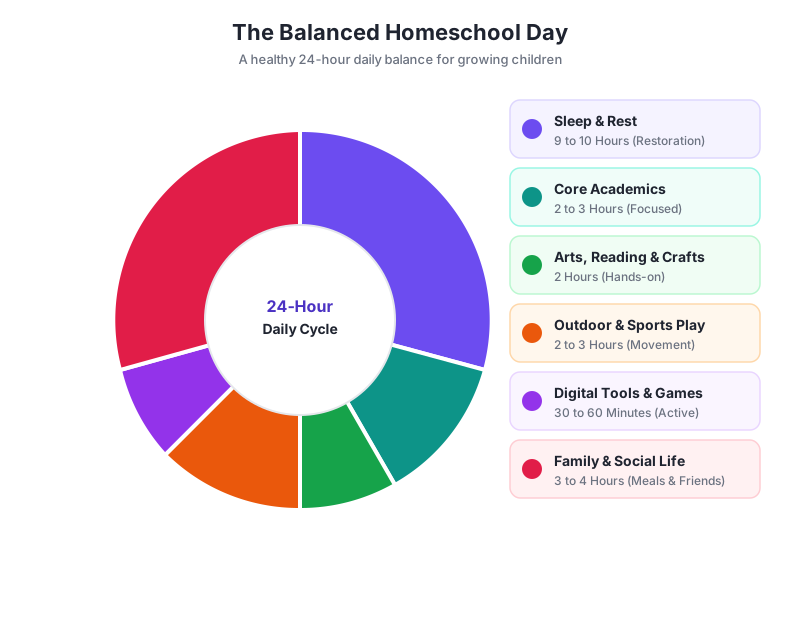
- Active beats passive: writing code, typing, solving problems and answering questions keep a child working. Autoplaying video does not. The American Academy of Pediatrics now recommends a family media plan with consistent limits rather than a single hour count for school age children.
- Move every day: the World Health Organization advises children and adolescents aged 5 to 17 to average at least 60 minutes a day of moderate to vigorous physical activity across the week.
- Rest the eyes: the 20-20-20 habit, looking at something 20 feet away for 20 seconds every 20 minutes, is an eye care convention rather than a WHO or AAP guideline, but it costs nothing and helps with tired eyes.
- Protect sleep: screens in the hour before bed delay sleep onset, which matters more for mood and learning than the total daily count does.
For the hours you want away from a screen entirely, we keep a running list of screen-free activities for kids sorted by age and by how much setup they need.
11. Community Coops and Learning Groups
Coops solve two problems at once. They cover subjects that are hard to teach alone, and they supply the regular peer contact that home days otherwise lack.
- Weekly parent coops: families meet one day a week and share teaching. One parent runs biology, another art, another PE.
- Learning pods: a few families share a space and often hire a tutor between them for a subject none of them wants to teach.
- Special interest clubs: robotics, chess, speech and debate, theater and 4 H, usually mixed age and often the highlight of a child's week.
- Hybrid academies: paid programs offering two or three taught days a week, sitting between a coop and a school.
Coop leaders looking for group activities that work across a wide age range will find plenty in our classroom games guide, most of which need nothing more than a screen and a room.
12. Home School Programs and How They Differ
A home school program is a packaged curriculum that gives a parent a framework to teach from. They fall into three broad shapes, and the right one depends far more on how much structure the parent wants than on the child.
- Boxed or all in one: a complete grade arrives in a box with textbooks, lesson plans, schedules and tests. Scripted, predictable, and the safest starting point for a first year. Less easy to adapt when a child is ahead in one subject and behind in another.
- Modular: the parent picks each subject separately, for example a hands-on science program alongside a literature based history. More work to assemble, much better fit.
- Online and self grading: lessons delivered through a web portal with automatic marking and a parent dashboard. The main attraction is that it removes most of the daily grading, which is what exhausts parents teaching several children.
Online programs vary in one respect that matters for the shape of your day. Asynchronous courses let a child work at any hour, which suits sport, travel and shift working parents. Synchronous courses run live at fixed times with a teacher and classmates, which gives structure and discussion but puts the timetable back. Many families deliberately mix the two, taking live classes for discussion subjects and self paced ones for skills practice.
13. K12 Online School and Virtual Public Options
A K12 online school is a tuition-free public school taught at home over the internet, funded by state tax money and often run with providers such as Stride K12 or Connections Academy.
This is the option most often confused with homeschooling, and the difference is legal rather than cosmetic. A child enrolled in a virtual public school is a public school student. The state supplies the curriculum, usually lends a computer, and provides licensed teachers who set work and issue report cards. In return the family accepts attendance rules, state standardized testing and a curriculum they did not choose.
That trade suits some families very well, particularly those who want the structure and the free equipment, or who are nervous about being solely responsible for a teenager's transcript. It suits others badly, because the thing that drew them to home education, control of pace and content, is precisely what they give up.
| Question | Virtual Public School | Independent Homeschooling |
|---|---|---|
| Who picks the curriculum | The school and the state | The parent |
| Cost | Free, computer usually loaned | Paid by the family, from nothing to a few thousand dollars |
| Attendance and testing | Required, on the state's schedule | Depends entirely on state law |
| Who issues the diploma | The school | The parent, unless enrolled in an accredited program |
14. Planning Kindergarten Through Grade 12
A full home education runs from kindergarten to graduation, and the parent's job changes completely along the way. Families who struggle in the middle years are often still teaching the way they did when the child was six.
| Stage | Core Focus | Parent Role |
|---|---|---|
| Early Years (K to Grade 2) | Phonics, handwriting, number facts, reading aloud together, and a great deal of play. | Teacher and guide, working alongside the child for most of the day. |
| Elementary (Grades 3 to 5) | Reading fluency, writing paragraphs, multiplication, geography and nature study. | Instructor, teaching directly and building steady daily habits. |
| Middle School (Grades 6 to 8) | Pre algebra, essays, source based history, experiments, and learning to manage a deadline. | Mentor, handing over ownership of the work bit by bit. |
| High School (Grades 9 to 12) | Lab sciences, advanced math, languages, college credit and career direction. | Counselor, keeping the transcript and managing applications. |
Number facts are the clearest example of work that belongs to the child rather than the parent. Ten focused minutes of times tables flashcards that mark themselves gives a parent ten minutes with another child, and gives this one more repetitions than most adults have patience to supply.
15. Accredited Programs and Online Schools
Accreditation means an outside agency has reviewed a school or provider against standards for academic quality, teacher qualifications and record keeping. The recognized agencies in the United States include Cognia, the Middle States Association and the Western Association of Schools and Colleges.
Accreditation is worth paying for in four situations: you expect to move a child back into a conventional school, you are chasing NCAA Division I or II athletic eligibility, you are living or moving abroad where a recognized diploma is expected, or you simply do not want to be responsible for the transcript. Outside those cases it is optional, and plenty of families never need it.
Established accredited online schools include Laurel Springs School, Stanford Online High School, Oak Meadow and Penn Foster High School. They differ enormously in cost, admission selectivity and teaching style, so compare the actual course list and the total annual fee rather than the marketing.
One caution worth stating plainly. Accreditation is a statement about administrative standards, not a guarantee that a program will suit your child, and an unaccredited curriculum is not a lesser education. Colleges admit homeschooled applicants on parent-issued transcripts every year.
16. Christian Homeschool Curriculum
Faith based programs are a large part of the home education market, which follows from the survey data in Section 2: three quarters of homeschooling parents give moral instruction as one of their reasons. These programs integrate a biblical framework into ordinary academic subjects, and they differ from each other as much as any secular curricula do.
- Abeka: traditional and highly structured, strong on early phonics and arithmetic drill, with full video lessons available.
- BJU Press: more emphasis on conceptual understanding and critical thinking, with colorful science and history texts.
- Apologia: conversational science texts and hands-on lab notebooks, written from a young earth creation position.
- Sonlight: literature based, teaching history and cultures through read aloud books rather than textbooks. Popular with families schooling several ages together.
- Classical Conversations: a network of weekly local communities following a classical model, so it supplies a curriculum and a coop in one.
Two practical notes for families comparing them. Several of these publishers take a clear doctrinal position, particularly in science, so read the sample chapters on origins and history before committing to a full grade. And the structured drill heavy programs are effective but unforgiving of a bad week, which is worth knowing before you buy twelve months of it.
17. Free Homeschool Curriculum
A complete education does not require an expensive box. Several organizations publish full curricula at no cost, and a family using them plus a library card can educate a child properly for close to nothing.
- Khan Academy: free video courses and practice from early arithmetic through calculus, plus science, computing and history. The math sequence is strong enough to serve as a spine.
- Easy Peasy All-in-One Homeschool: a complete day-by-day curriculum for kindergarten through grade 12, written by a homeschooling parent and free to use.
- Ambleside Online: a full Charlotte Mason curriculum with booklists and schedules, built around books largely available free in the public domain.
- CK-12 Foundation: free customizable digital textbooks and science simulations aligned to standards, useful for middle and high school.
- Core Knowledge Foundation: free downloadable teacher guides, readers and activity books, especially strong for language arts and history.
Free curricula ask more of the parent than paid ones. They rarely include ready made tests or records, and Ambleside in particular assumes you will source a stack of books yourself. Budget the time you save in money as time spent planning.
GamesMom fits alongside these rather than replacing them. Our free practice tools cover number facts, sight words, spelling, geography, science and typing, and our printable packs cover the same ground away from a screen for families who want part of the day off devices.
18. Online Schooling for High School
High school is where families most often bring in outside teaching, for the sensible reason that few parents are equally confident in chemistry, calculus and a foreign language. Online courses let a family buy in exactly the subjects they need without giving up control of the rest.
- Advanced Placement and honors courses: college level work with a qualified teacher and an externally recognized exam result, which is useful evidence on a parent-issued transcript.
- Dual enrollment: community college classes taken in grades 11 and 12 that count for both high school and college credit. Often the single best value option, and the transcript comes from the college.
- Flexible scheduling: self paced courses fit around serious sport, music training, an internship or a job.
- Portfolios: lab notebooks, coding projects and written work assembled over four years, which admissions officers can actually read.
Practical advice: pick courses that produce external evidence wherever you can, because an AP score or a college transcript answers the question a parent-issued grade raises. Typing speed also stops being a nice extra at this stage and becomes a bottleneck for essays and timed exams, which is what our free typing course for kids is for.
19. United States Laws and Senate Updates
Homeschooling is legal in all fifty states. What differs is how much you must tell the state and how often you must prove the child is learning. Check your own state directly through the HSLDA state law summaries before you rely on any general description, including this one.
| Oversight Level | Example States | Typically Required |
|---|---|---|
| Low | Texas, Idaho, Illinois, Indiana, Oklahoma, Alaska | A one time notice or nothing at all. Parents choose curriculum and keep their own records. |
| Moderate | California, Florida, Ohio, Virginia, North Carolina, Georgia | Annual notification plus a yearly progress review or standardized test result. |
| High | New York, Pennsylvania, Massachusetts, Rhode Island | An annual instruction plan, periodic progress reports, and approved testing or evaluation. |
Legislation in the United States Senate
Two bipartisan bills were before the Senate as of August 2026, both supported by HSLDA. Neither had become law at the time of writing, so treat them as proposals rather than current rules.
- Home School Graduation Recognition Act: would amend federal education law so that homeschool diplomas are treated equally with public and private school diplomas, confirming that homeschool graduates qualify for federal student aid.
- COMPASS Act: would let military families moving on orders choose whether to follow the homeschool law of their permanent home state or of the state they are posted to.
20. Global Laws and International Rights
Article 26 of the Universal Declaration of Human Rights states that parents have a prior right to choose the kind of education given to their children. National law varies widely in how far it honors that.
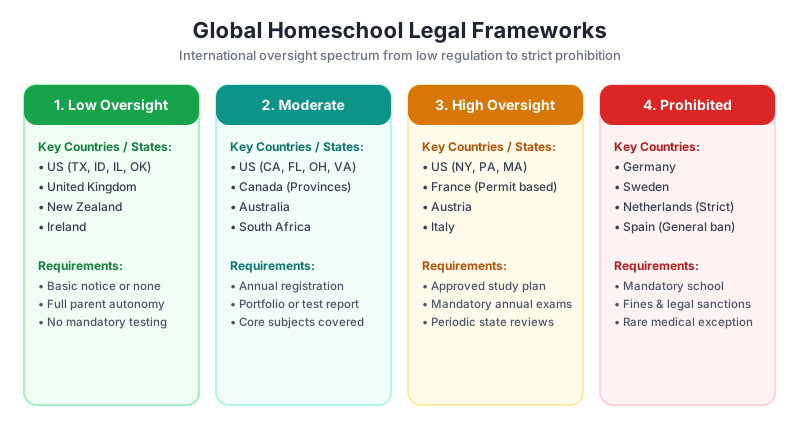
- England: home education remains legal under Section 7 of the Education Act 1996, which requires a suitable education by schooling "or otherwise". This is changing. The Children's Wellbeing and Schools Act received Royal Assent on 29 April 2026 and will require every local authority to keep a register of children not in school. The measures are not yet in force and await further regulations, so families should follow the House of Commons Library briefing on home education for the implementation timetable.
- Canada, Australia and New Zealand: legal across all provinces and states, with registration requirements that vary by jurisdiction.
- Continental Europe: Ireland, Italy, Norway and Austria permit home education. Germany and Sweden enforce compulsory school attendance with very narrow exceptions, and home education is effectively unavailable in both.
- International guidance: UNESCO has examined homeschooling through a human rights lens, weighing parental choice against every child's right to a quality education and to be seen by the system at all.
21. Costs and Education Savings Accounts
Direct costs usually run between about 500 and 2500 dollars per child per year for curriculum, supplies and outside classes. The larger cost is rarely on that list: home education generally means one parent earning less or not at all, and that is the number that decides it for most families.
- Education Savings Accounts: as of 2026, EdChoice counts 21 ESA programs across 18 states, including Arizona, Florida, Iowa, Utah and West Virginia, typically worth a few thousand dollars a year for approved curriculum, tutoring, supplies and testing.
- Read the conditions before accepting one: in several states taking public money changes your legal status, brings testing or reporting requirements, or means you are no longer classified as a homeschooler at all. The money is real and so are the strings.
- Keeping it cheap is genuinely possible: a library card, a free curriculum from Section 17 and free practice tools such as math practice for kids cover the core subjects at no cost.
- Where the money actually goes: for most families the biggest single line after curriculum is outside activities, because sport, music and coop fees add up faster than books do.
22. High School, Diplomas and College Entry
Homeschooled teenagers enter selective universities, community colleges, trade programs and the military every year. Admissions officers are long past treating home education as unusual, but they do need documentation, and that is the parent's job.
- The transcript: a parent-issued document listing courses, credit hours, grades and a grade point average. Start it in grade 9 rather than reconstructing it in grade 12.
- External evidence: SAT, ACT or CLT scores, AP results and community college grades all corroborate a parent-issued transcript, which is why they matter more for homeschooled applicants than for others.
- Dual enrollment: college classes in grades 11 and 12 give credits, a genuine college transcript and proof the student can handle college work.
- NCAA eligibility: student athletes must register with the NCAA Eligibility Center and submit course descriptions and evidence. The requirements are specific, and this is the one area where planning from grade 9 is not optional.
Requirements differ by college and by country. Contact the admissions office of any institution you are serious about, early, and ask exactly what they want from a homeschooled applicant.
23. Parent Rest and Avoiding Fatigue
Parent burnout is the most common reason families stop homeschooling, and it is far more often caused by the schedule than by the child.
- Stop recreating a school day: two to three focused hours is a full academic day for a young child. A six hour timetable is a design error.
- Protect a quiet hour: a fixed afternoon reading time gives every person in the house, including the adult, an hour that is theirs.
- Hand over the drilling: self marking practice and a weekly coop remove the two heaviest loads, grading and teaching everything alone.
- Talk to experienced parents: most panics in a first year are normal and temporary, and the fastest way to learn that is from someone three years ahead.
- Allow yourself to change course: a curriculum that is not working is information, not failure. Families who switch when something is wrong last longer than those who push through on principle.
24. Helpful Tips for Families and Teachers
Practical suggestions drawn from the evidence in this review:
For Parents
Protect sleep, outdoor time and reading aloud before anything else. Keep the academic day short and finish it. Arrange social life deliberately rather than hoping it happens.
For Teachers and Schools
Treat home educating families as partners. Allowing part-time access to sports, music, labs and exams costs a school little and serves children who may well return.
For Policy Makers
Keep reporting proportionate, make funding rules explicit about what accepting them changes, and ensure children who are not in school remain visible to services that protect them.
For Tool Creators
Build for active thinking rather than passive watching, work without an account, and collect nothing from children. Parents should not have to audit a product to trust it.
Simple Glossary of Terms
- Accreditation
- Formal review of a school or program by an outside agency against standards for teaching, records and academic quality. Useful for transcripts and transfers, and not required to homeschool.
- Deschooling
- A deliberate rest period after leaving school, before formal lessons begin, to reset a child's attitude to learning.
- Dual Enrollment
- Taking community college classes during high school so one course earns both high school and college credit.
- Education Savings Account (ESA)
- A state program giving eligible families public funds for approved curriculum, tutoring and supplies. Conditions vary and can change a family's legal status.
- Homeschool Cooperative (Coop)
- A group of families meeting regularly to share teaching, labs, sports and social time.
- Living Books
- Books written by an author with real enthusiasm for the subject, used in place of textbooks in Charlotte Mason and literature based programs.
- Mastery Learning
- Moving on only once a child has genuinely understood the current concept, rather than when the schedule says so.
- Microschool
- A small learning group, roughly five to twelve children, taught together in a shared space.
- Twice Exceptional
- A child who is gifted in some areas and has a learning difficulty or disability in others, needing extension and support at the same time.
- Unschooling
- Child led learning without a set curriculum, following the child's own questions and projects.
- Virtual Public School
- A tuition-free public school taught online at home. The child is legally a public school student, not a homeschooler.
About GamesMom research reviews
GamesMom publishes free, child-safe browser games, printables and practice activities for children from preschool through elementary school. There are no accounts, no downloads and no ads inside the play area.
Our research reviews exist because the guidance parents and teachers need is published, public and nearly unreadable. Each review reads a small number of authoritative sources, states what they say, links them, and says where the evidence stops. They are written by the GamesMom editorial team, checked against the live sources on the publication date, and corrected when a source changes. They are not medical guidance, and they are not original research. If something about your child worries you, the people to ask are the ones who know your child: their teacher, and their doctor. The other reviews are in our research library.
This review draws on the National Home Education Research Institute, the National Center for Education Statistics, the Peabody Journal of Education, UNESCO, the World Health Organization and the UK House of Commons Library. Every document is listed below, linked to the original.
References
Every source this review draws on, linked to the original document rather than to a summary, so you can check any claim yourself.
Links checked on September 20, 2026. If one has moved since, the publisher's own search will find the document from the citation above.
Frequently Asked Questions About Modern Homeschooling
What is homeschooling and how does it work today?
Homeschooling is parent-directed education where families guide their children outside a standard classroom. Today it includes structured home school programs, online courses, cooperative groups, hybrid schools that meet part of the week, and flexible family learning.
What is the difference between a K-12 online school and independent homeschooling?
A K-12 online public school is a tuition-free public school taught at home with state-certified teachers, attendance rules and state testing, and the child is legally a public school student. Independent homeschooling means the parent chooses the curriculum, the schedule and the pace, and the child is not enrolled in a public school.
Are accredited homeschool programs necessary for college admissions?
No. Accreditation helps with official transcripts, transferring back into a school and NCAA athletic eligibility, but colleges across the United States regularly admit students on a parent-issued transcript together with SAT, ACT or CLT scores. Requirements vary by college, so check each one directly.
Where can families find free homeschool curriculum?
Complete free curriculum is available from Khan Academy, Easy Peasy All-in-One Homeschool, Ambleside Online, the CK-12 Foundation and the Core Knowledge Foundation, alongside public libraries and free practice tools such as those on GamesMom.
How do homeschool academic test scores compare to public schools?
A 2026 study by Ray and Hoelzle in the Peabody Journal of Education found homeschooled students scored about 25 to 29 percentile points above the test norms across five subjects, placing the averages near the 75th to 79th percentile. The authors note the study is observational rather than a randomized experiment, and that families who homeschool and agree to be tested may differ from those who do not, so the gap should not be read as proof that homeschooling itself causes higher scores.
5. Social Life and Making Friends
Socialization is the first objection most families hear, and it rests on an assumption worth examining: that spending the day with thirty children of exactly the same age is the normal way to learn social skills. Homeschooled children generally mix across a wider age range, with adults in the community, and in activities they chose.
NHERI reports that homeschooled students are regularly involved in activities outside the home, including field trips, scouting, 4 H, church groups, sports teams and volunteer work. Precise participation rates vary by study and none should be quoted as a settled national figure.
Community Activities
Sports clubs, swimming, martial arts, dance, music groups and 4 H provide the regular peer contact a school day would otherwise supply.
Friends of All Ages
Mixed age coops mean children talk with younger children, peers, teenagers and adults in the same afternoon.
Fewer Forced Dynamics
Friendships are chosen rather than assigned by timetable, which removes some of the pressure that fuels bullying.
Community Volunteering
Families volunteering together at food banks, gardens and animal shelters builds social confidence with a real purpose.
The fair caution is that none of this happens automatically. Social life at home is something a parent has to arrange deliberately, and families who do not arrange it will find the objection becomes true. Our longer piece on homeschool socialization covers how families actually build that week.