
Secondary Research Review by gamesmom.com, 2026 Edition
Developmental Milestones for Children Aged 2 to 8
Fine Motor Skills, Screen Time and Daily Activity from Age 2 to Age 8
Developmental milestones at a glance
Parents and teachers are handed a great deal of conflicting advice about what a young child should be able to do, and by when. Much of it comes from sources with nothing behind them. Meanwhile the organizations that do publish carefully checked guidance, chiefly the Centers for Disease Control and Prevention, the American Academy of Pediatrics and the World Health Organization, write for clinicians, in language that is hard to use on a Tuesday morning in a classroom of twenty five children.
This is secondary research. We ran no study of our own. We read the primary reports and checklists that those organizations have already published, checked what they say, and set it out in plain English for parents, teachers and anyone deciding what young children need. It covers developmental milestones by age, fine motor skills, screen time and daily activity for children aged two to eight. Everything here is quoted from its source, and every source is linked so you can read the original.
Five things worth knowing about developmental milestones
- A milestone is not an average. Since 2022 a skill only appears on a CDC checklist for an age if three quarters of children can already do it. Missing one is a reason to ask a question, not a reason to panic, and it is no longer a reason to be told to wait and see.
- The official checklists stop at five. There is no CDC milestone list for a seven year old. Anything you read about what a seven year old "should" be doing comes from somewhere else, usually a school curriculum, and should say so.
- The CDC does not sort skills into fine and gross motor. It uses four areas: social and emotional, language and communication, cognitive, and movement and physical development. Charts that promise you a CDC fine motor list have reorganized it themselves.
- Only one pencil hold appears in the official guidance. By age four, most children hold a crayon or pencil between their fingers and thumb rather than in a fist. The detailed stage-by-stage sequences you find elsewhere come from occupational therapy practice, not from the CDC checklists.
- Hand skills at school entry track with early school results. A 2012 study in Child Development found that both fine motor skill and self-control predicted how kindergarten children did on standardized tests, with copying designs the strongest of the hand measures.
This is secondary research, not our own study
Secondary research means gathering what has already been published and presenting it usefully. We tested no children and collected no data of our own. What we did was read the primary sources, check that each claim matches what the source actually says, and rewrite it in plain English.
That makes this review useful in one specific way: the organizations below publish carefully checked guidance, and they publish it for professionals. This page carries the same information to the people who use it every day, without adding anything to it.
Where the information comes from
- Centers for Disease Control and Prevention: the milestone checklists for each age, from its Learn the Signs. Act Early. program.
- American Academy of Pediatrics: the 2022 revision of those checklists, published in its journal, and its guidance on young children and screens.
- World Health Organization: the 2019 guidance on daily activity, sitting still and sleep for children under five.
- Center on the Developing Child at Harvard University: its plain language explanation of the thinking skills behind planning and self control.
- One peer reviewed study in the journal Child Development, on hand skills and early school results.
- National Association for the Education of Young Children: its position statement on teaching practice that fits the child.
We are an education website, not a health one. Nobody at GamesMom is qualified to give health advice, and this page does not try to. It reports what the organizations above have published, nothing more. If anything about your child is worrying you, the people to ask are your child's doctor and your child's teacher. That is also exactly what the CDC itself tells families to do.
How We Made This Review
Sources were chosen on one test: does the organization publish the guidance itself, and can a reader reach the original in one click? That ruled out the aggregator sites and the parenting blogs that most milestone articles quote from, and left the agencies, the professional bodies, one peer-reviewed study and one university research center that produced the material in the first place.
For each age, the tables below reproduce what the CDC's own checklist for that age says, in the CDC's own four categories and close to its own wording, with the specific page linked. Where a claim comes from somewhere other than the CDC, the text says so in the sentence rather than leaving you to guess from a number at the end.
Two ordinary practices are worth naming, because their absence is how milestone articles go wrong. Nothing was quoted from memory: every checklist item here was read from the live page on the date of publication. And nothing was included because it sounded right. Several widely repeated claims did not survive the check and are not in this review.
1. What a developmental milestone means, and what changed in 2022
In 2022 the CDC and the AAP revised the milestone checklists used in the "Learn the Signs. Act Early." program. The revision was published in Pediatrics by Zubler and colleagues, and it changed the question each checklist asks.
The old checklists were built around the 50th percentile: the age by which half of children could do something. That sounds reasonable and works badly. If half of children cannot yet do a thing at the listed age, then a child who cannot do it is unremarkable, so a parent raising it was often told to wait and see. Waiting costs time in the years when support helps most.
The revised checklists use the 75th percentile instead. A skill only appears at an age if roughly three quarters of children can already do it. That makes a missing skill worth a conversation rather than a shrug. The published article reports that most of the revised milestones had normative data behind their placement, and the authors are explicit that the checklists exist to prompt a conversation at an ordinary check-up, and that they do not replace the fuller checks a doctor can carry out.
Two practical consequences follow for anyone reading a chart. First, a milestone list from before 2022 is answering a different question, so old printouts and old blog posts are not simply out of date, they are differently calibrated. Second, because the bar is what most children do, a checklist is a poor way to measure a child against other children. It tells you whether to ask someone, and nothing else.
2. The four areas of child development the checklists cover
The CDC checklists group everything a child does into four areas. They are worth knowing because almost every other chart on the internet regroups them, usually into fine motor and gross motor columns that the CDC itself does not use.
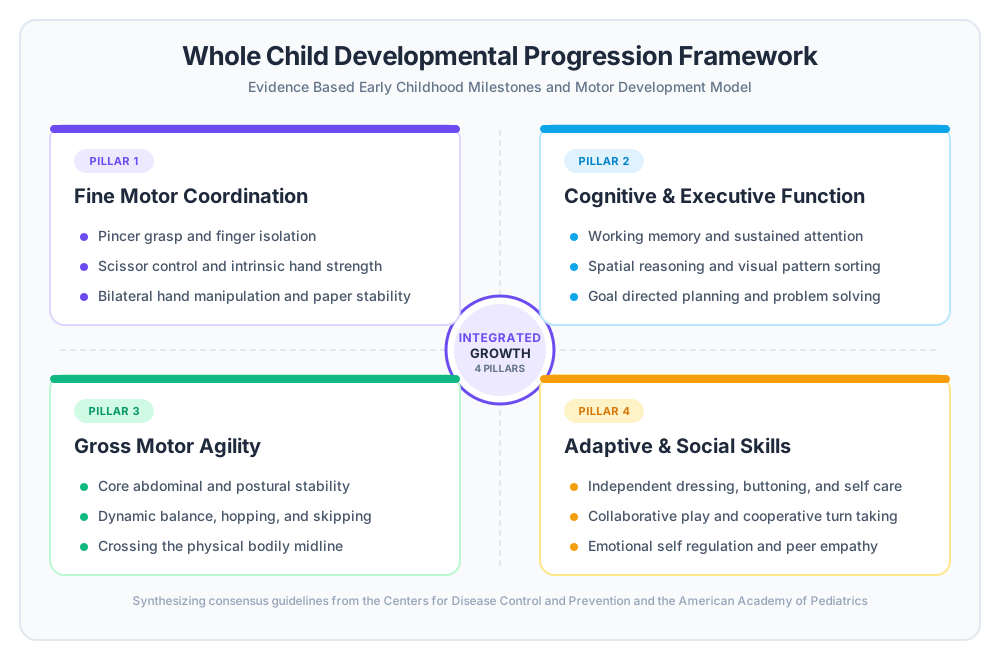
- Social and emotional: noticing when someone else is upset, joining other children, taking turns in a game.
- Language and communication: putting words together, asking questions, telling you what happened today.
- Learning and thinking, which the CDC calls cognitive: drawing a circle after a demonstration, naming colors, counting, holding one thing while using the other hand.
- Movement and physical development: running, stairs, buttons, using a fork, holding a crayon.
Notice where the hand skills sit. Threading beads, using a fork and holding a pencil are movement milestones, while copying a shape is a thinking milestone. The split is a fair reflection of how the two work together, and it is the reason this review does not give you a fine motor column.
3. Developmental milestones by age 2
Between two and three a child moves from exploring with the whole body to handling things on purpose. The list below is the CDC checklist for two years.
| Area | What most children (75 percent or more) do by 2 years |
|---|---|
| Social and emotional | Notices when others are hurt or upset. Looks at your face to see how to react in a new situation. |
| Language and communication | Points to things in a book when asked. Says at least two words together. Points to at least two body parts. Uses gestures beyond waving and pointing. |
| Learning and thinking | Holds something in one hand while using the other. Tries switches, knobs and buttons on a toy. Plays with more than one toy at the same time. |
| Movement and physical | Kicks a ball. Runs. Walks up a few stairs with or without help. Eats with a spoon. |
The holding-while-using milestone is the one to watch, because it is the start of the two hands doing different jobs. A two year old steadying a pot with one hand and lifting the lid with the other is practicing the same arrangement they will later use to hold paper still while cutting it.
4. Developmental milestones by age 3
At three, hands become noticeably more precise and speech becomes understandable to people outside the family.
| Area | What most children do by 3 years |
|---|---|
| Social and emotional | Calms down within about ten minutes after you leave, such as at a childcare drop off. Notices other children and joins them to play. |
| Language and communication | Talks with you using at least two back-and-forth exchanges. Asks who, what, where or why questions. Says what is happening in a picture. Says their first name. Talks well enough for others to understand most of the time. |
| Learning and thinking | Draws a circle after you show them how. Avoids touching hot objects when warned. |
| Movement and physical | Strings items together, such as large beads or macaroni. Puts on some clothes alone, such as loose pants or a jacket. Uses a fork. |
Drawing a circle after a demonstration is a bigger moment than it looks. The child has to watch what you did, keep it in mind, and make their hand reproduce it, which is why the CDC files it under thinking rather than movement. Activities that ask for the same watch-then-copy loop suit this age, which is what our preschool games are built around.
5. Developmental milestones by age 4
Four is the age at which the pencil hold most families worry about actually appears in the official guidance.
| Area | What most children do by 4 years |
|---|---|
| Social and emotional | Pretends to be something else in play. Asks to play with other children. Comforts others who are hurt or sad. Avoids danger. Likes to be a helper. Behaves differently in different places. |
| Language and communication | Says sentences of four or more words. Says some words from a song, story or rhyme. Talks about one thing that happened during the day. Answers simple questions such as what a coat is for. |
| Learning and thinking | Names a few colors. Says what comes next in a well known story. Draws a person with three or more body parts. |
| Movement and physical | Catches a large ball most of the time. Serves food or pours water with supervision. Unbuttons some buttons. Holds a crayon or pencil between fingers and thumb, not in a fist. |
That last line is the whole of what the CDC checklists say about pencil grip, and it is worth reading closely. The milestone is fingers and thumb rather than a fist. It does not specify how many fingers, and it says nothing about the shape a writing teacher might prefer.
6. Developmental milestones by age 5 and kindergarten readiness
Five is the last age with a CDC checklist, and it is the one most closely tied to starting school.
| Area | What most children do by 5 years |
|---|---|
| Social and emotional | Follows rules or takes turns in games with other children. Sings, dances or acts for you. Does simple chores, such as matching socks or clearing the table. |
| Language and communication | Tells a story with at least two events. Answers simple questions about a book or story. Keeps a conversation going over more than three exchanges. Uses or recognizes simple rhymes. |
| Learning and thinking | Counts to 10. Names some numbers between 1 and 5 when you point. Uses time words such as yesterday and tomorrow. Pays attention for five to ten minutes during an activity, not counting screen time. Writes some letters in their name. Names some letters when you point. |
| Movement and physical | Buttons some buttons. Hops on one foot. |
Two things stand out for anyone preparing a child for school. Writing some letters of their own name is the bar, not writing the alphabet, and the attention milestone explicitly excludes time in front of a screen, which is a useful distinction when judging whether a child can sit with a task. Our kindergarten games are grouped around the same skills this checklist names.
7. Ages 6 to 8, where the milestone checklists stop
The CDC checklists end at five. This is the single most useful thing to know about milestone charts, and almost nothing written for parents says it. If you find a table telling you what a seven year old should be able to do and it carries a CDC or AAP logo at the bottom, check what it is citing, because those organizations publish developmental milestones through age five, and the AAP's parent facing Ages and Stages pages continue past that as general guidance rather than as checklists.
After five, expectations mostly come from schools, and they are written as curriculum standards rather than developmental milestones. The two are different in kind. A milestone describes what most children do without being taught. A standard describes what a school intends to teach and then assess, which is why standards vary between countries while milestones largely do not.
For these ages the honest answer is that handwriting, cutting and ball skills keep improving with practice and vary widely between children in the same class, and that the useful comparison is the child against themselves a term ago. The practice material we group for this stage sits in our 1st grade games.
8. Fine motor skills and how to hold a pencil
How to hold a pencil is the question teachers are asked most, and fine motor skills is the phrase parents search for when they ask it. It helps to separate two things: what the official guidance states, and what the people who work with children's hands describe.
What the guidance actually says about pencil grip
The guidance states one thing. By age four, most children hold a crayon or pencil between their fingers and thumb rather than in a fist. That is it.
Beyond that, occupational therapists commonly describe a sequence that a hold passes through as a child grows, from a whole-fist hold in the toddler years, through a hold with the fingers pointing down at the paper, to holding it near the tip with the fingers doing the work. The American Occupational Therapy Association is the professional body for that field. This review does not put ages on those steps, because the age bands quoted around the internet vary from source to source and we found no single published document behind the exact figures that get repeated.
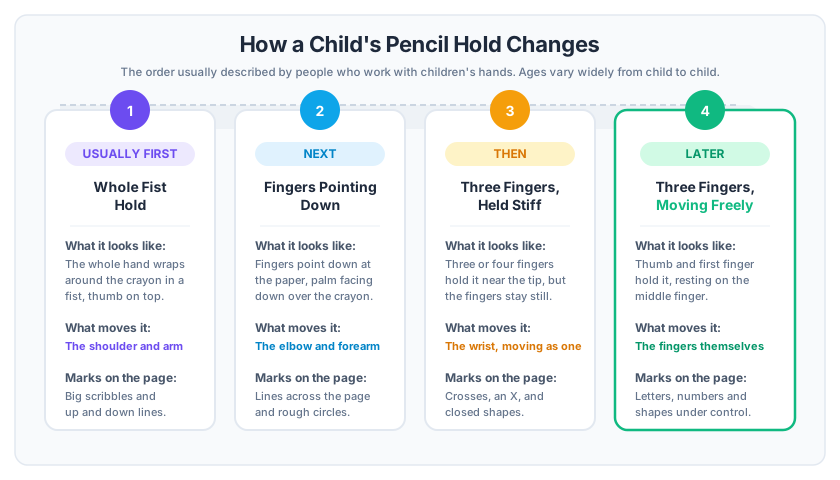
The practical point for a parent or a teacher is that a hold changes as a hand gets stronger, and that pushing a three year old into the hold a six year old uses tends to produce a tight grip and a child who would rather not draw. Short, frequent chances to make marks do more than correction does, which is the reasoning behind our letter tracing activity.
9. Two handed skills, from scissors to buttons
Cutting, threading and steadying paper all need the two hands doing different jobs at the same time. One hand does the work and the other holds the material still. It is easy to miss, because the helping hand looks like it is doing nothing.
The checklists track this from early on: holding something in one hand while using the other at age two, stringing beads at three, unbuttoning at four, buttoning at five. Scissors are the demanding version, because the cutting hand has to open and close while the other hand turns the paper to meet it. Printed sheets give a reason to hold paper steady, which is part of why we keep a set of free printables alongside the games, and why letter and word sheets such as the kindergarten sight words pack ask for cutting as well as reading.
10. Fine motor skills and early learning
Fine motor skills and thinking skills are not separate tracks. The clearest evidence comes from a 2012 study in the journal Child Development by Cameron and colleagues, which followed children into kindergarten. It found that fine motor skill and self control each made their own contribution to how children scored on standardized achievement tests at kindergarten, and that among the hand measures, copying designs was the one that predicted scores most strongly.
That is a narrower claim than the ones usually made about this study, and it is worth stating carefully. It is a link between skills measured around the same time, in one sample, not a demonstration that practicing with scissors raises reading scores years later. What it does support is treating drawing, copying and building as school-readiness activities rather than as a break from them.
What self control has to do with it
Researchers call it executive function: holding a plan in mind, resisting the obvious wrong move, and adjusting when something changes. The Center on the Developing Child at Harvard University publishes the clearest plain language explanation of it. Games that ask a child to hold a rule in mind while they play are practicing exactly that, which is what a round of matching games asks for, and the same demand runs through our memory games.
11. Screen time guidance for young children
The AAP's guidance for young children, published in Pediatrics as Media and Young Minds, is more specific than the headline number suggests. For children under about 18 months it advises avoiding screen media other than video chat. Between 18 and 24 months, if parents want to introduce media, the advice is to choose high-quality programming and watch it with the child. For ages two to five the recommendation is to limit screen use to one hour a day of high-quality programming, again with an adult alongside, helping the child understand what they are seeing.
The part that gets dropped in summaries is the adult. In the AAP guidance the co-viewing is not a nicety, it is the mechanism: young children learn considerably better from media when someone talks to them about it than when they watch alone.
It is also worth separating watching from doing. A child watching videos play one after another is doing something different from a child deciding, pressing and seeing what happens, even though both are sitting in front of a screen. Neither replaces moving about or being read to. For older children, practice that needs both hands and a decision on every keystroke is the most defensible kind of screen time we offer, which is what our typing games are for.
12. How much daily activity young children need
The World Health Organization published guidelines in 2019 covering activity, sitting still and sleep for children under five. For three and four year olds the recommendation is at least 180 minutes of activity spread across the day, of which at least 60 minutes is the energetic kind that leaves a child out of breath, plus no more than one hour of sedentary screen time and a regular sleep routine.
Three hours sounds like a lot until you count what it includes. Walking to the shops, playing in the yard, dancing in the kitchen and climbing at the park all count, and the guideline is explicit that the activity can be of any intensity for most of that time. For children over five the WHO's broader guidance moves to an average of 60 minutes a day of moderate to vigorous activity.
13. Fine motor activities for home and the classroom
None of this needs equipment. The fine motor activities below appear repeatedly in early years practice because they ask for the grip and the two handed arrangement that writing later needs, and because children will do them for their own sake.
Fine motor activities with things you already own
- Dough, putty and clay. Rolling, pinching and squashing ask for sustained effort from the whole hand in a way that a touchscreen never does.
- Threading and lacing. Beads on a lace, pasta on a string. The CDC lists stringing items at age three, so this is a milestone activity rather than a substitute for one.
- Tongs, tweezers and pegs. Moving cotton balls from one bowl to another with kitchen tongs uses the same finger and thumb pinch as holding a pencil.
- Tearing and crumpling paper. Free, endless, and it needs both hands doing different things.
- Short crayons. A broken crayon is too small to hold in a fist, so it quietly encourages the fingers and thumb hold without anybody being corrected.
The one activity the research keeps pointing at
- Drawing to copy. Circles at three, a person with a few body parts at four, some letters of their name at five. Copying is the activity the research keeps pointing at.
The NAEYC position statement on developmentally appropriate practice is the reference worth reading for the principle underneath all of this: match what you ask of a child to where that child is, rather than to the age printed on the box.
14. When to ask someone about your child
This is the part where an education website should be careful, so this section says only what the agencies themselves say.
The CDC's instruction to families is short and it does not ask anyone to interpret anything. Talk to your child's doctor if your child is not meeting one or more of the milestones for their age, if they have lost a skill they once had, or if anything else about their development concerns you. The CDC states plainly that acting early makes a difference, and its checklists are designed to prompt that conversation rather than to answer it.
Two details often get lost. Losing a skill a child previously had is on the list in its own right and does not wait for an age. And the CDC says plainly that its checklists do not replace the fuller checks a doctor can carry out, which is worth remembering about any checklist you find online, including this one.
15. What this review cannot tell you
Naming the limits is part of the job.
- It is not about your child. Everything here describes groups of children. No general document can tell you whether a particular child is fine.
- It is heavily United States based. The CDC and the AAP are American bodies. The WHO guidance is global, but the milestone checklists are not, and other countries publish their own with different wording and timing.
- Milestones are not a ranking. A checklist marks the level most children have passed. It was never built to sort children, and using it that way misreads it.
- Sources change. The CDC reorganized its milestone pages between 2024 and 2026, which broke a great many links in older articles. The links here were checked on the publication date and we recheck them when this review is updated.
- Some popular claims are missing on purpose. Widely repeated figures about falling hand strength in kindergarten children, and precise ages for each stage of pencil hold, were left out because we could not trace them to a published source we could link.
About GamesMom research reviews
GamesMom publishes free, child-safe browser games, printables and practice activities for children from preschool through elementary school. There are no accounts, no downloads and no ads inside the play area.
Our research reviews exist because the guidance parents and teachers need is published, public and nearly unreadable. Each review reads a small number of authoritative sources, states what they say, links them, and says where the evidence stops. They are written by the GamesMom editorial team, checked against the live sources on the publication date, and corrected when a source changes. They are not medical guidance, and they are not original research. If something about your child worries you, the people to ask are the ones who know your child: their teacher, and their doctor. The other reviews are in our research library.
This review draws on the Centers for Disease Control and Prevention, the American Academy of Pediatrics and the World Health Organization. Every document is listed below, linked to the original.
References
Every source this review draws on, linked to the original document rather than to a summary, so you can check any claim yourself.
Links checked on September 20, 2026. If one has moved since, the publisher's own search will find the document from the citation above.