
Teach Your Kids How to Play Chess
Chess looks hard from the outside. Six kinds of pieces, a big board, and players who stare and think. But the rules are simpler than they seem, and a child can learn them in one sitting. This guide starts at the very beginning. You will learn how to set up the board, how each piece moves, and the first few ideas that help a beginner stop losing and start winning. Read a little, then try it out on a free chess game for kids as you go.
What is chess?
Chess is a game for two players. One player has the white pieces and the other has the black pieces. Each player has sixteen pieces to start. You take turns moving one piece at a time. The goal is to trap the other player’s king so it cannot get away. That trap is called checkmate, and it ends the game.
You do not need to capture every piece to win. You only need to catch the king. Everything else is a way to get there.
Setting up the board
Set the board so each player has a white square in the bottom right corner. A quick way to remember this is the rhyme “white on the right.”
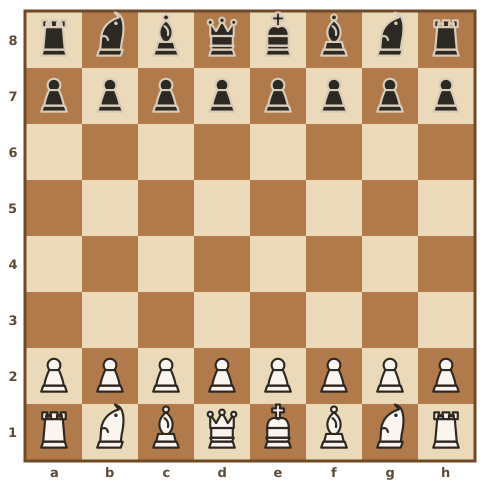
The back row holds the big pieces. From each corner, the order is rook, knight, bishop, then the queen and king in the middle. The queen always starts on her own color, so the white queen starts on a white square and the black queen on a black square. The row in front is all pawns, eight of them, like a wall.
White always moves first. Then players take turns.
How each piece moves
Learning the pieces is the biggest part. Take them one at a time.
The pawn moves straight forward, one square at a time. On its first move it may go one or two squares. A pawn captures in a different way, by moving one square diagonally. It can never move backward.
The rook moves in straight lines, up, down, left or right, as far as the path is clear. It looks like a little tower.
The bishop moves in diagonal lines, as far as the path is clear. Each bishop stays on one color for the whole game.
The knight is the tricky one. It moves in an L shape, two squares one way and then one square to the side. The knight is also the only piece that can jump over others. Many children love the knight because it is so sneaky.
The queen is the strongest piece. She moves like a rook and a bishop together, in straight lines and diagonals, as far as she likes. Keep her safe.
The king moves one square in any direction. He is slow, but you must protect him, because losing the king loses the game.
Check, checkmate and a draw
When a king is under attack, it is in “check.” The player must get the king out of check right away. There are three ways to do that. Move the king to a safe square, block the attack with another piece, or capture the attacking piece.
If a king is in check and there is no way to get out of it, that is checkmate, and the game is over. Sometimes a game ends with no winner, called a draw. One common draw is a stalemate, where a player has no legal move but their king is not in check.
Easy first moves and ideas
A beginner does not need clever tricks. A few simple habits beat most new players.
Start by moving a pawn in the middle of the board, such as the one in front of the king. This opens paths for your bishop and queen. Then bring out your knights and bishops so they point toward the center. Pieces do more good in the middle than stuck on the back row.
Try to get your king safe early. There is a special move called castling that tucks the king into a corner behind its pawns, and moves a rook toward the center at the same time. It is a smart move to learn once the basics feel easy.
One more habit matters more than any opening. Before you move, look at what your opponent just did. Ask a simple question. Is any of my pieces under attack? Spotting threats is half of chess, and it is a skill that grows fast with practice.
Watch out for the fast checkmate
New players often fall for a quick trap in the first few moves. The other player rushes their queen and a bishop at the square in front of your weakest pawn, hoping to checkmate in four moves. It feels scary the first time it happens.
The defense is calm and simple. When you see the queen come out early and point at your king’s side, just bring out a knight to guard the threatened square. A knight to the square in front of your bishop usually does the job. Once you know the trap, it stops working, and you can even turn it around on a player who tries it.
The lesson behind it is the one that matters most. Before every move, check what your opponent is attacking. Most beginner losses come from a threat that was there to see, if only someone had looked.
Why chess is good for kids
Chess rewards thinking ahead. Every move is a small choice with a result a child can see. Over time that builds patience and planning in a way that feels like play, not work. It also teaches a gentle lesson about mistakes. A blunder does not end the world; it just starts a new problem to solve.
The best part is that chess grows with a child. The rules never change, but there is always a better move to find. A six year old and a grandparent can sit at the same board and both enjoy it.
Keep practicing
The only way to get better is to play. Lose a few games, look at what went wrong, and play again. Start slow, think before each move, and keep your king safe. Those three habits carry a beginner a long way.
When you are ready, put these rules to work in the game above. If you want a gentler board game to try next, our checkers game uses simpler moves and builds the same kind of planning.
For more games that stretch thinking in the same way, browse our brain games.