
Shapes and Spatial Geometry Progression for Kids Guide
Explore the cognitive progression of early geometry from 2D shape identification to spatial rotation, tangrams, and 3D patterns.
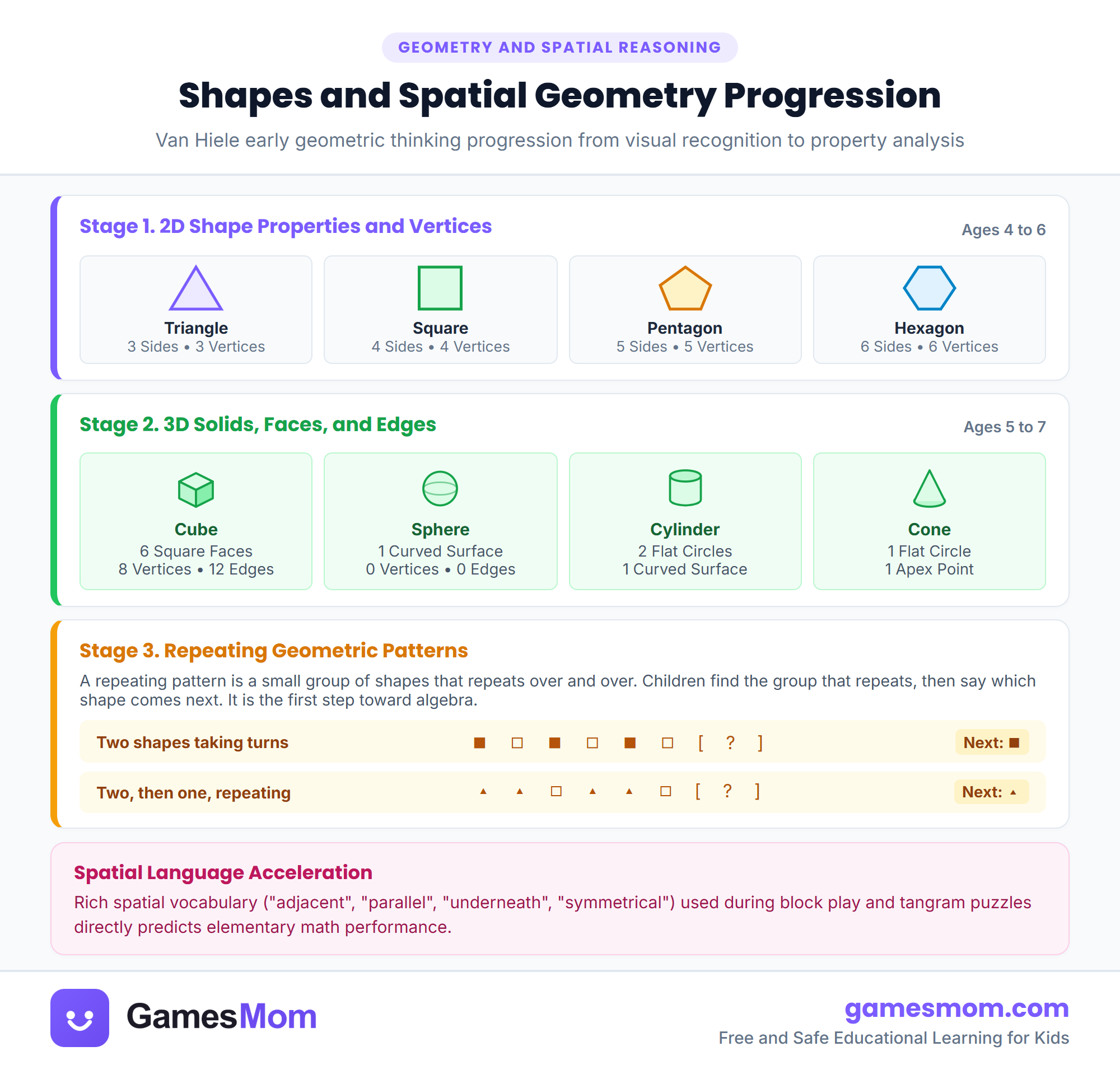
- Early geometry develops through distinct cognitive levels from holistic visual matching to attribute analysis.
- Counting vertices and sides moves children past simple visual naming toward true geometric understanding.
- Spatial rotation and tangram puzzles train mental rotation skills essential for future engineering.
- Understanding repeating patterns in 2D and 3D forms the bedrock for early algebraic thinking.
- Van Hiele Levels of Geometric Thought in Early Childhood
- Clements and Sarama Learning and Teaching Early Math
- Wai, Lubinski, and Benbow Spatial Reasoning in STEM Achievement
Why geometry is about spatial thinking rather than naming shapes
Many parents view early geometry as simply memorizing vocabulary words like circle, square, and triangle. However, true geometric competence is about spatial reasoning, which is the ability to mentally visualize, rotate, and transform shapes. Research tracking early learners demonstrates that spatial reasoning skills in preschool correlate more strongly with high school STEM achievement than early counting ability. Learn more in our guide to teaching shapes to kids.
According to the Van Hiele model, children progress through developmental levels. At Level 0 (Visualization), a child identifies a square because it looks like a window, but may fail to recognize a square turned forty-five degrees as still being a square.
Moving children to Level 1 (Analysis) involves counting sides, vertices, and measuring equal lengths. They realize a triangle is not defined by pointing upward, but by having exactly three straight sides and three vertices.
The four stages from recognition to spatial rotation
Stage 1 focuses on 2D shape recognition through real-world comparison: a clock is circular, a book cover is rectangular, and a pizza slice is triangular. Children learn to touch and outline shapes with their index fingers.
Stage 2 introduces attributes. Count vertices together. Explain that corners are where two straight sides meet. Showing children pentagons and hexagons expands their understanding beyond basic preschool shapes.
Stage 3 introduces spatial transformation through tangrams and tiling puzzles. When children rotate two small triangles to create a larger square, they discover decomposition and area equivalence. Practice this directly with our free tangram puzzle game online.
Stage 4 bridges into 3D solids and repeating patterns. Touching cubes, spheres, and cylinders helps kids perceive volume and spatial geometry in everyday physical structures.
Everyday activities to build spatial logic
Building with physical wooden blocks or magnetic tiles provides outstanding spatial training. Challenge your child to build a bridge that can support a toy car, which naturally teaches balance and geometric distribution.
Play shape scavenger hunts in the grocery store. Look for cylinders on the canned food aisle and rectangular prisms in the cereal section. Connecting math to real environments makes abstract geometry tangible.
Tackle jigsaw puzzles and spatial sorting games together. Learning to rotate puzzle pieces mentally before attempting to fit them into a slot trains the brain to anticipate spatial fits effortlessly.
Frequently asked questions
What age should a child know basic 2D shapes?
Most children can identify circles, squares, and triangles by age three. Rectangles, ovals, and diamonds typically follow between ages three and four.
Why does a child call a rotated square a diamond?
Young children in the visual phase rely on orientation. When a square is tilted, its points face up and down, looking visually different to them. Teaching them to count the four equal sides and four right angles helps them see it remains a square.
How do tangrams help with math skills?
Tangrams teach spatial composition and decomposition. Children learn how geometric shapes combine to form new shapes, which builds the conceptual foundation for fractions and geometry.