
Elementary Math Fluency Roadmap from Counting to Mental Math
Discover the five developmental stages of elementary math fluency, from early subitizing and number bonds to multiplication mastery.
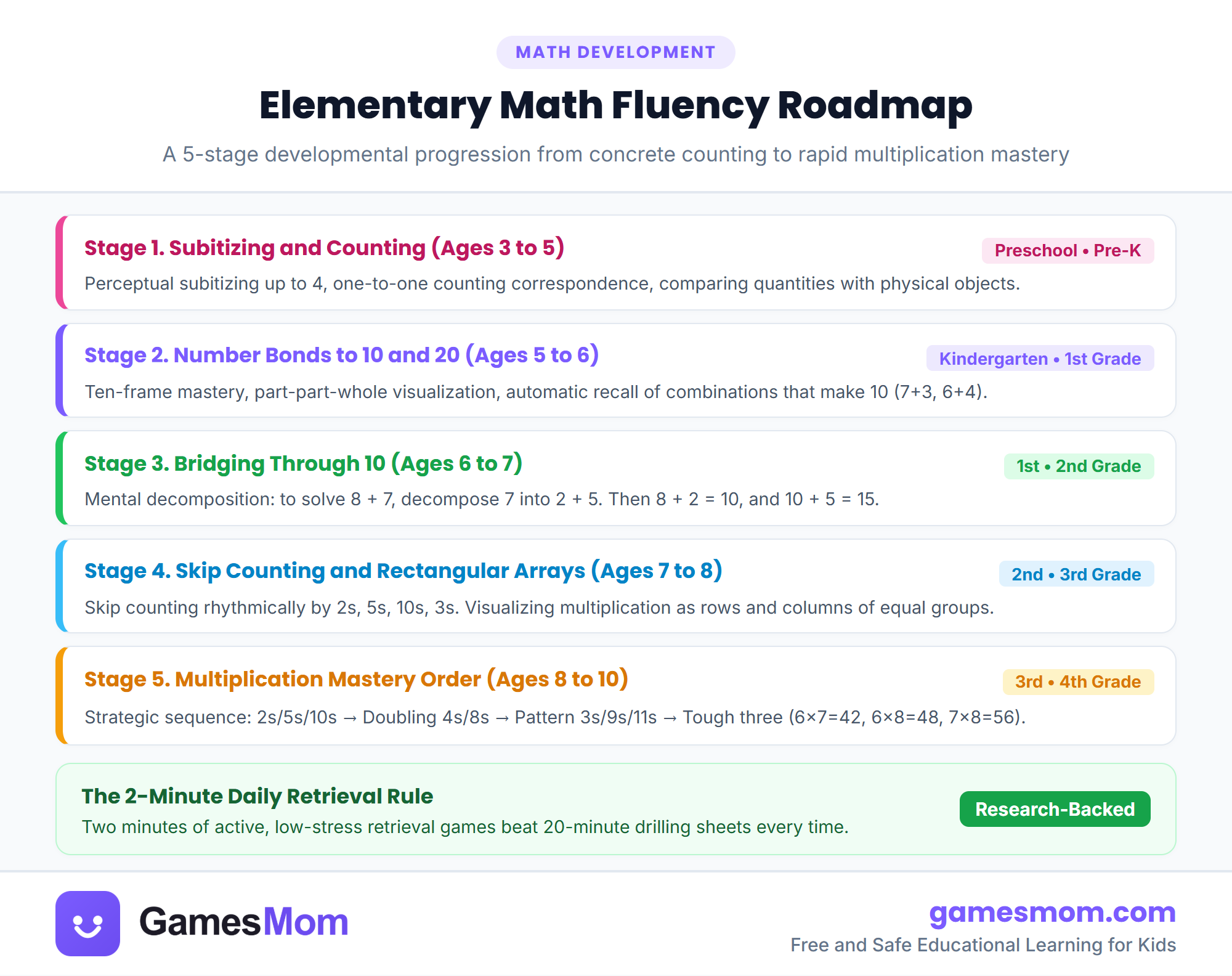
- Finger counting is a normal early bridge, but automatic number bonds free working memory for complex math.
- Subitizing helps young children see quantities instantly without counting one by one.
- Bridging through ten turns multi-digit addition into rapid mental arithmetic.
- A two minute daily retrieval habit builds stronger long term fluency than long weekly drills.
- National Council of Teachers of Mathematics Principles to Actions
- Singapore Math Concrete Pictorial Abstract Framework
- Sweller Cognitive Load Theory and Working Memory in Mathematics
Why mental math fluency begins with visual models
Many children hit a frustrating wall in second or third grade when word problems and multi-step arithmetic appear. In most cases, the difficulty does not stem from complex logic, but from working memory overload. When a student must pause to count single digits on their fingers, their brain has little bandwidth left to track the wider problem. Visual stepping stones provide the bridge from counting to automatic recall.
The Concrete Pictorial Abstract approach emphasizes starting with physical objects before moving to drawings and numerals. In early childhood, dot arrangements on dice help kids develop subitizing, which is the ability to see a quantity of three or four without counting each dot individually. Learn how this works in our comprehensive guide to number bonds for kids.
Once subitizing is secure, children transition naturally to ten-frames. Seeing eight red counters and two yellow counters filling a ten-frame creates a permanent mental picture. The child realizes that ten is not just a symbol, but an anchor around which all base-ten arithmetic revolves.
The power of bridging through ten
The biggest breakthrough in mental math happens when a child learns to bridge through ten. Consider an addition problem like eight plus five. A counting child counts nine, ten, eleven, twelve, thirteen, a slow process vulnerable to error. A fluent child mentally breaks five into two and three. They combine eight and two to make ten, then add the remaining three to arrive effortlessly at thirteen.
This mental leap turns subtraction into a smooth backward journey as well. Because the student understands that fifteen is ten plus five, subtracting eight involves pulling five from the single digits and three from the ten, landing directly on seven. Reinforce this daily with our fast paced quick math game online.
Practicing these combinations with visual ten-frames prevents math anxiety. Children realize numbers are flexible groups that can be taken apart and rebuilt to make calculations simpler.
The multiplication mastery sequence
When teaching times tables, sequential order matters immensely. Do not tackle tables in numerical order from one to twelve. Instead, begin with the easiest geometric and rhythmic families: the twos, fives, and tens. Children master these quickly because they connect directly to skip counting patterns.
Next, teach the doubling strategies. Once a student knows the two times table, they can double those products to solve the fours. Doubling the fours opens up the eights. Similarly, the three times table leads naturally into the sixes. Review our complete sequence in the times tables practice guide.
Leave the tricky facts like six times seven and seven times eight for last. By that point, the commutative property has already eliminated half the board. Just two minutes of playful digital retrieval each day locks these facts into permanent memory.
Frequently asked questions
What is subitizing and why is it important in kindergarten math?
Subitizing is the ability to instantly recognize the number of items in a small group without counting them one by one. It is the fundamental foundation for number sense, addition, and mental math.
How do number bonds help with multiplication?
Number bonds establish part-part-whole relationships and fluent mental addition. Because multiplication is repeated addition, having instant recall of number bonds eliminates finger counting and frees mental bandwidth.
How can teachers use this math roadmap in the classroom?
Teachers can print the roadmap as a student binder reference or display it as a classroom anchor chart. It helps educators identify where a struggling student is stuck along the progression from counting to fluency.