
How to Play Checkers, from Setup and Jumps to Kings
Checkers looks simple, and that is the trick of it. Two colors of pieces, one kind of move, a board anyone can set up in a minute. Yet underneath sits a real game of planning and traps that a child can learn in an afternoon and keep getting better at for years. This guide walks through the rules from the first move to crowning a king, then shares the tips that separate a beginner from someone who wins. You can follow along with a free Checkers game and try each idea as you read.
What is Checkers?
Checkers, known as draughts in many countries, is a board game for two players who face each other across an eight by eight board. Each player starts with twelve pieces and tries to capture all of the other player’s pieces, or leave them with no legal move. It is one of the oldest games still played today, and it remains a favorite because the rules are quick to learn while the play stays interesting.
The goal of the game
You win by taking all of your opponent’s pieces off the board, or by trapping them so they cannot move on their turn. Everything in a game of Checkers works toward that end, whether you are trading pieces to come out ahead or steering the game toward a position where the other side simply runs out of safe moves.
Setting up the board
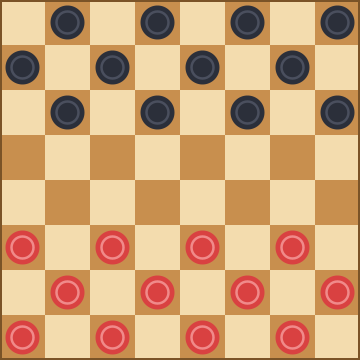
Place the board so each player has a dark square on their bottom left. The pieces only ever sit on the dark squares. Each player lines up their twelve pieces on the dark squares of the three rows closest to them, which leaves the two middle rows empty and ready for play. Darker pieces or lighter, it does not matter which color goes first as long as you agree, though the tradition is that the darker side moves to open the game.
How to play, move by move
A normal move slides one piece diagonally forward by a single square, onto an empty dark square. Pieces move forward only, never backward and never straight sideways, until they are crowned. That one rule is the whole of ordinary movement, which is why children pick the game up so fast.
Capturing is where Checkers comes alive. When an opponent’s piece sits on the square diagonally in front of yours, and the square just beyond it is empty, you jump over that piece and land on the empty square. The piece you jumped is captured and removed from the board. Better still, if your piece lands in a spot where another jump is available, you keep jumping in the same turn, so a single move can clear two or three enemy pieces at once.
When one of your pieces reaches the far row, the opponent’s back row, it is crowned a king, usually by stacking a captured piece on top. A king is worth far more than an ordinary piece because it can move and jump both forward and backward. Getting a king, and stopping your opponent from getting one, is often what decides the game.
The rules people get wrong
The rule that surprises most new players is that capturing is compulsory. If a jump is available to you, you must take it, and you cannot make a quiet move instead to dodge the trade. If more than one jump is on offer, you can usually choose which one to take. This turns Checkers into a game of setting traps, because a clever player can offer a piece knowing the forced jump that follows opens the way to take two of yours back. The second thing people forget is that ordinary pieces cannot jump backward, only kings can, so a piece that has slipped past your line is safer than it looks until it is crowned.
Simple tips to win at Checkers
Try to keep your pieces connected in a loose group rather than pushing one out alone, because a lone piece is easy to pick off while a wall of pieces supports itself. Hold your back row steady for a while too, since those squares are the ones that stop your opponent from crowning a king. Push toward the far side to make your own kings, and always look one move past a tempting capture, because the mandatory jump rule means a free piece is sometimes bait for a bigger loss. Checkers is one of the best two player games for practicing exactly this kind of thinking a move ahead.
The one tactic worth learning first is the two-for-one. Because a jump is compulsory, you can offer a single piece as bait so that when your opponent takes it, their piece lands where your next piece can jump back over two of theirs in a single turn. Set up patiently, give up one, take two, and you are a piece ahead with a cleaner board. Spotting this pattern, both when you can play it and when your opponent is setting it up on you, is the biggest single jump in skill a beginner makes.
Play the center, not the edges. A piece near the middle of the board usually has two ways forward, while a piece hugging the side wall has only one and is easy to trap. The exception is that the side squares are a safe place to park a piece you do not want captured, since nothing can jump a piece against the wall. Use the middle to attack and the edge to hide.
Trade when you are ahead, and stop trading when you are behind. Every time both sides swap one piece for one piece, the board gets simpler, and a simpler board favors whoever already has more pieces. So if you are up by one or two, welcome the trades and steer toward them. If you are down, keep your pieces on the board and play for a swindle or a king instead.
Aim to crown the first king, then use it. A king moves and jumps in both directions, which on a thinning board is often worth two ordinary pieces. Race for that first crown, protect the piece that is one step away from it, and once you have a king, send it hunting while your other pieces hold the line.
Fun variations to try
If the standard game starts to feel familiar, there is plenty more to explore. International draughts is played on a larger ten by ten board with more pieces and flying kings that slide any distance. Chinese Checkers, despite the name, is a completely different game about racing marbles across a star shaped board rather than jumping to capture. Even in standard Checkers you can agree house rules, such as whether a piece must always take the jump that captures the most pieces, which changes the feel of every game.
Is Checkers good for kids?
Checkers is a genuinely valuable first strategy game for a child. Every jump is a small trade off, and reading the board a move or two ahead builds the same planning skill that helps with math problems and with thinking before acting. It is calm and turn based, it teaches a child to win and lose gracefully, and because the dice play no part, a five year old can beat a grownup on a good day. Our other free board games for kids follow the same spirit, keeping the rules of the real game while being quick to start on any device.
Once the rules are clear, the fastest way to improve is to play plenty of games and pay attention to the traps you fall into. Set the board up, take turns against the computer or a friend, and put these ideas into practice.