
How to Play Bingo, with Easy Rules and Winning Patterns
Bingo is the calling game almost everyone has played at a party, a school fair or a family night. The rules take about ten seconds to learn, which is exactly why it works so well with children and in a busy classroom. This guide covers how a Bingo card is laid out, how the calling and daubing works, and how you win, plus a fun math twist that turns the game into quiet arithmetic practice. You can try it all in a free Bingo game as you read.
What is Bingo?
Bingo is a game of chance played with numbered cards and a caller who reads out numbers one at a time. Each player marks off the called numbers that appear on their card, racing to be first to complete a set pattern, usually a line of five. It is a social game that suits any number of players, from two children sharing a screen to a whole hall, and it needs almost no explaining, which is a large part of its charm.
The Bingo card
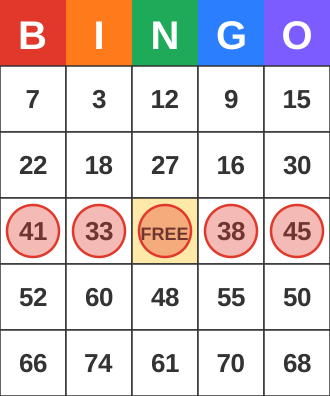
A standard Bingo card is a grid of twenty five squares in five columns, headed by the letters B, I, N, G and O. Each column holds numbers from its own range. B covers one to fifteen, I covers sixteen to thirty, N covers thirty one to forty five, G covers forty six to sixty, and O covers sixty one to seventy five. The very middle square is a free space that everyone counts as already marked, which gives every card a helpful head start toward the center line.
How to play, move by move
One person, or the game itself, acts as the caller and draws numbers at random, reading each one out with its letter, such as B seven or O sixty six. The letter tells you which column to check, so you only need to scan one column for each call. Every player looks at their own card, and when a called number appears on it, they mark that square, which is traditionally called daubing. Numbers are called steadily, so the game is partly about paying attention and finding your numbers quickly before the next call comes.
The first player to mark a full line of five wins. A line can go across a row, straight down a column, or along either diagonal, and the free center square helps complete the two lines that run through the middle. When a player completes a line they call out Bingo, the caller checks the marked numbers against the ones that were drawn, and if it all matches, that player wins the round.
Winning patterns beyond a single line
The plain line is the most common way to win, but Bingo has other patterns that keep the game fresh. Four corners asks players to mark the four squares at the corners of the card. A full house, sometimes called a blackout, needs every square on the card marked, which makes for a longer, tenser game. Agreeing the pattern before you start is part of the fun, since it changes how you watch your card.
A math mode for extra practice
Bingo turns into sneaky learning with one small change. Instead of calling a plain number, the caller reads out a sum, such as six plus seven, and players have to work out the answer and daub thirteen on their card. It plays exactly like normal Bingo, so the fun is identical, but every call becomes a quick bit of mental arithmetic. That is why teachers reach for it so often, and it sits nicely alongside our other free math games for kids as a painless way to practice sums.
You can match the calls to what your child is learning. Use simple adding for younger players, then subtraction or doubling, and times tables for older ones, such as calling seven times eight so players daub fifty six. Just check that every answer is a number that appears on the cards.
Simple tips for a good game of Bingo
Keep your card where you can scan it in one glance, and check the whole card each time a number is called rather than hunting square by square. If you are the caller for a group, call at a steady pace that gives younger players time to find their numbers, and repeat the last call once for anyone who missed it. And remember the free center square, since it is easy to forget it already counts toward a line through the middle.
Running Bingo with a class or a family
A few small habits make a group game run smoothly.
- Give every player a different card. If two cards match, two players will shout Bingo on the same call.
- Keep a list of the called numbers. Write each call on a whiteboard or a sheet of paper, so you can check a winning card in seconds.
- Use counters instead of pens. Buttons, dried beans or small squares of paper let you clear the cards and play again straight away.
- Agree what happens with a tie. If two players finish on the same call, both can win, or they can play a quick tiebreak round.
For younger children, make the game smaller. A card with three rows of three and the numbers one to twenty is much easier to scan. You can also swap the numbers for pictures, colors, letters or sight words, and call those out instead. The rules stay exactly the same, so children learn the game once and can play every version.
Is Bingo good for kids?
Bingo is a lovely game for children and a staple of the classroom for good reason. It builds number recognition, listening and quick attention, and the math mode adds real arithmetic on top of all that. A round is short enough to fit into a spare few minutes, it works for a whole class on a smartboard or two children on a tablet, and every player stays in the game until the very last call, so nobody is left out. It captures the same easy, everyone can join in feeling that makes it a favorite year after year.
Once the card and the calling make sense, Bingo runs itself. Pick a pattern, start the calls, and daub your way to a line.